


98% of manufacturers generate sales-qualified leads through digital marketing, according to a 2025 industrial-marketing summary from WebFX. That figure reframes digital marketing for manufacturing companies. It isn't a brochure project or a side experiment. For a Cincinnati shop trying to win better work, your website now has to do sales work before anyone picks up the phone, route the right buyer to the right engineer, and leave a trail you can measure even when that buyer never fills out a form on the first visit.
Why Manufacturing Buyers Research Online Before They Call
Your website is a trade-show booth that stays open around the clock, and engineers walk past it long before any salesperson is invited in. Say an engineer in Dayton needs a machined component with tight tolerances late on a Tuesday. She isn't calling three shops to ask basic questions. She's searching, opening spec pages in tabs, and dropping anyone who can't show materials, tolerances, and certifications up front.
That behavior is now the norm, not the exception. Industry research cited in 2025 by WebFX's manufacturing statistics roundup reports that 57% of industrial buyers make purchase decisions before directly interacting with a manufacturing company, while 40% of B2B buyers consume three to five pieces of content before contacting a salesperson. By the time your rep gets the call, the shortlist is mostly set.
What Buyers Are Checking While You Wait
Two audiences judge you in that window. Researchers find you through search, often by process or material, and decide in seconds whether you're relevant. Engineers and procurement staff then judge technical depth, looking for specifications, CAD files, certifications, application guides, case studies, and clear service information they can forward to a colleague.
For small and mid-sized shops competing with larger brands, that's an opening. A big competitor's name carries weight at a trade show, but search results reward the page that answers the specific question. Strong visibility and useful technical content can earn you a place on a shortlist before any request for quotation (RFQ) arrives, especially when paired with outside tools that help you identify buyers for manufacturing businesses already active in your market.
If a buyer can't verify your capability from your own pages, they'll verify a competitor's instead.
A Self-Check You Can Run Today
Search for your three main capabilities the way a buyer would, using process plus material or process plus city. Note whether your company appears at all, and where. Then open the top two competitor results and write down what they show that you don't, such as tolerance ranges, downloads, or a visible quote form. That gap list is your starting brief.
Which Channels Fit Each Stage of the Buying Journey
A manufacturer's channels should match the work a buyer is doing. Early research calls for useful technical information; later evaluation needs proof and a clear route to an engineer or quote. Track whether those channels help move buying groups forward, not just whether they attract clicks.
| Channel | Buyer stage | What it should produce | First KPI to track |
|---|---|---|---|
| Capability and product pages (SEO) | Research | Qualified organic visits from process and material searches | Organic visits to capability pages |
| Technical content and downloads | Evaluation | Spec sheet, CAD and application-guide downloads | Download-to-inquiry rate |
| LinkedIn and account outreach | Buying group awareness | Engagement from target accounts, engineers and plant managers | Target accounts engaged each month |
| Paid search | High intent | Clicks from specific process or quote queries | Cost per quote request |
| Paid display and retargeting | Evaluation reminders | Return visits from people who viewed specifications | Return visitor rate |
| Website quote paths | Decision | Quote and RFQ starts | RFQ start rate by product page |
| Email and CRM nurture | Repeat and post-inquiry | Reorders, follow-ups and saved-specification reminders | Reorder rate and time to first response |
| Webinars and virtual technical sessions | Education | Engineer and procurement registrations and attendance | Attendees who request contact |
SEO means search engine optimization, the work that helps pages appear in search results. CRM means customer relationship management software, which stores contact details and tracks follow-up. Each channel needs a specific next step, such as downloading a spec, starting an RFQ, or speaking with an engineer.
The Starting Order for a Small Shop
Start with the quote path and the pages buyers need to evaluate your capabilities. Then add technical content and LinkedIn outreach to give engineers and other members of the buying group useful information to share. Paid search can follow once the landing pages give visitors a relevant next step. Otherwise, paid clicks expose weaknesses in the page rather than produce useful evidence about demand.
Webinars and virtual technical sessions can help reach distributed engineering audiences. A session focused on a relevant process or compliance question gives attendees a reason to register and creates a clear opportunity to request follow-up.
Keep channels connected. Search, ads, downloads and outreach should lead to pages that support the same buying task, with analytics tracking what visitors do after they arrive. Helbling Digital Media's growth marketing services cover SEO and organic search, paid media, content strategy, analytics and AI visibility. Whatever channels you choose, explain how personal information is used when prospects download files or request quotes. Clear expectations can make engineers more comfortable sharing their contact details.
Capability Pages That Earn Search Traffic and Quotes
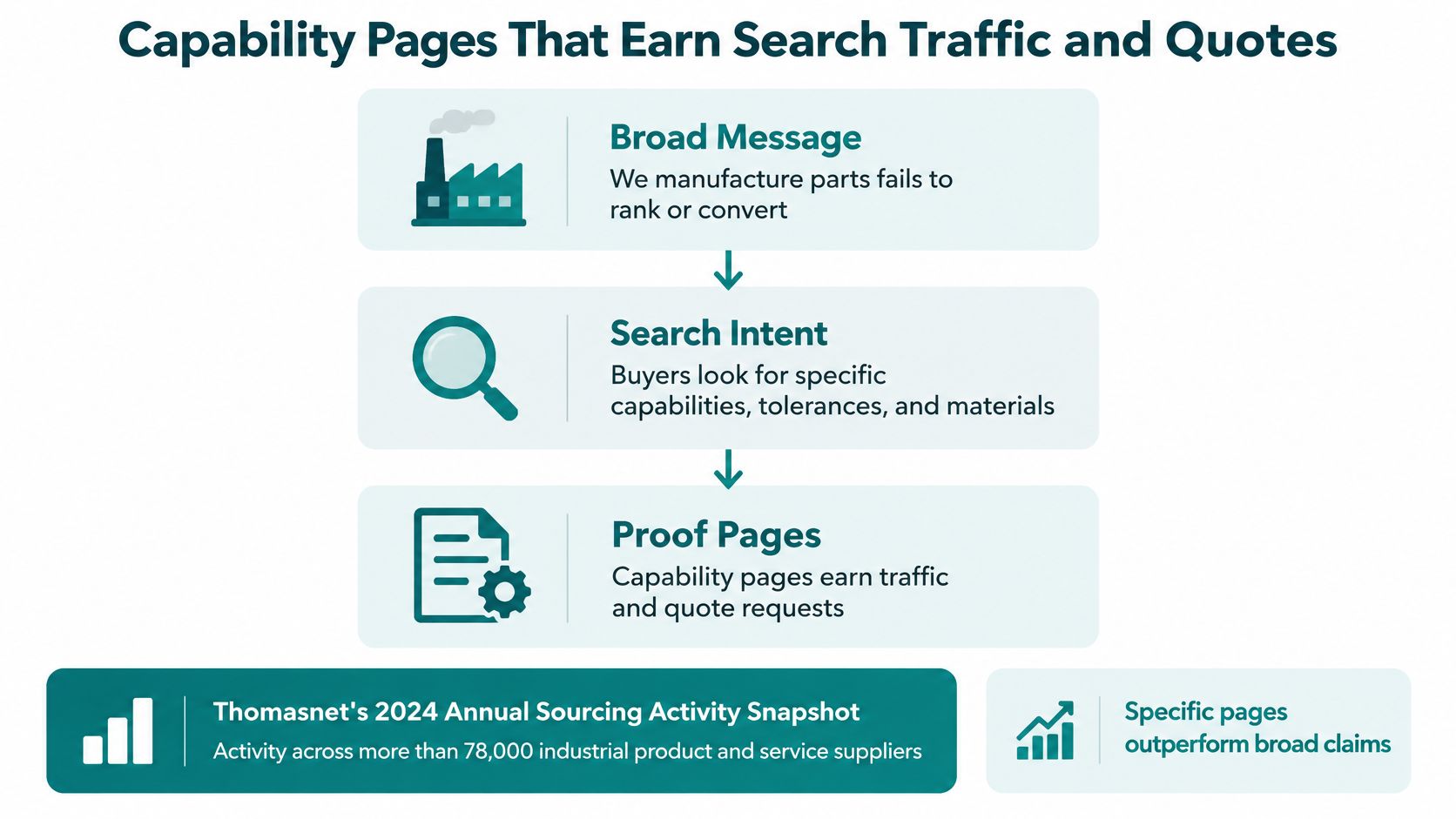
"We manufacture parts" fails twice. It gives search engines nothing specific to rank, and it gives a procurement researcher nothing to evaluate. Buyers don't search for a company that makes things. They search for a process, a material, a tolerance, or an industry application, and they shortlist whoever answers that exact query.
The scale of that specificity is clear in Thomasnet's 2024 Annual Sourcing Activity Snapshot, which reports activity across more than 78,000 industrial product and service categories, over 38,000 yearly buyer evaluations, more than 184,000 yearly impressions, and over 2,400 yearly requests for information. Its highlighted categories include CNC machining, plastic injection molding, and circuit-board assembly. Buyers shop by capability, so your site has to be organized the same way.
Build Steps
- List everything: Write down every process, material, and industry you serve, including work you win by word of mouth.
- Group by buyer question: Cluster items the way a buyer asks, such as machining aluminum parts, rather than the way your shop floor is organized.
- Build one indexable page per process: Include materials, tolerances, volume ranges, certifications, and accepted file formats so an engineer can judge fit without calling.
- Place an RFQ form above the fold: Put the quote action where visitors see it before scrolling, with file upload included.
- Link related pages together: Connect each process page to its material and industry pages so buyers and search engines can move between them.
Take a hypothetical Cincinnati CNC shop. Instead of one services page, it builds a CNC machining page listing machine capacity and volume ranges, a separate aluminum machining page covering alloys and finishes, and an aerospace page covering tolerance capability and documentation. Each page carries its own RFQ form, so an inquiry arrives already tagged with the capability that produced it.
Local Search and Proof It Works
Confirm your business listing shows the correct city, product categories, and phone number, because nearby buyers searching for suppliers see those details before they ever reach your site. An outdated category or wrong number costs you calls you never hear about.
You'll know the structure works when you can read organic visits and inquiries per page within 90 days. Pages earning visits but no inquiries need a stronger quote path. Pages earning neither need better targeting or more internal links pointing to them.
Technical Content and LinkedIn Outreach to Buying Groups
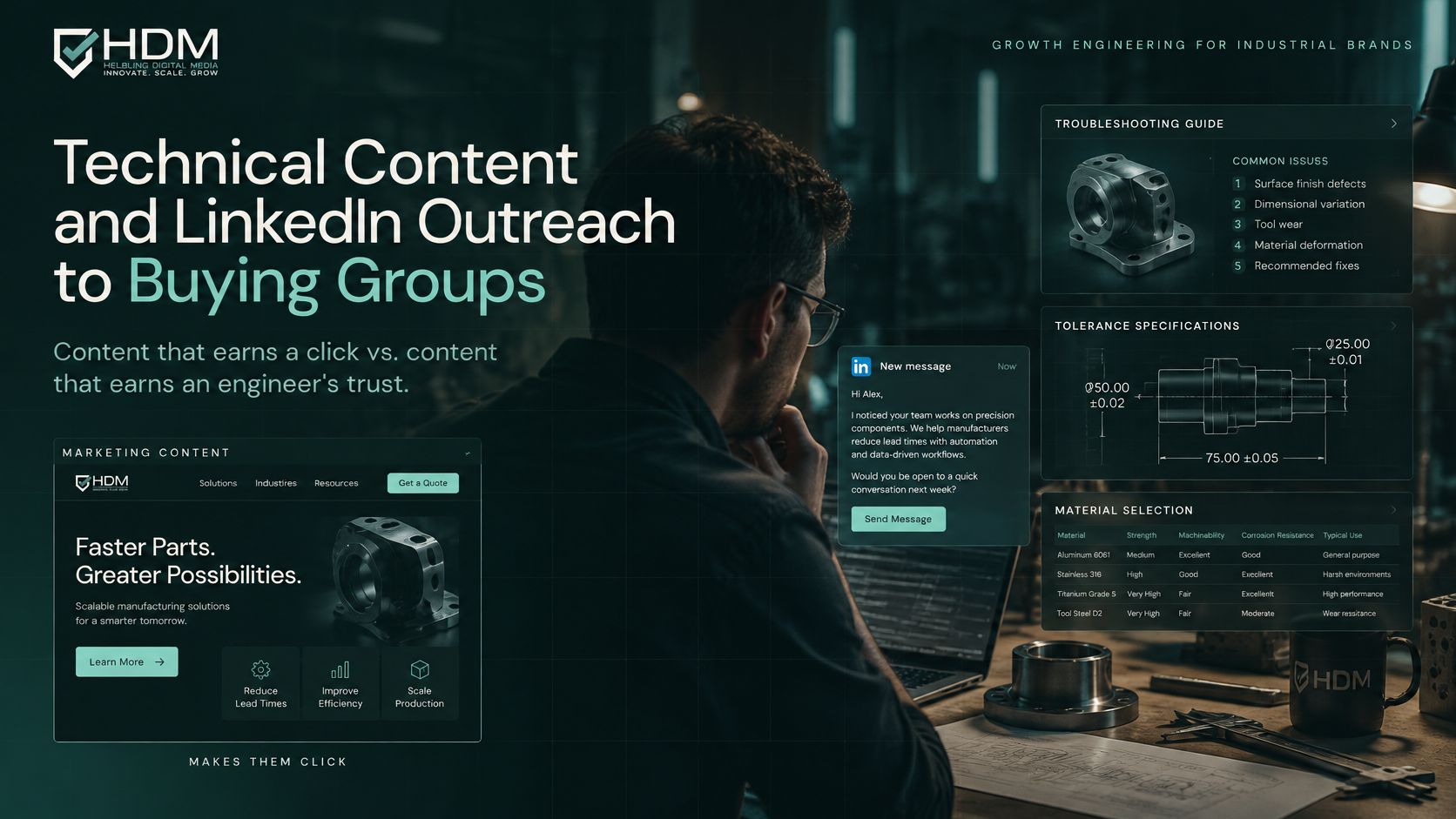
Content that earns a click and content that earns an engineer's trust are different products. A generic post about industry trends might rank briefly and persuade nobody. A troubleshooting guide, a tolerance explainer, a material selection comparison, or a plain-language description of how you validate first articles gets bookmarked, forwarded, and attached to internal emails. That's the content that survives inside a buying committee.
The image below shows the kind of focused desk work behind that content, drafting from real specifications rather than filling a calendar.
AI Drafting With an Engineering Gate
Use generative AI as a drafting aid only. It should draw on approved product data and revision-controlled specifications, with engineer review before anything publishes. A wrong tolerance, material, or compliance claim isn't a typo. It can set false expectations on a quoted job and create real liability.
Review rule: any claim containing a number needs sign-off from engineering or quality before publishing.
That discipline also protects your visibility in AI answers. We offer a free AI visibility check that looks at whether a business is the answer when customers ask ChatGPT, Google AI Overviews, Perplexity or Gemini who to hire, and inaccurate source content is one of the fastest ways to be misrepresented there. For the planning side, our guide to building a B2B content strategy covers how to map topics to buyer stages.
The short video below walks through practical ways manufacturers can present technical expertise online without turning engineers into full-time marketers.
<iframe src="https://www.youtube.com/embed/smMe56jWkzc" width="100%" height="400" frameborder="0" allowfullscreen></iframe>LinkedIn Outreach to Named Accounts
Buying committees include plant managers, engineers, and procurement staff, and LinkedIn is where you reach all three. Choose 10 to 20 named target accounts rather than broadcasting. Post technical content weekly from a named engineer, share case studies with measurable results, and send a short, relevant note after each download that references the specific document. Engineers building a visible presence can find inspiration for your personal brand from professionals who post credible, work-based content. Track which accounts engage and whether that engagement reaches an RFQ or a call, because likes from the wrong companies are noise.
Website Speed and Quote Paths That Turn Visits into Inquiries
| Metric | Good threshold | What it measures | First fix to try |
|---|---|---|---|
| First Contentful Paint | 1.8 seconds or less | How quickly the first content appears | Remove blocking scripts from the header |
| Largest Contentful Paint | 2.5 seconds or less | How quickly the main content loads | Compress hero and product images |
| Cumulative Layout Shift | 0.1 or less | How much the page jumps while loading | Reserve space for images and embedded forms |
| Interaction to Next Paint | 200 milliseconds or less | How quickly the page responds to a click or tap | Cut heavy third-party scripts on quote pages |
| Time to First Byte | 800 milliseconds or less | How quickly the server responds | Upgrade hosting or add caching |
Those thresholds come from Google's PageSpeed Insights documentation, which defines "Good" results as First Contentful Paint at 1.8 seconds or less, Largest Contentful Paint at 2.5 seconds or less, Cumulative Layout Shift at 0.1 or less, Interaction to Next Paint at 200 milliseconds or less, and Time to First Byte at 800 milliseconds or less. Core Web Vitals is Google's name for the core set of these loading, responsiveness, and stability measures. They're testable numbers, not design opinions.
Why Slow Pages Lose Quotes
Speed isn't a developer vanity metric. In Google's mobile-performance research, the predicted probability of a visitor bouncing increased by 123% as page-load time rose from one second to ten seconds, and when page elements increased from 400 to 6,000, the predicted probability of conversion fell by 95%. An engineer checking your capability page from a phone on the shop floor won't wait through a heavy homepage animation to reach a tolerance table.
Manufacturers face a real tension here, because you need drawings, certifications, and application details on the page. The answer isn't removing them. It's loading them efficiently, so the main content and quote action appear first and supporting files load on demand when a visitor opens or downloads them. Compress product images, cut decorative scripts, and keep the RFQ button visible without making buyers wait for everything else.
A Quote Path That Works
A working quote path has four parts. A visible RFQ button on every capability and product page. A short form with file upload, so buyers can attach drawings in the same step. A phone number for people who'd rather talk through a rush job. And a stated response time, because "we reply within one business day" removes the uncertainty that sends buyers to the next tab. Our breakdown of B2B conversion rate optimization goes deeper on testing these elements.
Ask any web provider for a before-and-after report on your homepage, capability pages, product pages, and quote form, measured separately rather than as one sitewide average. A Cincinnati-area provider should be able to show real loading and interaction measurements, not only a more modern look. If a redesign proposal contains no numbers, you're buying a paint job.
Routing Leads Through CRM, Automation and Human Follow-Up
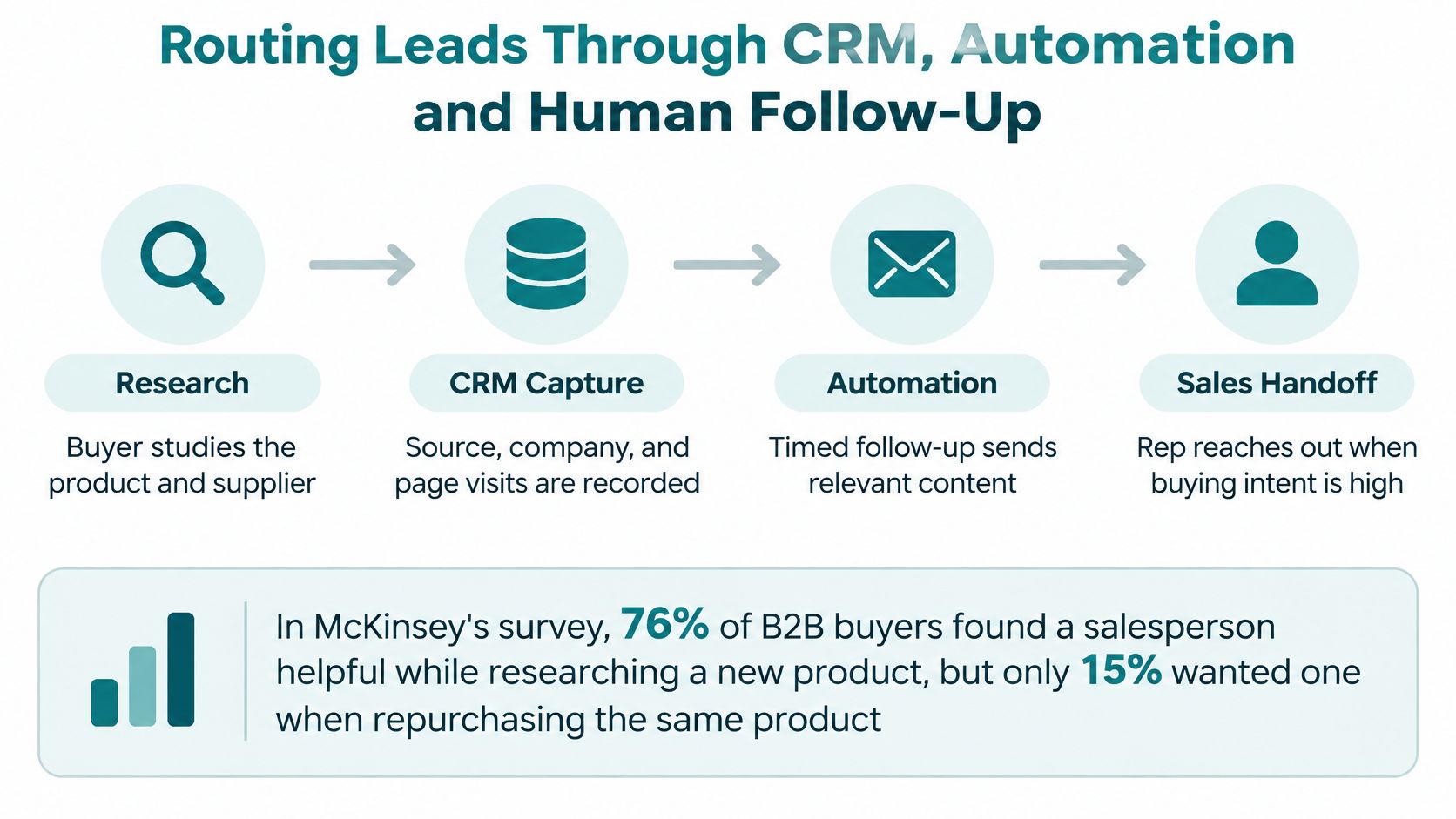
One journey doesn't fit every buyer, and forcing everyone through the same funnel wastes both kinds. In McKinsey's survey of more than 1,000 B2B buyers across four countries, 76% considered salesperson interaction helpful while researching a new product or service, but only 15% wanted salesperson involvement when repurchasing the exact same product. McKinsey also found 46% of buyers would be willing to purchase through a supplier website if the process were available and efficient, compared with only 10% currently doing so.
Three Paths Instead of One Funnel
New-product research needs engineering documents and visible access to an applications engineer who can answer fit questions. Repeat buying needs reorder tools and saved specifications, so a returning customer isn't re-entering the same details. Urgent quotes need a fast human reply, full stop in practical terms, because the buyer is comparing response speed as a proxy for how you'll handle their order.
Routing Steps
- Capture traffic source on every form: Record where each inquiry came from, so you know which channel produced it.
- Score behavior: Weight repeat product-page visits, spec downloads, and quote starts, because those actions signal intent more reliably than a single page view.
- Route high-intent contacts fast: Send them to a named salesperson or engineer within a set time, since delays push buyers toward faster competitors.
- Nurture everyone else technically: Send relevant application content by email rather than generic promotions, so early researchers keep learning from you.
- Log outcomes in the CRM: Record wins and losses against the source, so your content decisions improve each quarter.
One caveat matters more than any tool choice. Automation should never send a generic newsletter to someone who just asked for a quote. That single tone-deaf email tells the buyer nobody is handling their request.
Measuring Marketing When Buyers Research Anonymously
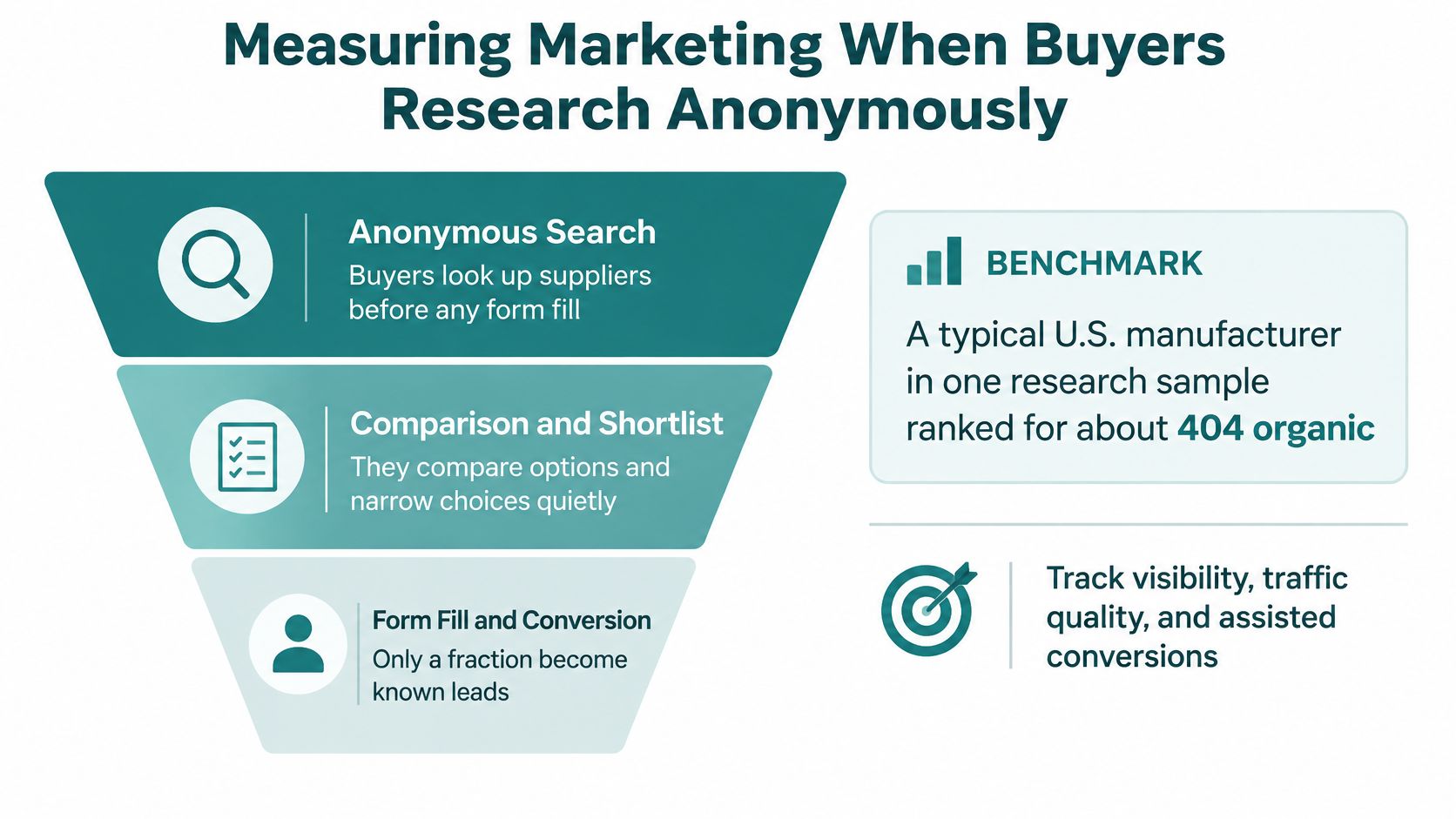
Most of your future customers are on your site right now without telling you. They search, compare, and shortlist suppliers long before submitting a form, which means form counts alone badly understate what's working. A practical benchmark from Grey Matter's State of B2B Manufacturing research found the typical manufacturer in its U.S. sample ranked for about 404 organic keywords and received roughly 1,100 organic visits per month. If your numbers sit far below that, visibility is likely your first problem, not your sales team.
Why Last-Click Reporting Misleads You
Last-click reporting credits only the final touch before a form submission. It systematically undervalues the technical guide an engineer read in March, the specification page procurement checked in April, the distributor referral, and the brand search that finally converted in May. Judging channels that way kills the early content that made the final click happen.
A Better Framework for a Smaller Shop
Track engagement at the account level rather than chasing individual anonymous visitors. Count qualified technical actions, meaning CAD downloads, certification views, configurator use, sample requests, and RFQ starts. Then follow each account from marketing source to opportunity to closed revenue inside your CRM.
You don't need enterprise attribution software to do this. Combine website analytics, CRM source capture, assisted-conversion reporting, and a quarterly opportunity review with sales. Our explanation of multi-touch attribution shows how credit can be shared across touches without pretending the math is exact.
Say six target accounts downloaded spec sheets in one quarter and two of them opened opportunities. That progression matters more than a raw lead count, because it shows which documents move real accounts forward. I'd rather have that evidence than fifty unqualified form fills. Treat all of it as directional evidence, though. Anonymous, multi-person buying groups can't be attributed perfectly, and any provider claiming otherwise is overselling.
First 90 Days and Choosing a Provider
Ninety days can establish a working foundation and show where to focus next. It is too short to promise a transformed pipeline. For a manufacturer starting with a limited web presence, use the first three months to improve priority pages, connect marketing activity to sales follow-up, and assess early signals.
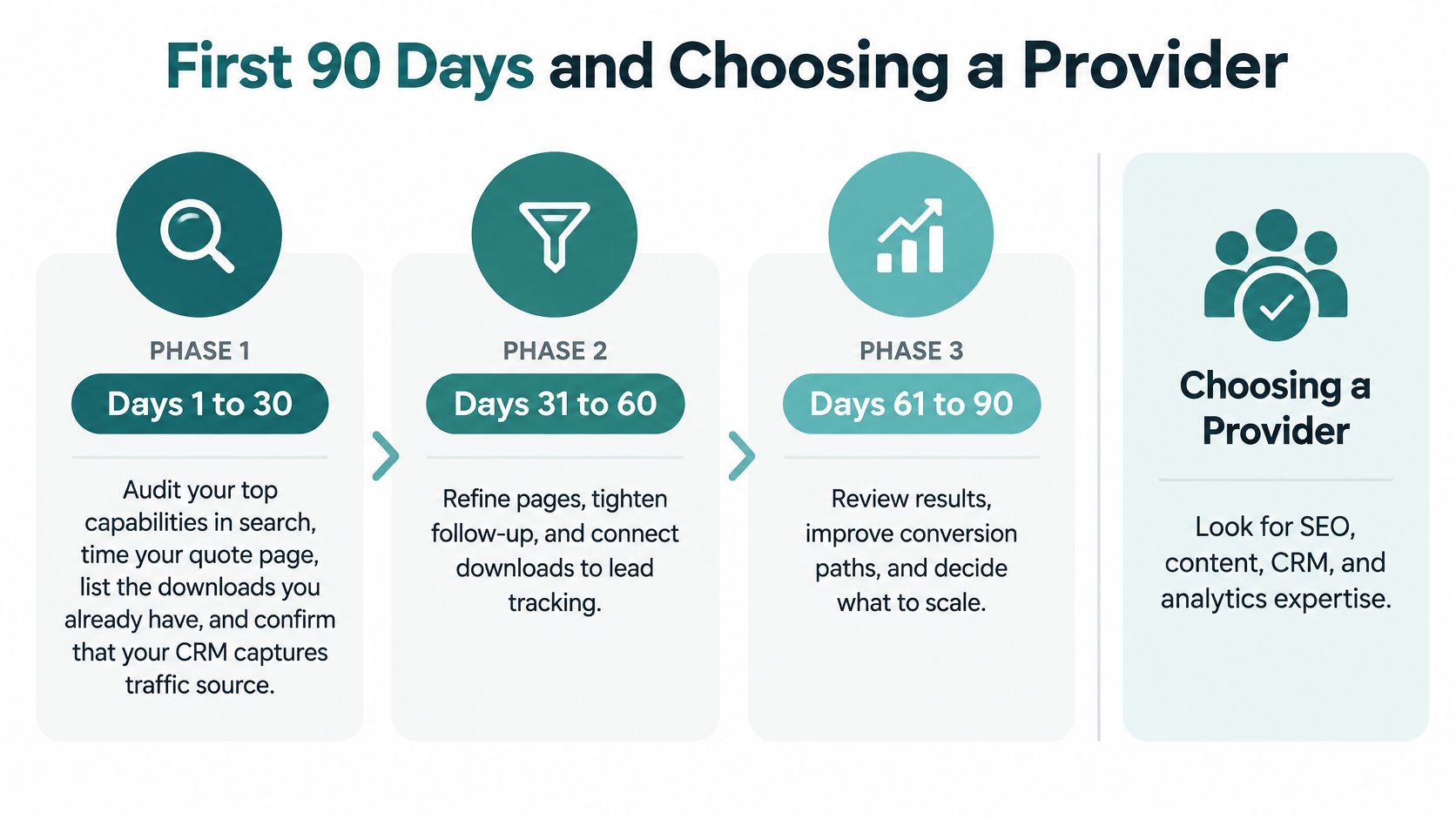
Days 1 to 30 Audit
Review how your main capabilities appear in search, and check whether each has a useful page. Test the quote path on mobile and desktop. Gather existing technical downloads, including spec sheets stored in shared drives, and confirm that your customer relationship management (CRM) system records the traffic source for form submissions.
For a hypothetical 40-person Cincinnati machine shop, the audit might show strong capabilities without dedicated pages. That points to a practical first priority: make the shop's services easier for technical buyers to find and evaluate.
Days 31 to 60 Build
Create three to five capability pages with clear paths to request a quote. Publish two engineering-reviewed technical articles, and begin LinkedIn outreach to 15 named accounts. A machine shop might start with machining, turning, and aluminum pages if those match its highest-margin work, then add a tolerance guide approved by its lead machinist.
Days 61 to 90 Expand and Review
Add paid search to the pages that are producing the strongest inquiries. Set rules so high-intent contacts reach a named person promptly, then review account-level activity with sales. Use inquiries per page and engaged accounts to decide what to improve or scale. Raw traffic alone cannot show whether the site is helping move a buying group toward a quote.
Questions to Ask Any Provider
Ask which pages they will measure for speed, what before-and-after figures they will report, and how often. Confirm who will lead the work, who reviews technical claims, and how results will be reported. Ask how the provider will connect website activity to sales follow-up without treating form fills as the whole buying journey.
Helbling Digital Media is built for businesses with $1M–$50M in revenue that need senior execution across several disciplines without hiring 3–5 full-time staff. The team works alongside in-house marketing teams, and a senior person is on every engagement. If Helbling Digital Media is on your shortlist, use the free 30-minute strategy call we offer prospective clients to test the plan against your own numbers before committing budget.
A provider should help turn the website into a sales-assist tool: making technical information easier to find, directing buyers toward the right next step, and giving sales a clearer view of account activity even when research remains anonymous. Helbling Digital Media serves businesses across the Greater Cincinnati area and worldwide.