A Cincinnati brokerage can lose a listing before an agent ever speaks with the seller. A homeowner searches for a local agent, compares websites, checks listing photos, and notices which firms make it easy to ask a question. If a competitor looks more credible online and responds first, the seller has a clear reason to call them instead.
Short answer: Digital marketing for real estate combines a credible website, local search visibility, listing presentation and fast follow-up so buyers and sellers choose your agents first. It works best when every channel points to an easy way to ask a question.
That's the practical case for digital marketing for real estate. It's not a website refresh in isolation. It's the connected experience that takes a buyer or seller from initial search to a conversation with an agent, then keeps the relationship moving toward a transaction.
Why Cincinnati Real Estate Now Runs on Digital
A Cincinnati agent may know a neighborhood inside out and still lose a potential client to a competitor with clearer listing pages and faster follow-up. The prospective client doesn't see the agent's local expertise until the website, photos, and first response give them a reason to make contact.
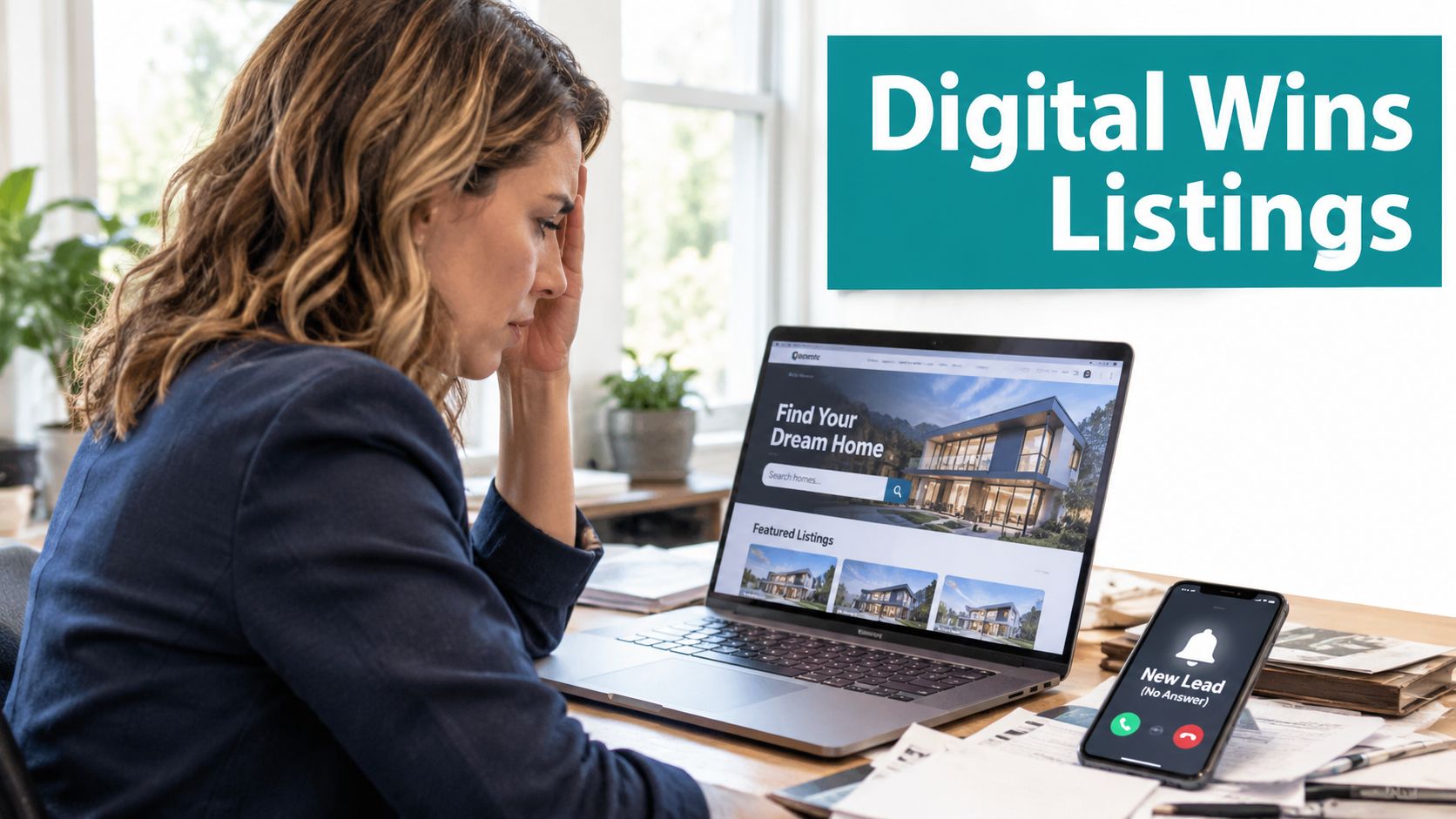
That first impression matters across Greater Cincinnati, where buyers may be comparing urban neighborhoods, suburban communities, or a move from outside the region. 94% of homebuyers used at least one online resource during their home search, according to Zillow's 2024 Consumer Housing Trends Report. A brokerage website is part of the sales process because it helps people decide what to explore and whom to contact.
Think of a website as a working storefront, not a brochure. It should help visitors find relevant properties, understand the agency's local knowledge, and take a clear next step. If property details are incomplete, pages are difficult to use on a phone, or contact forms lead nowhere, the website can lose interest that an agent never gets the chance to convert.
Make your online storefront work
The answer isn't automatically to replace every tool or rebuild the whole operation. Start by finding the points where buyers and sellers get stuck: hard-to-find contact details, slow or confusing listing pages, missing neighborhood information, and inquiries that don't reach the right person.
A Cincinnati-based agency such as HDM can help a brokerage connect its website, search visibility, and lead follow-up without treating an entire rebuild as the only option. The important standard is simpler: every digital touchpoint should help a real person make progress, whether that means finding a home, requesting a valuation, or booking a conversation.
Practical rule: If a prospect can't tell what to do next on a property page, make that your first improvement.
The Modern Real Estate Buyer Journey
Real estate marketing works better when it follows the buyer's timeline instead of treating every visitor like an immediate lead. Someone browsing listings is in a different position from someone comparing agents or asking to see a property. Match the marketing to the decision in front of them.
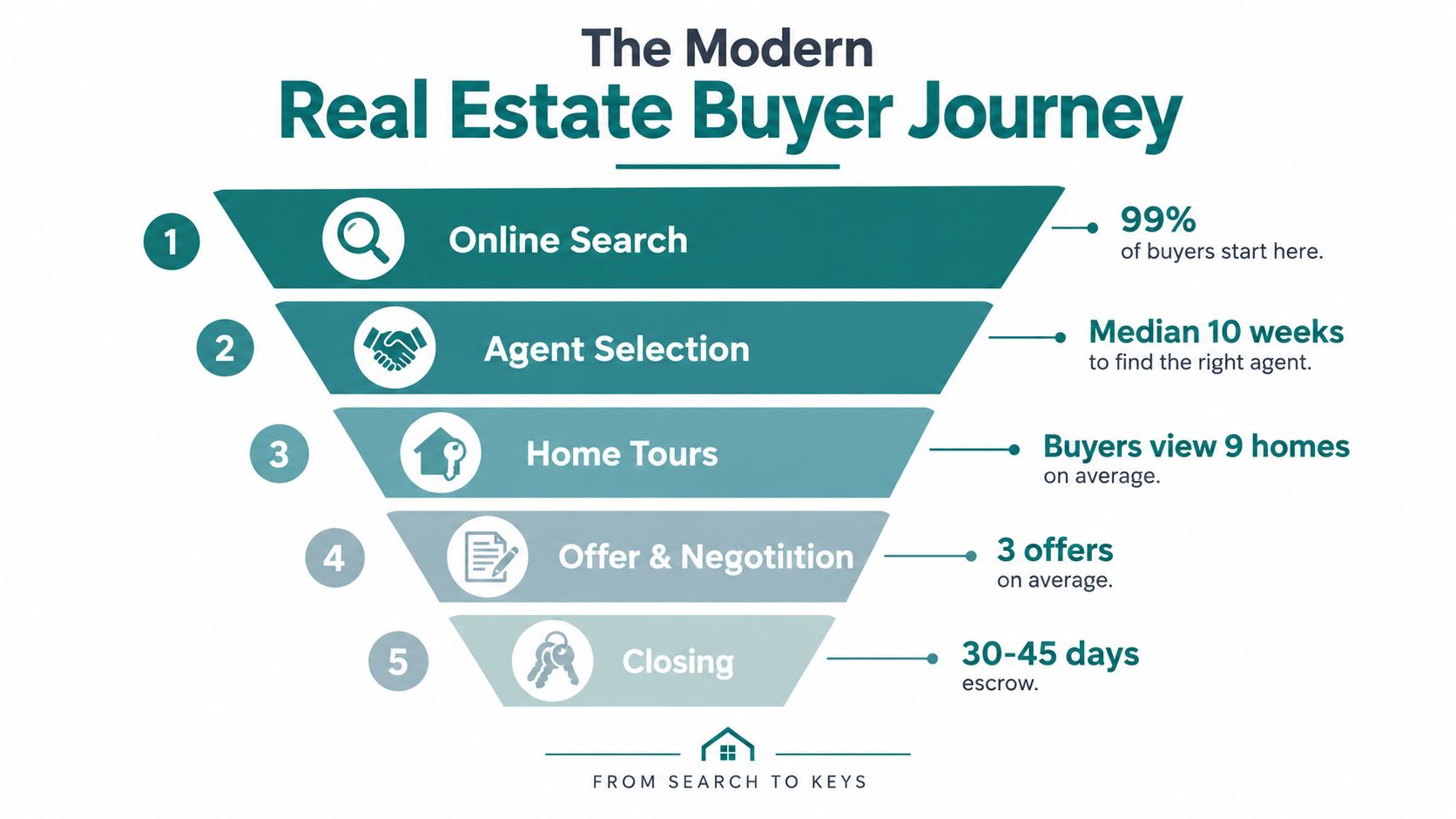
In NAR's 2024 Profile of Home Buyers and Sellers, 43% of buyers said their first step was searching for properties on the internet. Buyers typically searched for a median of 10 weeks and viewed a median of seven homes, including two viewed online only. Photos were the most valued website feature for 41% of buyers, followed by detailed property information at 39% and floor plans at 31%.
Those findings point to a journey that begins well before the showing.
From discovery to a serious inquiry
Online discovery: Buyers search for properties and neighborhoods before choosing an agent. Make the business discoverable with useful local pages, accurate listing information, and search-focused content that answers genuine questions.
Consideration: As prospects compare homes and locations, they need more than a stream of listing alerts. Offer clear property facts, helpful neighborhood context, and an easy way to save or revisit relevant information. Email can support this stage when it reflects the person's interests rather than sending the same message to everyone.
Agent selection and home tours: When a prospect is ready to ask a question or schedule a showing, remove friction. Make contact options visible, route inquiries to someone responsible, and give agents enough information to respond to the property or area the prospect asked about.
Offer through closing: The website may not drive every step of the transaction, but the digital experience still needs to feel organized. Clear communication, useful updates, and a dependable handoff between marketing and the agent help prevent interested prospects from feeling ignored.
A video can also help your team explain the buyer journey to clients or colleagues. Use it as a discussion aid, then connect its ideas to your own inquiry and follow-up process.
<iframe width="100%" style="aspect-ratio: 16 / 9;" src="https://www.youtube.com/embed/7dc9NafNCEs" frameborder="0" allow="autoplay; encrypted-media" allowfullscreen></iframe>Local SEO That Wins Cincinnati Neighborhoods
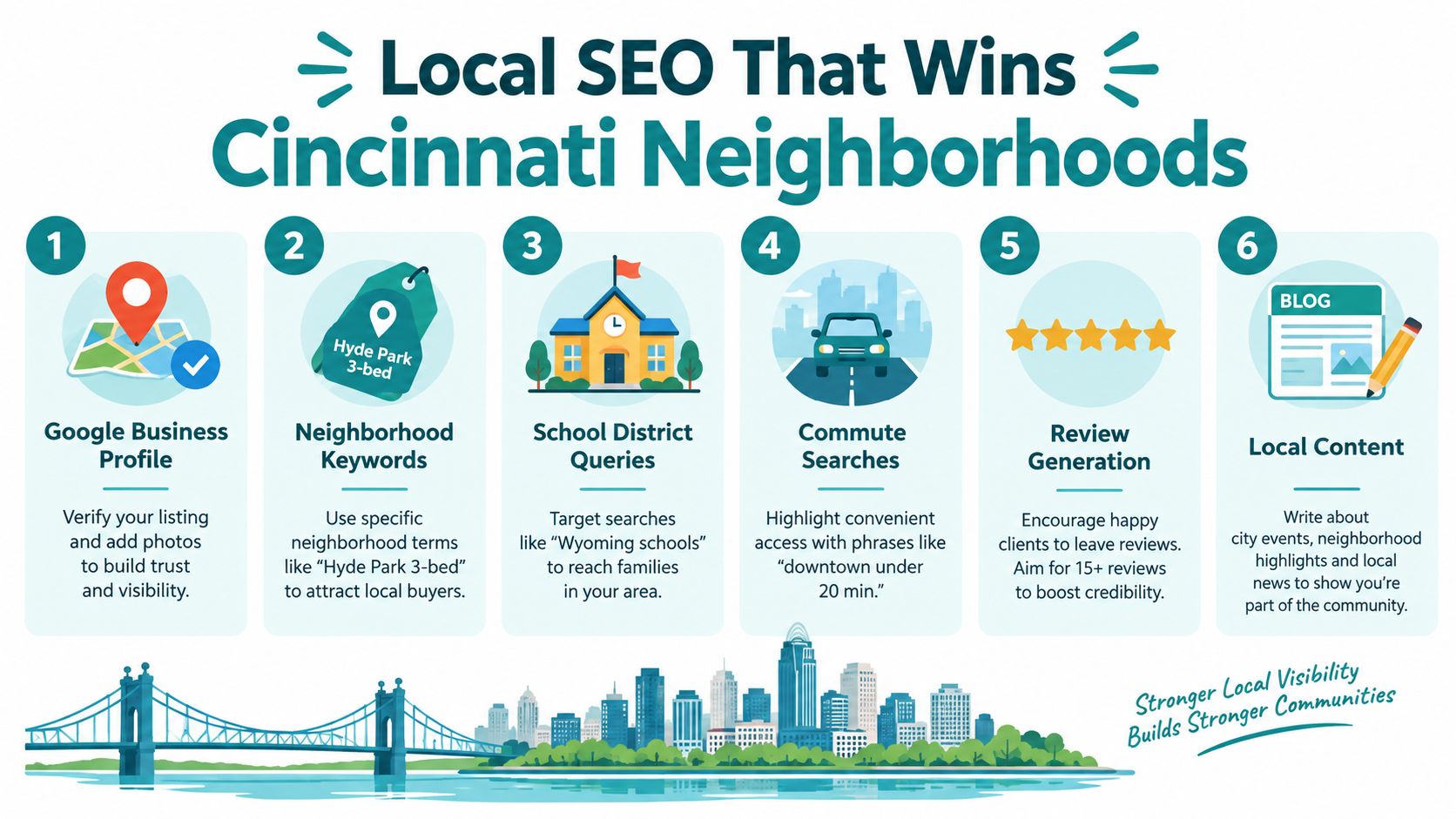
Local SEO should reflect how people describe the place they want to live. A generic page about Cincinnati real estate can't answer every question a buyer has about Hyde Park, West Chester, or a particular school district. Build pages that serve a specific search and a real local need, not pages that repeat neighborhood names.
Start with business locations and listing pages
Set up each legitimate office accurately. Keep the business name, address, phone number, and hours consistent wherever they appear. For firms with multiple offices, create a useful page for each location rather than sending every local search to one generic office page.
Complete your Google Business Profile. Add current photos, services, and the correct location details. Ask clients for honest reviews as part of a consistent service process, and respond professionally. Don't buy reviews or write them yourself.
Build neighborhood pages with a purpose. A page for Hyde Park should provide meaningful local context and relevant listings, not just swap a neighborhood name into a generic template. You can address searches about property types, nearby amenities, school-district questions, or commuting needs, but keep details accurate and avoid promising outcomes you can't verify.
Make property pages accessible to search engines. Use descriptive page titles, clear property details, useful photos, and crawlable text. Google's LocalBusiness structured-data documentation recommends defining each location with its most specific subtype, a physical address, and geographic coordinates with at least five decimal places of precision. Validate markup, check that pages aren't blocked from crawling, and keep location information consistent.
For more Cincinnati-specific guidance on showing up in local search, use HDM's guide to getting found on Google. If reviews and map visibility are priorities, this resource on how to boost your Google Maps ranking from RecensioAI B.V. offers another perspective.
Local SEO takes more than adding a map and a few keywords. The pages need to load reliably, answer the query, and give visitors a clear next action. Review your listings and office pages regularly, especially after a change in staff, address, inventory, or business hours.
Paid Search and Paid Social Working Together
Paid search and paid social solve different problems. Google Ads can put a property or agency in front of someone already searching for a home or agent. Meta and TikTok can help put a new listing, open house, or neighborhood story in front of people who may not be actively searching yet.
NAR's 2025 REALTORS® Technology Survey found that 75% of respondents used social media. 39% said social media generated the highest number of quality leads during the previous 12 months, compared with 23% for CRM systems. That supports taking social seriously, but it doesn't mean every brokerage should shift its entire budget to social ads.
| Dimension | Paid Search (Google) | Paid Social (Meta, TikTok) |
|---|---|---|
| Best fit | Capturing active searches for homes, agents, or a location | Introducing listings, open houses, and local content |
| Audience intent | Usually explicit. The person is searching for something | Often earlier. The person encounters the content while browsing |
| Creative | Search text, location, price, and a focused landing page | Listing photography, property video, and neighborhood stories |
| Main risk | Paying for broad queries that don't match your service area or inventory | Getting attention without meaningful inquiries or follow-up |
| Next step | Make it easy to view a property, call, or request information | Send interested viewers to a page built for that listing or event |
Set the budget around the job
For a small brokerage, don't start with an arbitrary percentage split. Start with the business priority. If you have listings with active demand and people searching for them, test search campaigns around those specific listings or areas. If you need to build awareness for an open house, a new listing, or a neighborhood, test social creative that shows why the property or event is worth attention.
Give each campaign its own landing page and goal. Don't send every ad to the homepage and expect visitors to figure out what you meant. Use a listing page for a property campaign, an open-house page for an event, and a relevant consultation or valuation page for a seller-focused campaign.
Retarget people based on the page or content they engaged with, but keep the message useful and the audience appropriate. To frame campaign planning, HDM's paid media strategy guide can help teams think about channel roles, landing pages, and measurement as one system.
CRM, Email, and the Speed-to-Lead System
An inquiry isn't a result. It's a request for a response. If the website captures a lead but no one owns the next step, the marketing system has failed at the moment it matters most.
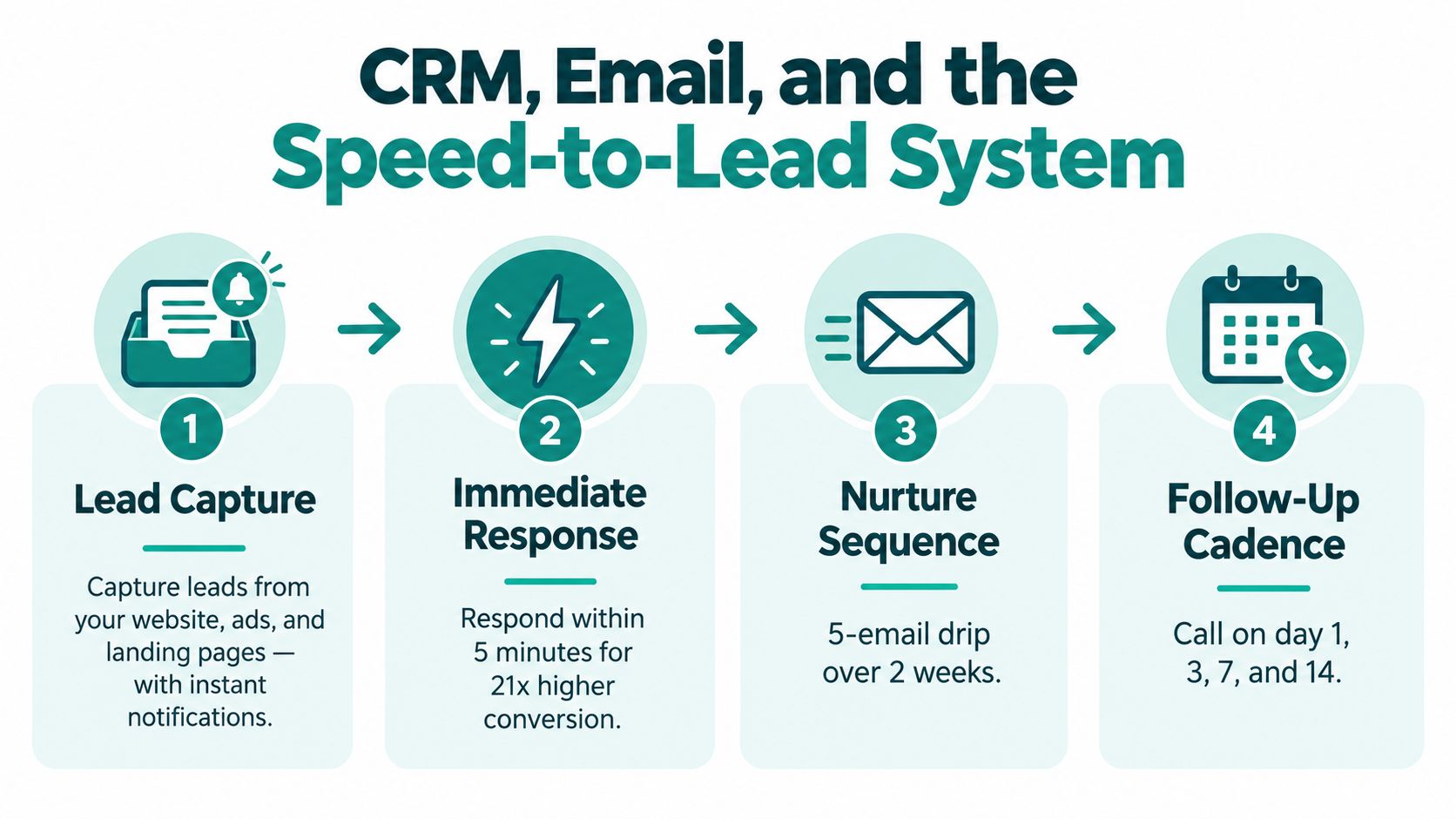
Industry reporting on the MIT/InsideSales Lead Response Management Study found that contacting a lead within five minutes, rather than 30 minutes, made the lead approximately 100 times more likely to be reached and 21 times more likely to qualify. The source is industry reporting on speed-to-lead for real estate. Your process should make a prompt response routine, not dependent on whether an agent happens to notice a notification.
Build a follow-up path agents can actually use
- Capture the inquiry: Send website forms and advertising leads into a CRM such as Follow Up Boss or another system your team will use consistently. Include the property or campaign that prompted the inquiry.
- Acknowledge it promptly: Set an automated email or text to confirm receipt and explain what happens next. Use language that sounds like your team, not a generic robot.
- Assign human follow-up: Create a task for an agent to call as soon as possible. Use the five-minute target as an operating rule when staff are available, while keeping the automated acknowledgment separate from the agent's personal response.
- Nurture with relevance: Segment contacts by neighborhood, price range, property interest, or stated timeline. Send useful listing updates, local information, or relocation resources rather than repeated generic blasts.
- Re-engage based on activity: If a prospect returns to a property page or asks about a showing, alert the responsible agent. A workflow should make the next conversation easier, not replace it.
A practical CRM setup also records consent, opt-outs, duplicate inquiries, and who owns each lead. For another perspective on designing a timely response process, RealEstateCRM's Guide for agents and brokers covers speed-to-lead considerations. HDM can connect a website, campaigns, CRM, and email workflows so a brokerage can trace inquiries through the pipeline; its overview of marketing automation workflows is a useful starting point for evaluating what to automate.
Using AI Without Falling Into the Generic Content Trap
The wrong way to use AI is to publish a flood of neighborhood articles that could describe any city. Generic copy doesn't prove local expertise, and it can leave prospective buyers with vague or inaccurate impressions. Use AI to support a real marketing process, not to manufacture the appearance of one.
A Realtor.com R survey reported that 82% of Americans interested in buying or selling used AI for real-estate information. Respondents viewed agents and AI as nearly equally useful for understanding the market, with 62% finding agents useful and 61% finding AI useful (Realtor.com R survey findings). That's a reason to make reliable information easy to understand, not a reason to hand local judgment over to a text generator.
Use AI as support, keep people accountable
AI can help route inquiries, sort incoming questions, draft internal summaries, or tailor follow-up around a prospect's stated interests. Those tasks can reduce repetitive work, but an agent still needs to confirm the property facts, review the message, and make the relationship personal.
For published content, put accuracy ahead of volume. Provide clear listing details, update dates, neighborhood context, and transparent disclosures. Name the author or reviewer where appropriate. If a page discusses schools, accessibility, financing, or neighborhood characteristics, check the underlying information and avoid language that could mislead or unlawfully steer prospective buyers.
AI visibility is also becoming a practical concern. Buyers may ask AI tools to compare Cincinnati neighborhoods or summarize a property, and the source material available online can affect the answer. Structure property information consistently, make important pages accessible to search engines, and review generated summaries when possible. Correct errors on your own site instead of adding more generic content to bury them.
The standard is straightforward: AI can help scale the work, but a knowledgeable person must own the claims. Use it to improve responsiveness and organize information. Don't use it as a substitute for neighborhood knowledge, fair-housing awareness, or an agent's responsibility to represent a property accurately.
Measuring What Matters and a 90-Day Rollout Plan
Measure the path from first visit to real conversation, not just website traffic. A dashboard that shows clicks without CRM outcomes can make an unproductive campaign look successful. Keep the measures tied to actions agents and owners can improve.
Track qualified leads, response time, showing requests, appointments, and closed transactions attributed to digital channels. Zillow's 2025 Consumer Housing Trends report found that the median home search lasts three to four months, and 22% of buyers searched for six months or more. Follow-up should continue long enough to support that kind of timeline, with messages based on what a prospect wants and how they've engaged.
Roll out improvements in a workable order
First, fix the basics. Check your business profiles, contact paths, listing details, mobile usability, and lead routing. Make sure inquiries reach an accountable person and receive an acknowledgment.
Next, build durable local visibility. Improve neighborhood and property pages, connect relevant advertising to focused landing pages, and set up reporting that links campaign activity to CRM outcomes. If social campaigns are part of your plan, this resource on Facebook ads for real estate can help you assess campaign formats and creative choices.
Then, refine based on actual behavior. Review which pages generate useful conversations, where prospects stop, and how quickly the team responds. Add automation or AI support only where it addresses a clear bottleneck. Warning signs include inquiries with no owner, campaigns sending traffic to irrelevant pages, and regular reporting that never reaches the sales pipeline.
Frequently asked questions
- What should a real estate website include?
- Clear agent and office information, listing search or links, local market content and easy ways to contact an agent.
- Does local SEO matter for real estate?
- Yes. Buyers and sellers often search by neighborhood or city, so accurate local listings and pages help them find you.
- How fast should agents respond to online leads?
- As quickly as possible. Setting up instant notifications and clear follow-up routines helps.
HDM works with Greater Cincinnati businesses on website design, SEO, paid media, analytics, and marketing automation, including the connections between property pages and lead follow-up. If your brokerage needs a clearer route from online discovery to qualified conversations, visit HDM to discuss your website and growth priorities.