
You've paid for the clicks, the dashboard shows conversions, and yet the phone isn't ringing with better prospects. A Cincinnati clinic may be attracting patients from outside its service area. A law firm may be paying for searches from people looking for free information. A retailer may see inexpensive traffic that never becomes profitable revenue.
Those problems usually begin before an ad is written. A useful paid media strategy starts with audience quality, commercial intent, and measurement. Campaign settings matter, but they can't rescue an unclear customer definition or a conversion report that counts every platform claim as revenue.
Why Your Paid Media Strategy Needs a Foundation First
Digital advertising gives a small business immediate reach, which is both its advantage and its trap. You can launch a campaign quickly, but speed can hide weak assumptions about location, buyer intent, exclusions, landing pages, and what counts as a valuable result.
A Cincinnati-area business should define the business outcome before choosing a platform. A healthcare organization may value a booked appointment, not a form fill from someone who never responds. A legal practice may need qualified consultations rather than raw lead volume. An e-commerce company should separate profitable new-customer sales from repeat orders.

Start with the customer, not the campaign
Before spending, write down:
- Service area: Decide whether your market is downtown Cincinnati, Northern Kentucky, the eastern suburbs, or a wider regional footprint.
- Commercial trigger: Identify the problem that causes someone to search, compare, call, or purchase.
- Qualification rule: Define the lead attributes your sales team can serve.
- Economic outcome: Connect the conversion to appointments, signed matters, completed procedures, orders, or revenue.
A campaign can produce an impressive click-through rate and still fail if the audience has no realistic path to becoming a customer. That's why the cheapest impression or click isn't automatically the best purchase.
Key Insight: Treat every ad dollar as a test of a business assumption. If you can't state the assumption, you won't know what the result means.
For owners who need a plain-language overview of channel choices and setup decisions, how to advertise your small business offers useful introductory context. The next step is more specific: build a local plan around your actual customers, margins, sales process, and capacity.
Digital Advertising in 2026
A Cincinnati business can burn through budget fast if it mistakes activity for progress. That happens every day. A healthcare practice buys broad social reach, a law firm chases cheap display clicks, or a retailer copies a national brand's channel mix. The problem usually is not the platform. It is using the wrong channel for the wrong job and measuring the wrong outcome.
The market is large enough that paid media still matters, and crowded enough that weak targeting gets expensive. Analysts at the Interactive Advertising Bureau and PwC's 2024 Internet Advertising Revenue Report found that U.S. internet advertising revenue reached $258.6 billion in 2024, up 14.9% year over year. Search remained the largest category at $102.9 billion, or 39.8% of digital advertising revenue. For a Cincinnati attorney or healthcare provider, that matters because search usually reaches people who already have a problem and want options now.
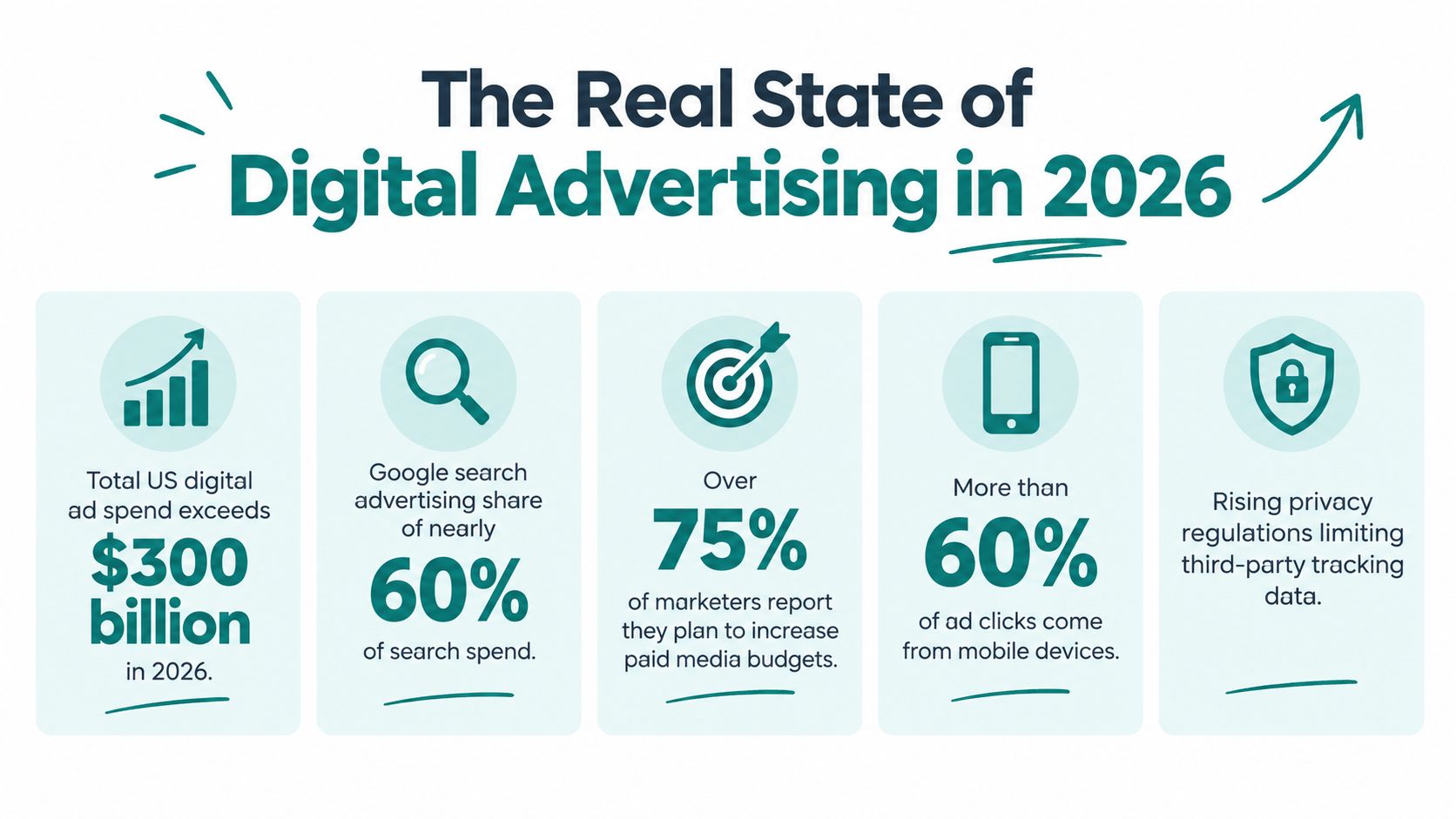
Demand capture and demand creation serve different jobs
Social advertising and display still matter, but they rarely solve the same problem as search. They are better for introducing a brand, building familiarity, showing proof, or staying visible until someone is ready to act. Video can do that job well too, especially when a local business has a clear offer and a credible message.
That distinction matters more than any platform trend. A retail business in Ohio may benefit from ads that sit closer to a transaction. A service business often needs stronger filtering. Wide reach looks good in a dashboard, but it can send sales teams low-intent calls, weak form fills, and wasted follow-up.
Audience quality comes first. Incrementality comes next. Then channel setup.
For local owners, the practical move is simple. Match each channel to a business objective, then judge performance by qualified consultations, booked appointments, signed matters, completed purchases, or another outcome that the business can verify. If you need a grounded view of what shapes budget levels across channels, review this guide to online advertising cost.
Defining Your Audience Before You Spend a Dollar
The most expensive audience is the one that looks large in a platform but has little chance of buying. Start by describing your commercial audience in terms a platform, analyst, and salesperson can all understand.
Nielsen's 2023 Digital Ad Measurement Benchmark reported an average digital-ad on-target rate of 65% across North America, including 64% in the United States and 66% in Canada. That means delivery volume alone doesn't prove that your ads reached the people you intended to reach. The benchmark is summarized in Nielsen's Annual Marketing Report.
Build an audience definition that can be checked
Use this sequence:
- Name the buyer. Separate the patient, family member, property owner, business decision-maker, or shopper who can take action from people who merely show interest.
- Define the need. Write the event that creates urgency, such as a diagnosis, a legal dispute, a home project, or a product comparison.
- Set geographic boundaries. Use the places you can serve profitably. A Cincinnati practice shouldn't pay for statewide visibility if its staff only accepts local clients.
- Create exclusions. Remove existing customers when the goal is acquisition, current employees, irrelevant service categories, job seekers, and locations outside the operating area.
- Assign a quality signal. Pass qualified leads, booked appointments, completed purchases, or revenue values back into the platform where privacy and consent practices allow it.
A market research process can make these assumptions more concrete. HDM's market research and analysis resource is a useful reference for organizing customer, competitor, and demand information before campaign setup.
Measure audience quality after launch
Monitor on-target rate, reach, frequency, viewability, invalid traffic, conversion rate, and revenue quality by market and placement. A low cost per thousand impressions can be misleading if the inventory reaches the wrong people. A high click-through rate can also disappoint when visitors have weak post-click intent.
Healthcare and legal advertisers need extra discipline. Use consent controls, minimize collected data, and avoid sensitive-audience practices that create compliance risk. E-commerce advertisers should distinguish new-customer revenue from repeat purchases so acquisition campaigns don't receive credit for customers who were already likely to return.
Audience expansion and automated targeting can help discovery, but they should be tested against the business outcome you care about. The right question isn't, “Can the platform find more people?” It's, “Can it find more people who become economically valuable customers?”
Choosing the Right Channels for Your Business Goals
A channel decision should follow the customer journey and the economics of the offer. Search is often a natural starting point for a Cincinnati law firm because the prospect may already be looking for representation. A healthcare provider may use search to capture appointment intent while using video or social content to build familiarity around a specialized service. An e-commerce retailer may need social creative and retail placements to create demand before a shopper searches for a product.
| Channel | Best For | Key Strength | Typical Goal |
|---|---|---|---|
| Search | High-intent services and products | Connects ads to active queries | Qualified calls, forms, or purchases |
| Social | Prospecting, education, and retargeting | Uses visual creative and audience signals | Awareness, engagement, leads, or sales |
| Programmatic | Broad reach and audience extension | Automates buying across placements | Reach, consideration, and assisted demand |
| Retail media | E-commerce near a transaction | Uses commerce and first-party shopping signals | Product discovery and sales |
| Video | Demonstrations, expertise, and brand memory | Communicates more context than a text ad | Awareness and demand creation |
Search is powerful, not self-sufficient
Google Ads doesn't rank advertisements by bid alone. Google's Ad Rank considers the bid, ad and landing-page quality, minimum thresholds, auction competition, location, device, time, query, competing ads and organic results, and the expected effect of ad assets such as sitelinks. These factors explain why an ad's position can change even when budget and bid stay the same, as described in Google's Ad Rank documentation.
Google's Quality Score is a diagnostic rating on a 1–10 scale based on signals associated with expected click-through rate, ad relevance, and landing-page experience, according to Google's Quality Score guidance. It isn't the live auction score, and raising it should never become the business goal. Use it to identify message, keyword, and landing-page problems, then connect those fixes to qualified calls or revenue.
Social and programmatic need stronger controls
Social can reach people before they search, but the creative must earn attention and the conversion signal must reflect quality. Programmatic can extend reach efficiently, but cheap delivery can conceal poor placement or weak intent. Retail media is more directly connected to commerce, though it makes most sense when product data, margins, and transaction tracking are dependable.
TikTok may suit a visual product or younger audience, while it may be a poor fit for a highly local legal service. Before adding it, compare actual customer value rather than vanity metrics. A practical resource on measuring TikTok ad returns can help frame that evaluation.
Moving Beyond Basic ROAS to Real Measurement
A Cincinnati retailer can turn on branded search, see strong platform ROAS by Friday, and still learn almost nothing about whether the spend created new demand. The same problem shows up for healthcare groups and law firms. If credit goes to the last click, campaigns that harvest existing intent look stronger than campaigns that brought in new patients, shoppers, or consultations.
Start with measurement discipline. The IAB and MRC retail media measurement guidelines outline a useful three-layer approach because it forces teams to clean up inputs before they argue about performance.
Layer one creates consistent inputs
Set naming rules, conversion definitions, click and impression collection, and attribution windows before budget shifts start. A conversion has to mean the same thing everywhere. For one business that may be a form fill. For another, it may be a qualified phone call, a scheduled visit, a signed matter, or a completed order.
Document the rules that keep reporting honest:
- Identity resolution: How you match records without counting the same person or household twice.
- Deduplication: How duplicate leads, calls, and orders are removed.
- Consent status: Which data can be used, and for which purpose.
- Attribution window: How long after an exposure or click a conversion can receive credit.
- Confidence intervals: How much uncertainty surrounds the reported outcome.
Google's data-driven attribution can spread credit across multiple touchpoints, but Google's eligibility guidance sets clear thresholds. Some accounts do not have enough volume for that model to be dependable. If a local advertiser is below those requirements, presenting algorithmic attribution as settled truth is a mistake.
Layers two and three connect reporting to causality
Next, reconcile ad platform numbers with analytics, CRM records, revenue, and privacy-compliant first-party data. For a Cincinnati clinic, that means tying inquiries to completed appointments where appropriate. For a law firm, it means checking whether a lead became a qualified consultation, not stopping at the thank-you page.
Then test what caused lift. Incrementality testing guidance is useful here because it shifts the question from “What got credit?” to “What changed because we ran ads?” A geo holdout, conversion lift study, or matched-market test can answer that better than dashboard ROAS alone. Marketing mix modeling can help too when there is enough clean historical data.
Trade-offs matter. Small budgets, heavy seasonality, short promotions, and channel spillover can weaken a test fast. Attribution still has value for optimization, especially when teams need a multi-touch attribution model to compare search, social, and remarketing. It just should not be confused with causal proof.
For social teams, PostPulse's developer guide is a practical reference for structuring goals before results hit the reporting layer.
Putting It All Together Into an Action Plan
A durable paid media strategy is a management loop, not a campaign launch. Start with an audit of the audience, conversion definitions, landing pages, channel mix, CRM handoff, and reporting gaps. If the system can't distinguish a qualified Cincinnati lead from an irrelevant inquiry, increasing spend only increases uncertainty.

Use a practical operating rhythm
Weekly: Review search terms, placements, geography, invalid traffic, lead quality, landing-page behavior, and obvious tracking failures. Make small diagnostic changes rather than reacting to one unusual day.
Monthly: Reallocate budget according to marginal CPA, incremental ROAS where available, qualified pipeline, new-customer revenue, or profit. A campaign with attractive reported ROAS may deserve less budget if it mostly captures existing demand.
Quarterly: Run a holdout or conversion-lift test when the market, budget, and sales volume support it. Record the test design, exclusions, timing, promotions, spillover risks, and interpretation limits.
Continuously: Test one meaningful variable at a time, such as audience, creative angle, landing page, bidding approach, or placement. Feed better conversion signals into automated systems, but don't surrender judgment to default settings.
AI-assisted discovery adds another measurement question. Adobe reported a 39% increase in consumers using AI for online shopping in February 2025, while 34% used AI for product research before turning to traditional search. Its analysis also found AI-driven traffic showed 9–12% higher engagement than other traffic. These findings appear in Adobe's Digital Insights report. For Cincinnati businesses, protect high-intent search while checking whether AI-originated visits engage, inquire, and purchase differently. Use clear service content, product information, structured data, and first-party analytics so those visits remain interpretable.
A local partner such as HDM can support paid campaigns across Google Ads, Facebook, LinkedIn, Instagram, and other platforms, including targeting, creative testing, optimization, and ROI-focused reporting. Whether that work stays in-house or moves to an agency, the standard should remain the same: reach the right audience, measure qualified outcomes, and prove incremental value before scaling.
The process is easier to understand when you can see how testing and refinement fit together:
<iframe width="100%" style="aspect-ratio: 16 / 9;" src="https://www.youtube.com/embed/NyLbwKohcII" frameborder="0" allow="autoplay; encrypted-media" allowfullscreen></iframe>Don't wait for a disappointing monthly report to expose weak foundations. Define your audience, audit your conversion data, choose channels by business role, and run a focused test that can change the next budget decision.
HDM helps Cincinnati-area businesses connect paid media with audience strategy, landing pages, analytics, SEO, and conversion-focused web development. Visit HDM to discuss a measurable plan built around qualified leads, appointments, sales, and incremental growth.