

AI-generated answers are becoming a discovery channel where your business can be mentioned, recommended, or cited without a customer ever scrolling through a traditional results page. That shift is already visible in the data. AI Overviews appear on nearly 65% of question-based searches, according to Seer Interactive's analysis of Google AI Overviews, while one large study found that 81% of cited pages had schema markup across ChatGPT, Google AI Overviews, and Perplexity, as reported in this analysis of structured data and AI search visibility.
That doesn't mean publishing generic AI-written articles will make a Cincinnati business visible. AI systems need useful information they can interpret, credible signals from other sources, accessible ways to evaluate or try an offer, and measurement that connects visibility to qualified business outcomes.
The most effective strategies for AI visibility enhancement combine traditional SEO with content structure, conversion design, customer data, helpful tools, and disciplined testing. A healthcare practice, law firm, manufacturer, retailer, or professional services company may need a different mix. An agency such as Cincinnati-based HDM can help connect web design, development, SEO, analytics, and marketing execution without treating AI visibility as a separate project disconnected from revenue.
For a practical overview of how marketers can monitor this shift, see this guide to AI visibility for marketers.
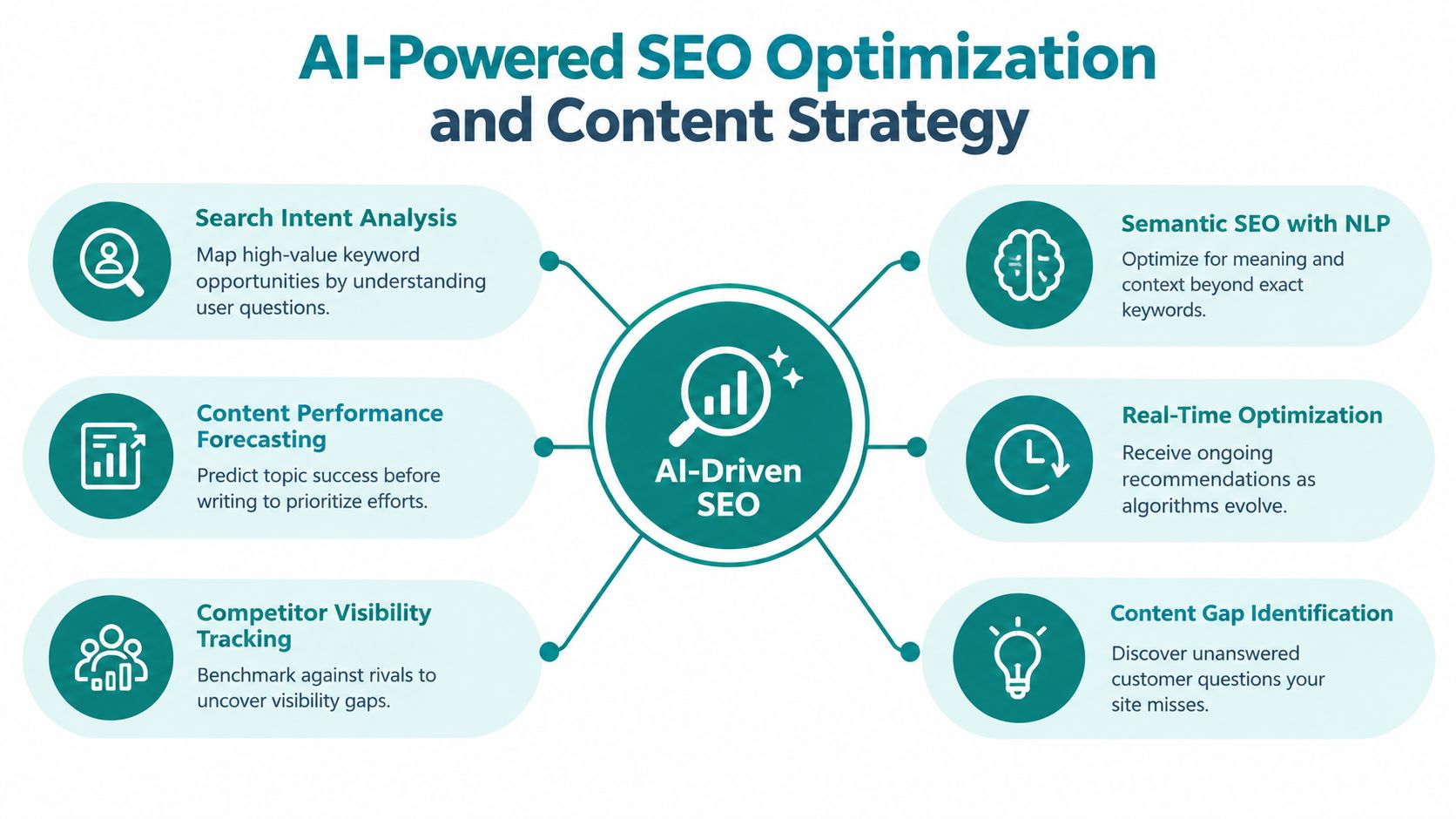
1. AI-Powered SEO Optimization and Content Strategy
AI visibility starts with a clear understanding of what customers ask before they contact you. Traditional keyword research still matters, but a list of short phrases isn't enough. Your pages should answer complete questions, explain trade-offs, identify who a service is for, and make your local expertise clear.
A Cincinnati dental practice might need content that explains how patients compare implant options, what questions to ask during a consultation, and how the practice serves nearby communities. A law firm could address what happens during an Ohio contested divorce in plain language. An e-commerce company might build buying guides around seasonal product needs rather than producing thin pages that repeat product names.
AI tools can help identify gaps across existing pages, competitor coverage, search intent, and customer questions. They shouldn't decide your strategy alone. Sales calls, support tickets, appointment conversations, and reviews often reveal the language and objections that make content useful.
Start with pages that already have potential
Review your strongest existing service and product pages before commissioning a large volume of new content. Look for pages that earn impressions but fail to answer obvious questions, pages that attract visitors but don't explain the next step, and pages that describe your company without demonstrating expertise.
Use AI to suggest missing questions, related topics, and clearer outlines. Then have a subject-matter expert verify every recommendation. This is especially important for healthcare, legal, financial, and technical claims.
- Answer first: Put a concise answer near the beginning of each important page, then provide context and detail.
- Build topic depth: Connect service pages with guides, comparisons, case explanations, and local proof.
- Refresh deliberately: Review high-value pages regularly instead of publishing new material while old information becomes inaccurate.
- Track business value: Measure qualified inquiries, calls, appointments, purchases, and assisted conversions, not just impressions.
A useful starting point is AI-driven SEO services from HDM, particularly when content planning needs to connect with technical improvements and conversion work.
2. Conversion Rate Optimization Using AI Behavioral Analytics
Being cited by an AI system is only useful if the resulting visitor can understand your offer and act on it. A visitor who arrives on a confusing service page, can't find a phone number, or faces an overly complicated form may leave even when the content answered their original question.
Behavioral analytics can show where that friction occurs. Heatmaps reveal which elements attract attention, session recordings show how people move through a page, and form analytics can identify the field or step where visitors abandon the process. These tools don't replace customer interviews or accessibility testing, but they can help a small team see patterns that ordinary traffic reports hide.

Fix the path from answer to action
A Cincinnati law firm might discover that prospective clients read an informative page but can't find the consultation option. A medical practice may learn that patients understand the service but hesitate at an unclear appointment form. An online retailer may see shoppers leave when delivery terms appear later than expected.
Start with the pages that receive meaningful traffic and are expected to produce an inquiry, booking, call, or sale. Review recordings from visitors who didn't convert, compare mobile and desktop behavior, and ask whether the page gives people enough trust and information to proceed.
Practical rule: Use AI to prioritize possible tests, but use controlled testing and human review to decide whether a change actually helped.
Don't redesign every page at once. Test one meaningful change, such as a clearer call to action, a shorter form, stronger service proof, or more transparent delivery information. The landing page best practices from HDM offer a useful framework for connecting page structure with conversion intent.
A page that AI systems can quote but customers can't use is not a growth asset. Good CRO makes the information persuasive, accessible, and easy to act on.
For a practical look at how conversational data and user interactions can inform marketing decisions, this resource explains why conversation analytics matter.
<iframe width="100%" style="aspect-ratio: 16 / 9;" src="https://www.youtube.com/embed/nuPrBltPh88" frameborder="0" allow="autoplay; encrypted-media" allowfullscreen></iframe>3. Predictive Analytics for Customer Segmentation and Personalization
A visitor arriving from an AI-generated answer may be a first-time researcher, a returning customer, a developer testing a product, or someone ready to request a quote. One website experience rarely serves all of them equally well. A Cincinnati manufacturer, for example, may need different paths for a procurement manager, technical evaluator, distributor, and developer exploring a distributed demo.
Predictive segmentation groups audiences through signals such as purchase history, browsing behavior, engagement, service interest, and CRM activity. The useful output is not a mysterious score. It is a practical choice about which explanation, proof point, offer, or next action should appear first.
A retailer might separate visitors comparing premium products from those seeking entry-level options. A dental practice could distinguish routine-care patients from people researching cosmetic treatment. A software company may present documentation and a trial path to technical users, while showing implementation guidance and business outcomes to decision-makers.
Start with decisions, not a complicated model
Choose segments your team can recognize and serve. High-value versus low-value customers, active versus inactive engagement, and new versus returning visitors often provide a workable starting point. Combine website analytics, CRM records, email activity, and sales notes only where privacy policies and customer permissions allow.
Use a simple operating loop:
- Use predictions as guidance: A model can flag likely interest, while sales or care teams add context before acting.
- Personalize one touchpoint: Begin with an email, landing-page message, product recommendation, documentation path, or demo rather than rebuilding the entire website.
- Protect sensitive data: Healthcare and other regulated organizations need clear governance, access controls, and review of automated messaging.
- Recheck assumptions: Customer behavior changes, so evaluate segments regularly instead of treating them as permanent labels.
Measure whether personalization produces qualified inquiries, bookings, renewals, trials, or larger engagements. AI visibility improves when the people and communities discovering a brand can quickly find the information suited to their intent, without being forced into a narrow path.
Useful personalization answers the visitor's next question and keeps the full offer visible. A small number of maintained segments will usually serve a midsize business better than an elaborate system with poor data ownership.
4. AI-Powered Chatbots and Conversational Customer Support
A chatbot earns its place when it answers a recurring question, supports a clear next step, and helps the business appear in useful AI-assisted customer journeys. Service eligibility, appointment preparation, product availability, delivery status, and inquiry forms are practical starting points. Installing one because competitors have one usually creates cost without improving customer access.
For a Cincinnati healthcare organization, a chatbot could explain scheduling options and collect non-sensitive details before staff respond. A law firm could identify the general matter type and route the visitor to the right intake process. A retailer could answer product and order questions, then direct customers to human support when judgment is required. These focused experiences also create distributed demonstrations of what the business can help with, provided the answers match approved public information.
Build the handoff before the greeting
The escape route deserves as much attention as the welcome message. Show visitors how to contact a person and explain when a response should arrive. Keep medical, legal, financial, and warranty decisions under appropriate human review. A chatbot should not make promises that its content cannot support.
Start with questions staff already answer repeatedly. Build responses from approved website pages and internal documentation. Then examine chat transcripts for missing details, confusing wording, and incorrect assumptions. An outdated answer delivered with confidence can weaken trust faster than no chatbot.
Use these operating rules:
- Set a narrow scope: Handle common questions well before adding complex conversations.
- Collect only useful details: Request information that helps staff respond, rather than data that only expands a profile.
- Make escalation visible: Offer a phone number, email option, appointment path, or human chat handoff.
- Review on a schedule: Update answers when services, policies, hours, or inventory change.
Track completed inquiries, qualified contacts, appointments, resolved support requests, and handoffs that reach the right team. Those measures show whether the assistant improves business outcomes, not just conversation volume.
Businesses considering a custom assistant can review AI chatbot development from HDM. The technology matters, while content ownership, routing, privacy controls, and staff workflow determine whether customers receive dependable help.

5. Dynamic Pricing and Revenue Optimization Using AI
Dynamic pricing can help a business respond to demand, inventory, capacity, and usage, but it carries a trust risk that many marketing discussions understate. Customers may accept a price that changes because availability or service conditions changed. They may react badly if the logic feels hidden, arbitrary, or unfair.
For an online retailer, AI can flag slow-moving inventory and help prioritize a promotion. A hospitality business can evaluate demand by day, event calendar, occupancy, and booking behavior. A software company can use usage patterns to guide customers toward an appropriate plan rather than showing every visitor the same recommendation.
The responsible starting point is usually operational, not personal. Adjusting a clearance offer based on inventory is easier to explain than charging different customers different prices because a model predicts willingness to pay.
Protect value perception
Set boundaries before automation begins. Establish approved price ranges, discount rules, and conditions that require human review. Monitor competitor pricing for context, but don't automatically copy every temporary change. Your brand promise and margin requirements still matter more than a short-term reaction.
A practical rollout might focus on one category, one service type, or one inventory problem. Compare revenue, margin, conversion quality, returns, cancellations, and customer complaints. A price change that produces more orders but weaker profitability or lower trust isn't necessarily an improvement.
Transparent pricing usually creates stronger long-term relationships than clever pricing that customers can't explain.
For professional services, the equivalent may be capacity-based scheduling, packaged service options, or clearer recommendations based on project scope. AI should support consistent commercial judgment, not disguise price discrimination or push people toward an unsuitable purchase.
6. Content Generation and Scaling Using AI Writing Assistants
AI writing assistants can expand a small marketing team's output, but they do not replace business knowledge. They can build outlines, draft variations, repurpose material, and support a steady publishing schedule. People still need to supply firsthand expertise, verify regulated claims, and explain how a Cincinnati customer's situation affects the recommendation.
A practical workflow starts with evidence. A subject-matter expert provides customer language, approved facts, examples, and editorial judgment. The assistant organizes that material into a draft, while a human editor checks accuracy, improves usefulness, and approves the final version.
Use cases should match the risk and complexity of the subject. A retailer can generate product-description drafts from a structured template, then have a merchandiser confirm specifications. An accounting or consulting firm can turn a client question into a guide, email, and short social post. A healthcare provider may use AI to organize patient-education content, but qualified staff must review clinical accuracy and reading level before publication.
Build a repeatable content system
Create a brief for each important asset. Specify the audience, purpose, service area, required facts, exclusions, voice, internal links, and call to action. Provide source material rather than asking the system to invent authority. That makes the content easier to review and gives AI systems clearer information to interpret and cite.
- Draft from evidence: Use approved documents, product information, transcripts, and real customer questions.
- Preserve local relevance: Add Cincinnati-area details only when they reflect the actual service area and customer experience.
- Edit for originality: Replace generic openings with specific expertise, examples, and useful distinctions.
- Check every claim: Verify names, dates, prices, technical details, legal language, and healthcare information before publication.
High-volume AI content becomes a liability when pages repeat the same ideas without original value. Clear formatting helps systems parse an article, but headings and lists cannot substitute for expertise. HubSpot's analysis of generative engine optimization statistics reported that LLMs were 28% to 40% more likely to cite clearly formatted content, including hierarchical headings, lists, and tables. Structure supports discoverability. Human knowledge gives the page a reason to be cited.

7. Predictive Lead Scoring and Sales Acceleration
A business can appear in an AI answer, attract more inquiries, and still waste sales time if those inquiries lack a clear fit. Predictive lead scoring helps marketing and sales separate casual research from signals of a genuine buying need.
The model might evaluate pages visited, forms completed, email engagement, company fit, service area, product interest, and previous interactions. For a Cincinnati law firm, a qualified inquiry may match the firm's practice areas and intake requirements. For a B2B manufacturer, the relevant signals may include application, production needs, and purchase timeline.
Start with the handoff, not the software. Agree on which actions should trigger follow-up, what information sales receives, and how staff records the result. A lead who finds the company through an AI recommendation may need a product explanation or demo before a sales call. A local service prospect may need a faster response and confirmation that the business serves their area.
A score supports judgment. It does not replace it. An urgent prospect may have no budget, while an important account may research anonymously or share a device with other users. Sales staff should be able to add context and explain when the score missed the situation.
Use four operating rules:
- Use clear thresholds: Connect each score range to a defined action, such as educational follow-up, a sales alert, or direct outreach.
- Record outcomes: Compare predictions with consultations, qualified opportunities, purchases, and retained customers.
- Respect consent: Follow applicable privacy requirements for tracking and communication.
- Keep human review: Allow staff to override a score when business context supports it.
Review closed and lost opportunities regularly. Remove signals that create noise and strengthen signals associated with qualified outcomes. A simpler model built on reliable information will usually outperform a complicated score that staff cannot explain or trust. Sales acceleration comes from consistent decisions, timely follow-up, and feedback that improves the process.
8. Marketing Attribution and ROI Measurement Using AI
AI visibility matters only when it reaches the right audience and supports a business outcome. Track whether an appearance in an AI answer builds trust, drives a visit, influences a contact, or contributes to revenue.
Attribution gets difficult when a customer sees a local listing, reads a guide, returns through search, receives an email, speaks with sales, and converts later. Last-click reporting gives all credit to the final interaction. First-click reporting can overlook the content or recommendation that helped close the sale. AI-assisted analysis can compare these paths, but its conclusions depend on accurate tracking and revenue data. For practical guidance on why conversation analytics matter, connect conversation records with the rest of the customer journey.
Measure visibility at the engine level
AI visibility varies by platform, query wording, location, and customer intent. Searchable's analysis of AI visibility found less than a 1% chance that two AI responses recommended the same brands, while 68% of brands appeared on only one AI platform. A single visibility score therefore hides differences that affect local growth decisions.
Test the questions customers ask in ChatGPT, Google AI Overviews, Perplexity, and other relevant systems. Record whether the business appears, how the answer describes it, which sources it cites, and whether it directs users to the company or a competitor. Repeat tests with different wording. A Cincinnati service company might appear for “emergency furnace repair” but disappear for “best furnace company near me.”
- Track qualified outcomes: Connect visibility with calls, forms, appointments, purchases, and revenue where tracking permits.
- Separate platforms: Report results by AI engine, query category, location, and intent.
- Use controls: Compare updated pages or campaigns with pages and audiences that did not change.
- Expect uncertainty: Research has not established a stable, cross-platform causal effect for one GEO technique, as discussed in this review of Generative Engine Optimization studies.
Structured data supports this measurement system, but it does not guarantee citations. A five-million-request analysis reported that valid structured data improved extraction, crawl depth, re-crawling frequency, and bot engagement, according to the LightSite structured data analysis. Separate testing of 1,885 pages found no major citation uplift from JSON-LD alone in several AI systems, as reported by CMSWire's structured data evaluation. Keep schema accurate, then measure whether the full content and authority program earns visibility that produces qualified business results.
AI Visibility, 8-Strategy Comparison
| Solution | Implementation complexity | Resource requirements | Expected outcomes | Ideal use cases | Key advantages |
|---|---|---|---|---|---|
| AI-Powered SEO Optimization and Content Strategy | Medium, tool setup, data integration, ongoing tuning | AI SEO tools, content team, analytics data | Improved rankings and targeted organic traffic (typically 3–6 months) | Local businesses, content-driven lead generation, niche keyword targeting | Data-driven topic selection, faster ranking gains, scalable content prioritization |
| Conversion Rate Optimization (CRO) Using AI Behavioral Analytics | Medium–High, tracking, session capture, A/B testing setup | Behavioral analytics, A/B testing platform, sufficient traffic, UX resources | Higher conversion rates (often 5–20%), reduced funnel drop-offs | E‑commerce checkout funnels, service intake pages, high-traffic landing pages | Identifies friction points, prioritizes high-impact tests, combines qualitative + quantitative insights |
| Predictive Analytics for Customer Segmentation and Personalization | High, model building, data integration, regular retraining | Clean cross-channel data, ML models, CRM/CDP integration | Improved personalization, higher LTV, reduced churn over time | Email marketing, personalized web experiences, loyalty and retention programs | Targets high-value segments, improves ROI, enables lookalike acquisition |
| AI-Powered Chatbots and Conversational Customer Support | Medium, bot training, integrations, escalation flows | Conversational AI platform, knowledge base, CRM/support integration | Reduced support volume (≈30–40%), 24/7 lead capture and faster responses | Customer support, appointment scheduling, pre-qualification of leads | Scales support, instant responses, collects qualification data off-hours |
| Dynamic Pricing and Revenue Optimization Using AI | High, real-time feeds, pricing logic, governance | Pricing engine, real-time sales/inventory/competitor data, analytics | Revenue uplift (typically 5–20%), lower overstock and smarter markdowns | E‑commerce, hospitality, inventory-sensitive retail and services | Maximizes revenue, adapts to demand, optimizes margin vs. volume trade-offs |
| Content Generation and Scaling Using AI Writing Assistants | Low–Medium, tool adoption and editorial workflows | AI writing tools, editors/reviewers, style guides | Faster content production (3–5×), lower content costs | Product descriptions, local landing pages, social and email content | Rapid drafting and ideation, consistency at scale, cost-efficient output |
| Predictive Lead Scoring and Sales Acceleration | Medium–High, historical model training, CRM workflows | CRM with historical data, ML models, sales automation | Higher close rates (25–40%), shorter sales cycles when validated | B2B sales, high-touch services, lead qualification processes | Prioritizes ready-to-buy leads, improves sales efficiency and routing |
| Marketing Attribution and ROI Measurement Using AI | High, cross-platform data stitching, identity resolution | Attribution platform, consolidated tracking, revenue mapping | Clear channel ROI, better budget allocation, improved campaign decisions | Multi-channel marketers, enterprise reporting, budget optimization | Reveals true channel value, informs spend shifts, supports incrementality testing |
Turn AI Visibility Into a Measurable Growth Plan
You don't need to launch every AI tactic at once. A small or midsize business will usually make better progress by fixing the foundation, selecting one high-value use case, and measuring what changes.
Start with an answer-focused website. Make your services, products, locations, audience, expertise, and next steps easy for people and systems to understand. Check crawlability, mobile experience, internal links, page speed, navigation, and page hierarchy. Google AI Overviews draw from Google's existing organic index rather than a separate AI-only crawl, so traditional SEO and AI visibility guidance still applies. A page generally needs to be indexed and reasonably visible in standard search before it has a chance to appear in an AI answer.
Then select the gap that best matches your business model. A professional services firm may need stronger question-led content and lead routing. A healthcare organization may prioritize accessible patient information and safe appointment support. A retailer may focus on structured product information, useful comparisons, and better checkout behavior. A manufacturer may need technical documentation, application pages, and content that helps procurement teams evaluate fit.
Don't judge the project by raw mentions alone. Record whether AI systems describe your business accurately, whether citations point to useful pages, and whether the resulting visitors become qualified prospects or customers. If your business is mentioned but the description is wrong, clarify the website and third-party information. If your pages are cited but visitors don't act, improve the conversion path. If traffic rises without revenue, revisit targeting and lead quality.
A practical sequence for Cincinnati businesses
- Audit current visibility: Test real customer questions across relevant search and AI platforms. Note mentions, citations, competitors, and inaccurate descriptions.
- Repair the foundation: Improve technical SEO, page structure, internal links, mobile usability, and business information.
- Publish useful answers: Build content from sales conversations, support questions, subject-matter expertise, and local customer needs.
- Choose one growth initiative: Add a chatbot, improve a lead form, create a product comparison, or develop a targeted content hub.
- Connect measurement: Track qualified leads, appointments, sales, margin, and revenue alongside AI mentions and citations.
- Review before expanding: Keep what produces useful outcomes, revise what shows promise, and stop activities that create volume without value.
Schema can support this work, especially through relevant Organization, Article, BreadcrumbList, FAQ, and Product markup, but it shouldn't become the entire strategy. Clear content, topical relevance, context, trustworthy third-party references, and strong traditional SEO still determine whether a business has something worth retrieving and citing.
Research on structural feature engineering across 200 articles and 377 real-world queries reported an average 17.3% increase in visibility score and citation rate, with nearly 20% improvements in certain search-and-synthesis architectures, as described in this evaluation of GEO structural features. Those results are useful evidence, not a guarantee for every website. Test changes against your own audience, platforms, and business outcomes.
For teams assessing professional credibility on LinkedIn as part of a broader marketing review, a LinkedIn SSI score checker can provide one additional reference point, but it shouldn't replace customer research or revenue reporting.
HDM is a relevant local option for businesses that need content, web development, analytics, SEO, conversion optimization, and AI consulting connected in one program. HDM is based in Springboro, Ohio, serves the Greater Cincinnati area and clients worldwide, and works with industries including healthcare, legal, manufacturing, hospitality, professional services, and e-commerce. The practical takeaway is simple: audit your current visibility, choose the highest-impact gap, test one initiative, and review the business result before adding complexity.
If your Cincinnati-area business needs a clearer path from AI search visibility to qualified leads and revenue, HDM offers web design, SEO and GEO strategy, custom development, analytics, conversion optimization, and AI consulting. Visit the site to discuss your current visibility gaps and identify a focused next step.