
A Cincinnati business owner can build a strong reputation at one location and still lose customers at the next. A Blue Ash branch may have accurate hours, current photos, and thoughtful review responses, while a Hyde Park location shows an old phone number, incomplete services, or a landing page that barely differs from the corporate template. Customers don't experience that as a marketing problem. They experience it as uncertainty, then choose a competitor.
Short answer: Multi-location marketing keeps every branch's listings, pages, reviews and campaigns accurate and consistent while still reflecting each local market. Customers should get the same quality of information no matter which location they find first.
Multi location marketing solves that problem by connecting one recognizable brand with several locally relevant operations. The strongest programs don't just copy one campaign across every branch. They create a shared system for information, content, advertising, reviews, and measurement, then give each location enough flexibility to serve its own neighborhood.
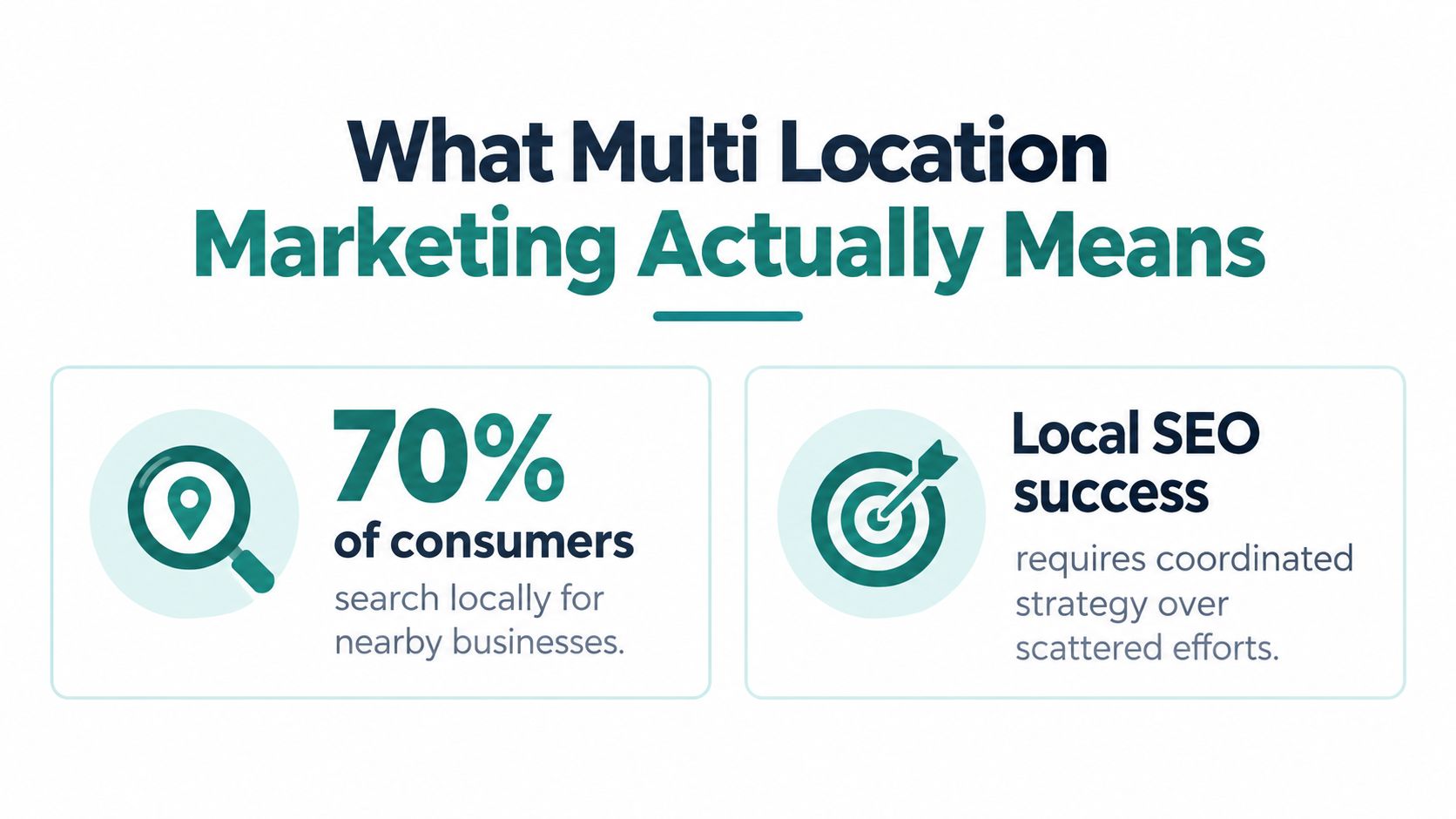
What Multi Location Marketing Actually Means
A Cincinnati service company opened a second office and assumed its original digital strategy would transfer automatically. The main website still sent every visitor to one contact page. Both Google Business Profiles displayed similar information, but one had outdated hours. Paid ads reached people across the metro area without clearly identifying the nearest office. The two managers also requested reviews independently, so no one could compare customer sentiment by location.
The company had one brand, but it didn't have one coordinated marketing system. Each office competed for attention, and neither team had a reliable view of which searches, calls, or appointments belonged to which market.
Multi location marketing means promoting one organization across distinct physical locations while preserving two things at once:
- Brand consistency: Customers should recognize the same name, promise, visual identity, and quality standard.
- Local relevance: Each branch should answer the questions people nearby ask, including where it is, when it opens, which services it provides, and how to reach it.
- Location-level accountability: Managers should be able to see whether a specific office generates calls, directions, bookings, visits, and revenue.
Local intent has historically been particularly valuable. Google research reported by Search Engine Watch found that 88% of surveyed consumers used smartphones for local searches, while 84% used computers or tablets. The same research reported that 18% of local searches led to a sale, compared with 7% of non-local searches, and that 50% of mobile local-search users visited a store, compared with 34% of computer or tablet users. Those figures are historical, but they illustrate why a generic corporate campaign can't replace accurate information for each branch.
One brand, several micro-markets
A location near downtown Cincinnati may serve different customers from one in Mason, Florence, or West Chester. Search language, competitors, commuting patterns, neighborhood references, and service expectations can vary. You shouldn't create unrelated mini-brands, but you should let each location explain its own value in language that feels locally useful.
A centralized framework makes that possible. Corporate or ownership teams control the facts and brand standards. Local managers contribute approved details about staff, availability, community involvement, and branch-specific customer needs.
For broader perspective, a franchise marketing company can provide useful examples of how franchise systems coordinate national standards with local execution. The principle applies just as well to independent Cincinnati businesses with multiple offices, clinics, stores, or service territories.
Building Your Foundation With Local SEO and Listings
Start with the information customers need before they decide to call or visit. Search engines can only connect a person with the right branch when your business data is complete, accurate, and consistent.
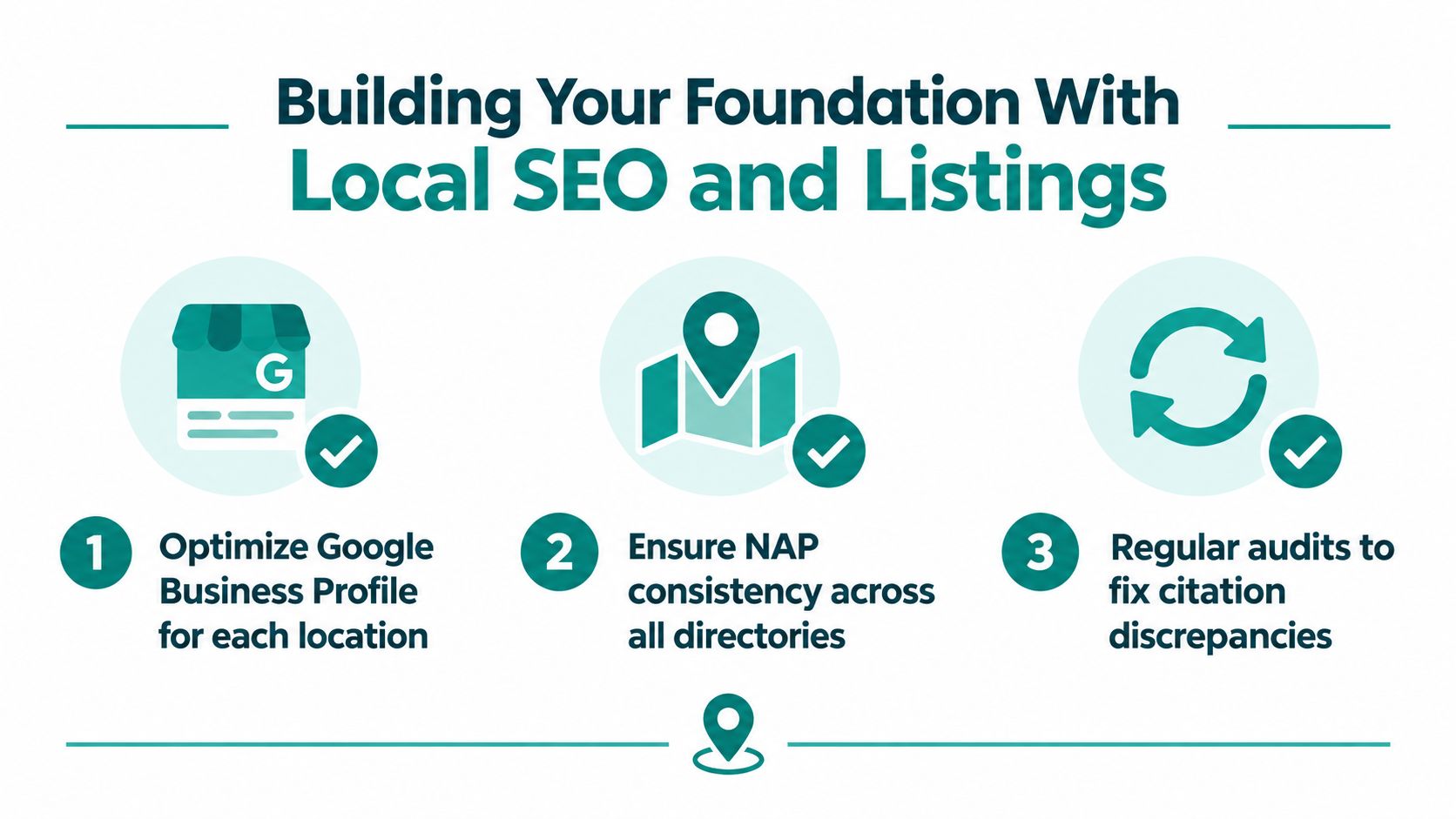
Google's official guidance says a business should maintain one Business Profile for each legitimate physical location, and duplicate profiles for the same location can create display problems in Search and Maps. Google also requires a precise real-world address and doesn't accept remote P.O. boxes or mailboxes as business locations. Review the Google Business Profile guidelines for representing your business before creating profiles for new Cincinnati-area branches.
Start with a location inventory
Create one row for every branch in a controlled spreadsheet or database. Record the official business name, street address, local phone number, hours, holiday hours, primary category, services, accessibility details, booking link, website URL, and profile owner.
Then compare those fields across:
- Google Business Profile
- Your website
- Apple Business Connect
- Bing Places
- Industry directories
- Chamber and association listings
- Major map and review platforms
Don't allow each manager to edit core facts without a defined process. A local manager may know that a branch changed its Saturday hours, but the central team still needs to update every important channel.
Claim and complete every profile
Use the same brand standards across profiles, but don't treat them as identical records. Each location needs its own photos, services, attributes, description, and customer responses. Add directions and a link to the matching location page, not the corporate homepage.
Google's local-search guidance also supports the importance of accurate addresses, hours, categories, and service information. In practice, incomplete profiles create friction at the exact moment a customer is deciding whether a visit is practical.
Audit on a schedule
An audit shouldn't happen only after a customer complains. Assign responsibility for checking high-risk fields, especially phone numbers, hours, holiday schedules, addresses, and booking links. Automated validation can flag mismatches, while a person confirms whether the change is legitimate.
Local search has a strong offline connection. Research cited by Digitaleo reported that 63% of shopping occasions began online, while another cited study found that 81% of consumers searched online before visiting a physical store. The same research reported that 72% of local searchers visited a store within five kilometers, and 78% of geolocated mobile searches resulted in an in-store purchase. These historical findings reinforce a practical point: listing accuracy isn't housekeeping. It supports the transition from digital discovery to a real visit.
Creating Location Pages That Actually Convert
A location page should do more than repeat the company name and city. It should help someone decide, quickly and confidently, whether that branch can solve their problem.
Consider two approaches. A centralized template is efficient, but a page that swaps only “Cincinnati” for “Blue Ash” can feel empty and indistinguishable from every other branch. A locally useful page keeps the brand structure while adding branch-specific evidence, directions, staff details, services, appointment availability, and nearby context.
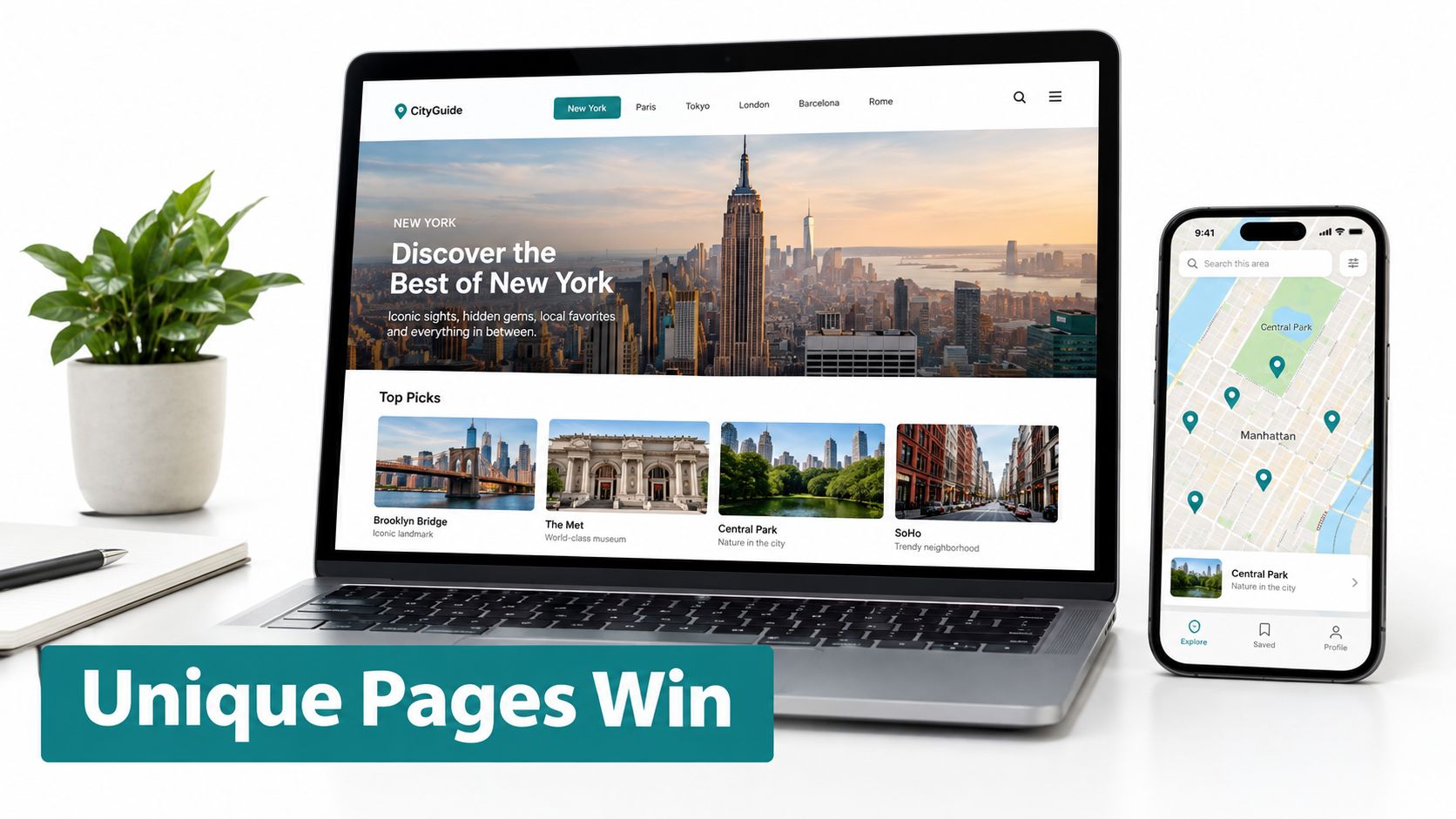
Compare the two page models
| Generic network page | Strong location page |
|---|---|
| One location directory with minimal detail | A unique, indexable page for every legitimate location |
| Corporate phone number or general contact form | Direct local phone number and location-specific action |
| Repeated copy with city names substituted | Original information about the branch and its market |
| Generic reviews and photos | Reviews, team details, images, and services tied to that location |
| Directions hidden behind several clicks | Clear map, address, parking or access details, and directions |
Give each page a stable URL structure, such as /locations/blue-ash-ohio/, and link it from a central locations hub. Connect nearby pages where that helps customers compare service areas, but don't create pages for cities where you have no real, customer-facing operation.
Google's Business Profile guidelines matter here too. A city page created only to capture a keyword isn't a substitute for a legitimate location. The page should represent an actual branch, office, or service operation and should match the business information published elsewhere.
Write for the person nearby
Use local details because they clarify the customer experience, not because they make the page longer. Explain the services available at that branch, nearby neighborhoods served, parking or access instructions, staff expertise, inventory or appointment availability, and the next step a visitor should take.
A healthcare office might explain which providers work at a Cincinnati location and how patients reach the entrance. A repair business could identify the branch serving Blue Ash and tell customers whether they should call before bringing in equipment. A professional firm may describe the office's service area and how to schedule a consultation.
The site architecture guidance for SEO can help you connect location pages to service pages, navigation, breadcrumbs, and internal links without creating a maze.
A good page also respects mobile behavior. Put the address, hours, phone number, booking button, and directions where a customer can find them without excessive scrolling. Structured data should reinforce the visible information, not introduce claims that the page doesn't support.
<iframe width="100%" style="aspect-ratio: 16 / 9;" src="https://www.youtube.com/embed/0MWgfZzRGDQ" frameborder="0" allow="autoplay; encrypted-media" allowfullscreen></iframe>Practical rule: Give every location one clear next action. If the customer needs an appointment, show the booking path. If the customer needs directions, make the map and address prominent.
Scaling Paid Media Across Different Markets
Paid media becomes more useful when you stop treating the Cincinnati region as one uniform audience. A branch with strong organic visibility may need only targeted support for a seasonal promotion. A newer location may need broader awareness before searchers know its name. An established office in a competitive area may require more careful bidding and landing-page testing.
The right budget depends on opportunity, service capacity, competition, and conversion quality. Don't divide spend evenly just because every location deserves attention. Allocate enough to learn what each market can produce, then increase support where qualified actions and revenue justify it.
Separate campaigns by location
Build campaigns or ad groups that map clearly to the branch they serve. Use geographic targeting that reflects the actual service area, exclude places you don't serve, and send each click to the matching location page.
Localized ad copy can mention:
- The neighborhood or city
- A branch-specific service
- Local appointment availability
- Parking or access information
- A nearby service area
- A direct call or booking action
Avoid forcing local language into every ad. If a customer is searching a broad service term, clarity may matter more than a neighborhood reference. For exploratory searches, educational content can help. For immediate searches such as nearby service queries, the ad should reduce distance and availability uncertainty.
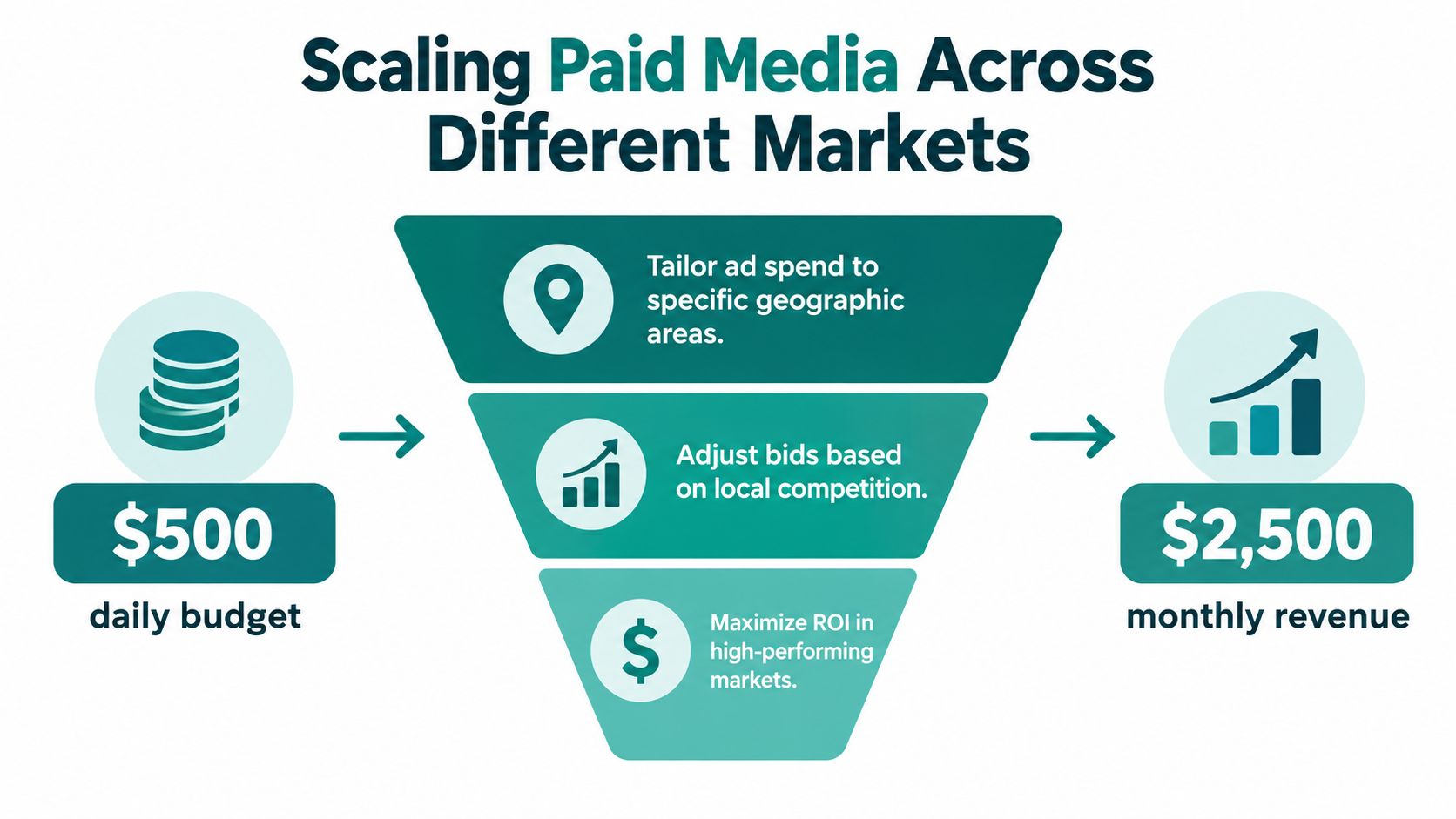
Use intent and capacity to guide spend
A location that generates many clicks but few calls may have a landing-page or offer problem. A location that produces qualified calls but can't schedule customers may need operational attention before receiving more budget. Review search terms, impression share, call quality, booking starts, completed bookings, and revenue by branch.
Local search behavior also differs by query type. A 2025 analysis summarized by Whitespark found that Google AI Overviews appeared for an average of 68% of local searches, while another study of more than 700 search results found that only 1% triggered both an AI Overview and a traditional Maps Pack. Question-based searches triggered AI Overviews 28% of the time and Maps Packs less than 1% of the time, while “near me” searches triggered Maps Packs 100% of the time and never triggered AI Overviews. These figures come from Whitespark's guide to Google's AI Mode for local businesses, and they point to separate strategies for research and immediate visits.
For paid media execution, HDM's paid media growth marketing services provide a useful reference for connecting targeting, creative, landing pages, and measurement. The important operating habit is simple: judge each market by qualified outcomes, not clicks alone.
Measuring Performance With Accurate Attribution
A network-wide report can look healthy while one branch loses demand behind the scenes. Total traffic, total leads, or total revenue doesn't tell you which location created the result or which one needs help.
Build reporting around the customer actions that matter to your business. A Cincinnati clinic may care about calls, appointment starts, completed bookings, and patient inquiries. A retailer may prioritize directions, store visits, product availability requests, and purchases. A professional-services office may track consultation forms, calls, and signed matters.
Create a location-level measurement framework
Use consistent naming for campaigns, pages, forms, and phone numbers. Then connect those identifiers to a dashboard that separates locations rather than averaging them together.
Track at least these categories:
- Discovery: Local impressions, profile views, map visibility, and branded versus non-branded searches.
- Engagement: Website visits, calls, direction requests, form starts, booking starts, and message interactions.
- Conversion: Completed appointments, qualified leads, purchases, and signed engagements.
- Business value: Revenue, service capacity, cancellation patterns, and customer quality by location.
Call tracking can identify which profile, ad, or page produced a phone lead, but use it carefully. Keep the primary business number visible and consistent where required, and make sure tracking systems don't create conflicting public information.
Connect digital actions to offline outcomes
Ask staff to record the location and source of every qualified inquiry in the CRM or point-of-sale system. Use unique booking links or campaign parameters where appropriate. Compare online actions with actual appointments, visits, purchases, or signed work.
Attribution rarely fits a single perfect rule. Someone may discover a brand through an informational search, return through a local page, click an ad, and then call later. The multi-touch attribution guide offers useful context for evaluating that sequence without assigning all credit to the final click.
Measurement principle: Report the path to the location, then verify the outcome with the location's own operational data.
Review results by branch and by market conditions. A smaller office may produce fewer leads but better-fit customers. A high-volume branch may need to improve close rates rather than generate more traffic. The dashboard should support decisions, not merely display activity.
Governance Strategies for Consistent Brand Operations
Consistency doesn't require centralizing every decision. It requires assigning ownership before problems occur.
A useful governance model separates information into three groups. Corporate or ownership teams control the facts that protect trust and compliance. Local teams adapt details that genuinely differ by branch. Shared workflows handle anything that needs review before publication.
Define ownership by field
Central standards should cover the brand name, logo, core promise, legal language, privacy statements, primary categories, and approved service claims. Location owners should maintain local hours, staff details, branch photos, service availability, community partnerships, and responses to location-specific reviews. Shared approval should apply to promotions, sensitive claims, crisis responses, and changes that affect several channels.
Put those rules in a living operating document. Assign one accountable owner to every important field, record a deadline for updates, and define an escalation path when a location misses it. A structured CMS or database is safer than a collection of disconnected spreadsheets because it can publish approved data to the website, schema, listings, and dashboards.
This structure also supports authentic local communication. A central team can protect the brand voice while a branch manager responds to a customer who had a specific experience at that branch. A generic reply may satisfy a workflow, but it rarely demonstrates that anyone understood the issue.
Treat reviews as compliance-sensitive operations
The Federal Trade Commission's Consumer Reviews and Testimonials Rule took effect on October 21, 2024, and prohibits businesses from creating, buying, selling, or distributing fake reviews. The rule also addresses undisclosed insider testimonials, reviews that misrepresent a customer's experience, and certain methods of suppressing negative feedback. The FTC announcement on the final rule explains the scope.
For every branch, invite genuine customers to review their actual experience. Don't condition an incentive on a positive review, ask staff or relatives to post undisclosed testimonials, or remove legitimate criticism because it lowers an average rating.
The FTC says businesses don't have a general duty to investigate every review, but liability can arise when a business has clear indications that purchased or fake reviews are likely and fails to investigate. The FTC's review-rule questions and answers can help shape an escalation process for unusual review clusters or suspicious activity.
A location-level review log should record who sent the request, when it was sent, which transaction it related to, and how the business responded. For additional operational ideas, 10Seat on multi-location operations provides a useful perspective on coordinating distributed teams.
Implementing Technology to Streamline Growth
Technology should remove repetitive work without removing accountability. A location database can hold the official name, address, phone number, hours, services, images, staff, links, and ownership details. An API-based publishing layer can then distribute approved changes to the website, structured data, listings, analytics events, and reporting tools.
For a small or mid-sized Cincinnati business, the stack doesn't need to be elaborate. It does need to answer four questions:
- Where is the source of truth? One approved record should define each location's core data.
- Who can change it? Permissions should match responsibility, with local access for local details and central control for sensitive fields.
- How are errors detected? Automated validation should flag inconsistent addresses, phone numbers, hours, categories, and links.
- How is performance connected? Dashboards should join visibility, calls, directions, bookings, visits, and revenue by location.
A headless CMS or structured database works well when a business manages many location pages and needs the same data in several places. Smaller organizations may begin with a carefully designed content system and a listing-management platform, then add integrations as operational complexity grows.
The same principle applies to industry-specific tools. A company comparing multi-location repair shop software should assess whether the system can connect branch scheduling, customer records, inventory, reporting, and marketing data. The best platform isn't the one with the longest feature list. It's the one that helps teams publish accurate information, act on local signals, and verify business outcomes.
AI can assist with anomaly detection, review categorization, content drafts, and workflow routing, but a person should approve claims, sensitive responses, and meaningful changes. Automation scales a good process. It also scales a careless one.
A durable multi location marketing program therefore has three connected layers: accurate location data, locally useful customer experiences, and measurement tied to business results. Build those layers in that order, and adding another Cincinnati-area location becomes a repeatable operational decision rather than a scramble.
Frequently asked questions
- What is multi-location marketing?
- Marketing that manages listings, pages, reviews and campaigns for several locations under one brand.
- How do I keep listings consistent across locations?
- Keep a single source of truth for each location's name, address, phone and hours, and update every listing from it.
- Should each location have its own landing page?
- Yes. A unique page per location helps customers and search engines find the right branch.
HDM helps Cincinnati-area businesses connect web design, SEO, paid media, analytics, custom development, and scalable content systems to location-level growth. Visit HDM to discuss a practical multi-location strategy for your branches, offices, clinics, or stores.