
A $100,000 SaaS budget rarely buys $100,000 of coding. The frontend and backend work most owners picture is only one line item. Design, testing, deployment and first-year maintenance absorb much of the rest, and that split should change how you read every proposal.
The overrun record is the reason to read closely. Legislative audits of large software projects have found that many finish well over their original estimates, and a significant share are canceled before completion. That research covers software broadly rather than SaaS alone, but the pattern is familiar: the build gets priced carefully, while the cost of running it year after year gets treated as an afterthought.
Treat the first invoice as one stage out of five. A platform you can bill customers for carries discovery, design, development, testing, launch, hosting, maintenance, compliance and eventual modernization, and those obligations continue after the code ships. Compare proposals on five-year cost and the cheapest first quote usually stops looking cheap.
Where a SaaS Development Budget Actually Goes
Start with the shape of the money rather than the headline number. A published breakdown from DevCostCalculator's SaaS cost guide allocates approximately 10% to 15% to discovery and planning, 10% to 20% to UI/UX design, 40% to 50% to frontend and backend development, 10% to 15% to quality assurance and testing, and 20% to 35% to deployment and first-year maintenance.
| Budget phase | Share of total | Amount on $100,000 |
|---|---|---|
| Discovery and planning | 10% to 15% | $10,000 to $15,000 |
| UI/UX design | 10% to 20% | $10,000 to $20,000 |
| Frontend and backend development | 40% to 50% | $40,000 to $50,000 |
| Quality assurance and testing | 10% to 15% | $10,000 to $15,000 |
| Deployment and first-year maintenance | 20% to 35% | $20,000 to $35,000 |
The ranges overlap because they're benchmarks, not a formula. A product with a familiar workflow might need less design and more testing. A regulated product might need more of both. What doesn't move is the principle: more than half the budget usually sits outside the coding hours, and a quote that only prices coding hours is pricing roughly half a product.
What each phase buys
Discovery and planning defines who the users are, what workflow they complete, and which features make the first release. Skip it and you pay for the same thinking later, at development rates, while the code gets rewritten around the answers.
UI/UX design is the look and the ease of use customers experience. Onboarding flows and dashboard layouts get decided at this stage, and a confusing screen turns into a support ticket six months later.
Frontend and backend development is the part that comes to mind first. Frontend is what users see and click. Backend is the hidden engine holding accounts, permissions, billing rules, data and integrations together, and it's the larger and less forgiving half.
Quality assurance and testing catches failures before customers do. Automated tests, manual passes and tenant isolation checks all live here, and this is the line most often trimmed to make a proposal look competitive.
Deployment and first-year maintenance covers the servers, monitoring, backups, security patches and fixes that start the day the product goes live. Launch is not the finish line. It's the point where a second, smaller bill begins.
How to read a proposal against the table
Ask the vendor to map every deliverable to those five categories, then ask which ones are missing. A proposal with no testing line and no deployment line isn't cheaper. It's incomplete, and the gap comes back as an invoice later.
If you want a second opinion on how the phases should be weighted before you sit down with anyone, TekRecruiter on engineering budget forecasts walks through the same exercise from an engineering-staffing angle.
A paid discovery phase de-risks this stage. Ours costs $1,000 and is credited toward the build, so the planning work is either the first slice of the project or a cheap way to find out the project isn't ready.
Typical SaaS Cost Ranges and the Labor Baseline
Answer the "what will this cost" question with a band, not a number. The floor is set by people. The U.S. Bureau of Labor Statistics reported a median annual wage of $134,040, or $64.44 per hour, for software developers, quality assurance analysts and testers in 2025.
Read that as a single line item. One full-time developer at the national median is more than $134,000 in direct wages before benefits, management, design, infrastructure or agency overhead. A product that needs a developer, a designer, a tester and someone managing the work for four months cannot plausibly cost $15,000, no matter what the proposal says.
The method matters as much as the rate. The COCOMO II model estimates effort by combining software size with cost drivers such as product complexity, required reliability, platform difficulty, personnel capability and schedule pressure, then converts person-months into labor cost. For a SaaS build, that means estimating separate work packages (tenant isolation, identity, billing, API design, data model, observability, deployment automation, testing, admin tooling) instead of one undifferentiated feature list.
What to ask for: three numbers from every agency, a low estimate, an expected estimate and a high estimate, each with the assumptions written underneath.
A single fixed figure with no range is a warning sign, not a bargain. So is a range with no stated assumptions, because you can't tell which end you'll land on. Use the $100,000 example as a sanity check, and if you're weighing hired help against a permanent team, LATAM salary benchmarks from Virtustant give you regional rates to compare against.
The Factors That Move Your SaaS Price
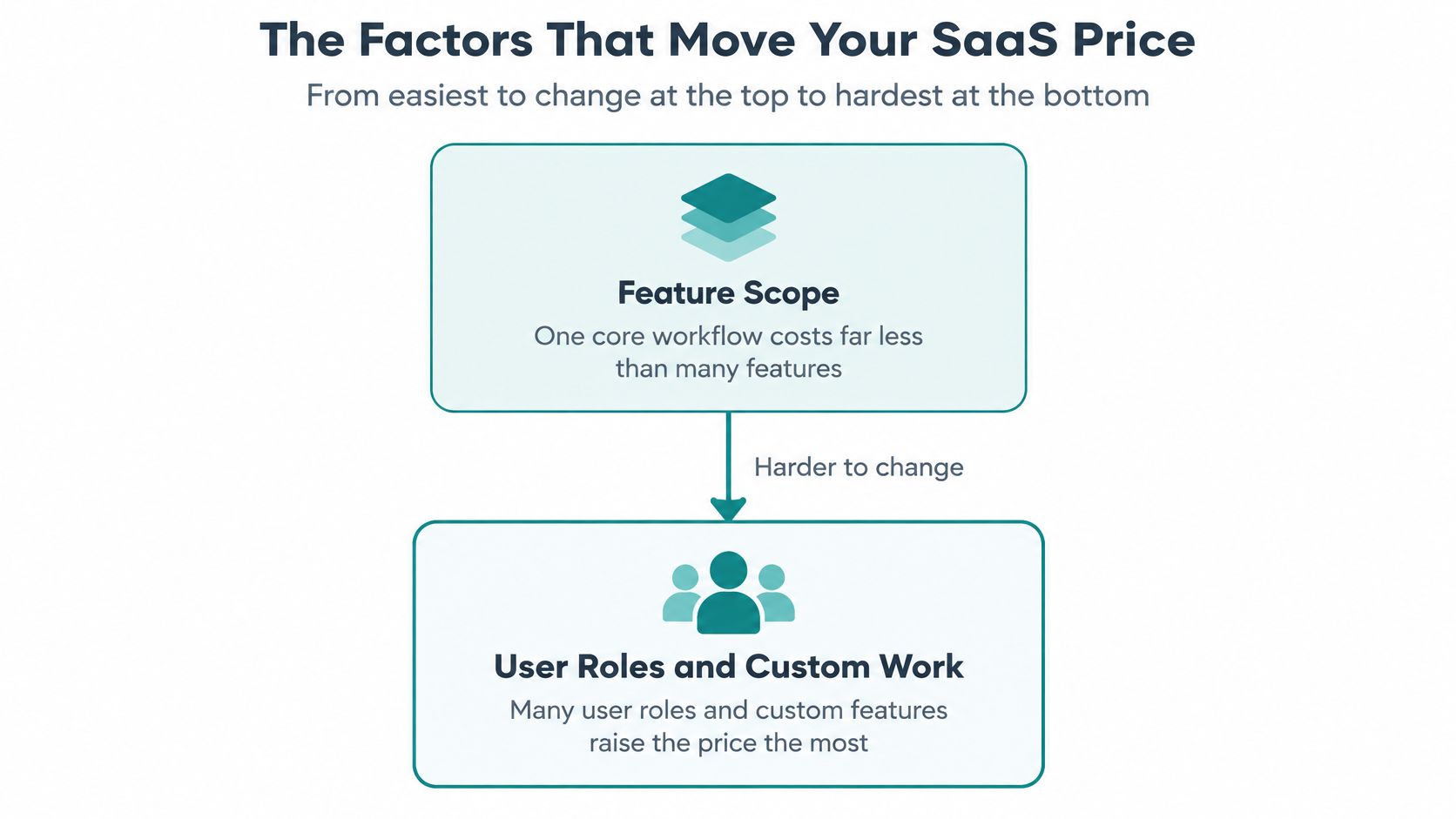
A SaaS platform isn't one product. It's a set of parts: customer logins, user roles, billing, dashboards, client portals and integrations, which is the shape of the custom web apps we build. Price moves when any one part gets bigger, and the factors sort roughly from easy to change to nearly fixed.
| Factor | Lower-cost choice | Higher-cost choice |
|---|---|---|
| Feature scope | One core workflow for one user type | Multiple user roles, custom workflows and reporting |
| Design | Template-based interface with standard components | Fully custom design with user research |
| Architecture and reliability | Standard uptime expectations | High availability and automatic failover |
| Data sensitivity and compliance | General business data | Health, payment or financial records with strict rules |
| Timeline | Standard schedule | Compressed or urgent launch |
| Team structure | Small senior team with clear roles | Many handoffs across design, development, testing and management |
Feature scope sets the floor
One core workflow for one type of user is the cheapest thing you can build that customers will pay for. Add a second user role and you've added permissions, screens, empty states and tests. Add custom reporting and you've added a query layer, exports and a whole category of support questions.
Reliability and compliance set the ceiling
Standard uptime is a single server and a backup. High availability means redundancy, failover, health checks and someone on call. Health records, payment data or financial information bring encryption, audit logs, retention rules and evidence you can hand a buyer's security team. Both raise the build and the monthly bill.
Timeline and team shape the middle
Compressing a schedule raises cost faster than the schedule shrinks, because parallel work means more coordination, more review and more rework. Team structure matters just as much: a small senior team with clear roles moves faster than a large one passing work between design, development, testing and management. If you're pricing that choice, a budgeting guide for nearshore engineering hires from GENTY recruitment breaks down what each model carries.
Price is shaped by the number of pages, custom features and integrations, design complexity, technical requirements such as e-commerce or booking systems, and timeline, which can run standard or expedited for urgent launches. AI features sit on top of all of it, adding usage-based fees that grow with customer activity rather than staying fixed.
Rank your must-have features for launch before you request a proposal, so the quote prices the smallest useful first release rather than the full wish list.
Why SaaS Budgets Overrun and How to Plan for It
Think about renovating an older house. The first wall you open reveals wiring nobody priced, and the electrician's quote was written before anyone saw it. Software behaves the same way, which is why the first estimate so rarely survives contact with the work.
The Standish Group study of 365 public- and private-sector organizations, cited in a Minnesota legislative audit, found that nearly one-third of information-systems projects were canceled before completion, and its related work put U.S. spending at more than $250 billion a year across roughly 175,000 IT application-development projects. Those are historical figures covering software broadly, not a current price list for SaaS. Their use is diagnostic: the build is one cost category, and requirements changes, integrations, security, testing, infrastructure and delayed delivery push the total past it.
Four causes account for most of the damage. Requirements move after work starts, usually because nobody wrote down what "done" meant. Integrations take longer than anyone expects, because the other vendor's documentation is wrong and their sandbox is slow. Security and testing were never in the first estimate, so they arrive as change orders. And deadlines force shortcuts, which get paid for twice, once in the shortcut and once in the repair.
Three habits that keep a budget honest
Split the budget in two. Fund a minimum viable product, the smallest version customers can use, then a separate stage for production hardening. Mixing them hides how much of the spend is optional.
Write the assumptions down. Every number in a proposal rests on something, whether that's two integrations, one user role or a fixed launch date. Unwritten assumptions can't be tested and can't be defended.
Label a reserve. Set aside a documented amount for scope changes and estimation error, and agree in writing on who approves a change and what it costs before work begins.
Then ask any agency the question that separates a partner from a vendor: what happens to the budget when the scope changes?
How Integrations, Security and Compliance Change the Math
Connections are where estimates fail. A U.S. Department of Transportation research summary covering 3,555 software projects with labor costs of at least $10 million found that only 6.4% were completed successfully, while 52% were classified as challenged because they exceeded budget, missed schedule or failed to meet user expectations. Healthcare.gov remains the cautionary example: a project whose costs rose from under $100 million to more than $1 billion because of weak estimation experience, weak technical leadership and schedule pressure.
Most SaaS products are far smaller than that. The pattern still holds whenever data is sensitive or many systems connect, because each connection is a small project with its own mapping, testing, error handling and maintenance. The first quote often prices the happy path. It rarely prices the work needed when a vendor changes a field, a token expires, a role is missed or a customer asks for an audit trail.
This is the part owners should treat as a lifetime cost decision. A cheap launch becomes expensive when access rules, integrations and security controls are handled badly and then rebuilt. A clearer scope costs more thought up front, but it gives you a better basis for comparing proposals.
The line items that hide the real work
Login and roles. Authentication is the easy part. Deciding that a regional manager sees three locations and a store manager sees one, then enforcing it on every screen and every query, is the work. Role design touches navigation, reports, exports and support requests. Skip that design and the cost returns as fixes after launch.
Monitoring and backups. You need to know the product is down before customers tell you, and you need a backup you've restored at least once. A backup that has never been tested is an assumption, not a recovery plan. Monitoring should cover the application, the database and the integration jobs that stop running without warning.
Disaster recovery and performance testing. What happens under peak concurrent load, and what happens when the database host has a bad day. These answers affect architecture, hosting choices and the size of the hardening stage. They also affect what you promise customers before the product has earned that promise.
Compliance controls. Encryption, audit logs, retention rules and access reviews, all of which need evidence, not just intent. If personal or health data is involved, the data model, logging and retention policy need to be settled before the build, not added after a surprise review.
Questions to ask before you sign anything
- How many outside systems must connect at launch? Each one has a vendor, a sandbox, an approval process and a failure mode.
- Who owns the access keys? The credentials that let your software talk to other software should be in your name, not the agency's.
- What personal or health data will you store? This single answer decides your encryption, logging and retention requirements.
- Which rules apply to you? Healthcare and financial data carry strict handling requirements, and Cincinnati healthcare and legal firms should ask any builder how it handles protected data before a quote is even discussed.
- What happens when a vendor changes their API? Someone has to maintain that connection, and it should be priced.
Architecture work sits behind the features and never appears on a demo. Our API integration services exist because that work is where integrations succeed or fail. Price architecture and security as their own line, never buried inside a feature list. For a five-year comparison, also ask which of those controls are one-time build items and which become recurring operating costs.
Ongoing Hosting and Maintenance After Launch
The build is paid once. Maintenance is paid every year, and it covers bug fixes, security updates, backups, uptime monitoring, compatibility work as browsers and services change, customer support and small improvements. Available industry estimates commonly place general software maintenance at roughly 15% to 25% of the original build cost per year, per planning benchmarks compiled by HeyNeuron, with SaaS products running higher when releases are frequent and the product is scaling.
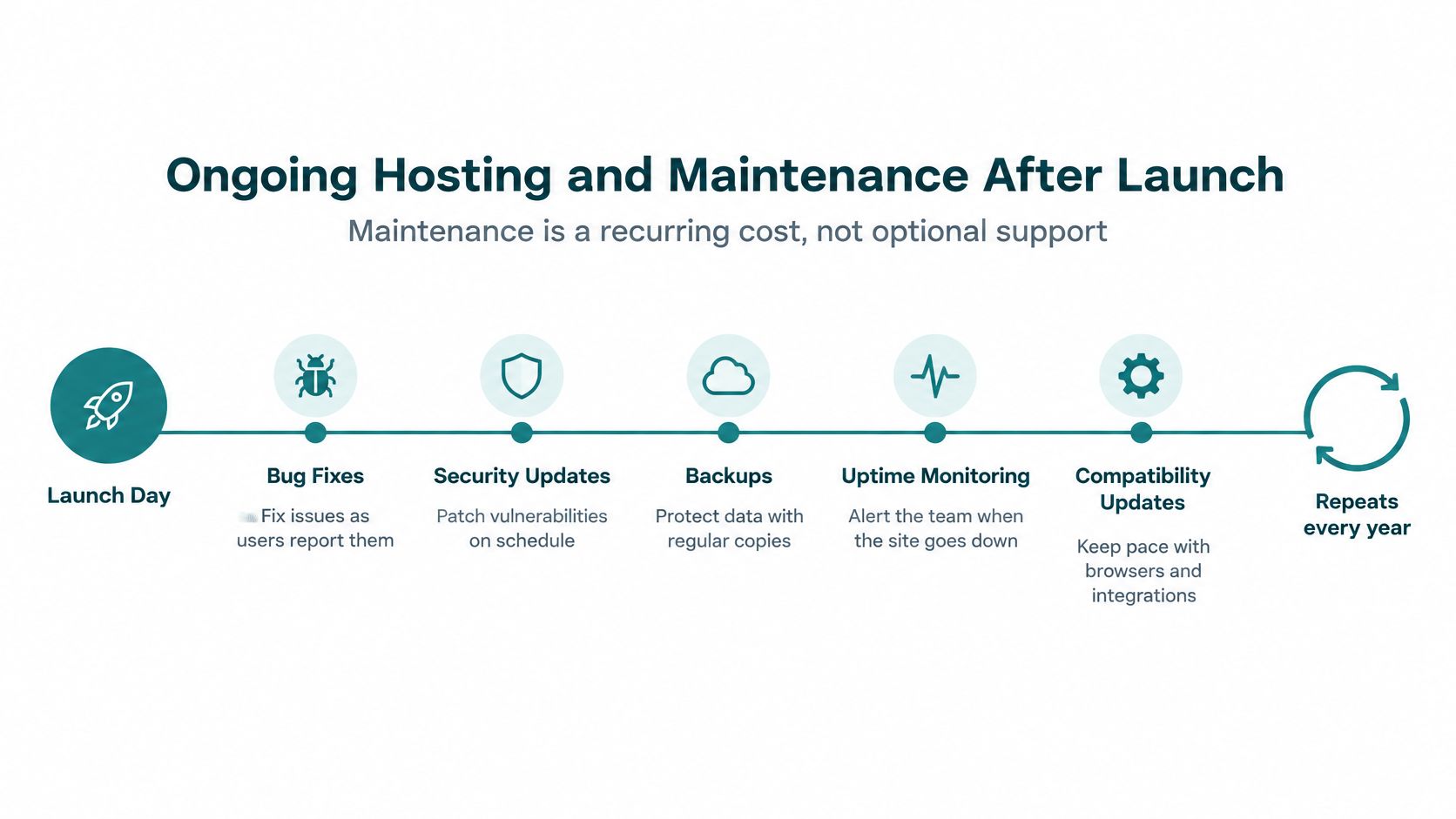
On a $200,000 platform, that benchmark implies a reserve of roughly $30,000 to $50,000 a year before unusual compliance or growth demands. One cited estimate puts SaaS maintenance at 30% to 50% of build cost annually when continuous shipping and scaling are included, which should be read as a planning benchmark rather than a universal rule.
| Cost item | Planning figure | Notes |
|---|---|---|
| Maintenance for general software | 15% to 25% of build cost per year | $30,000 to $50,000 a year on a $200,000 platform |
| Maintenance for SaaS with frequent releases and scaling | 30% to 50% of build cost per year | Planning benchmark, not a universal rule |
| Hosting | $40 per month | Confirm what the monthly fee covers |
| Care Plan, entry tier | $325 per month | Keeps the site running after launch |
| Care Plan, middle tier | $450 per month | Keeps the site running after launch |
| Care Plan, top tier | $650 per month | Keeps the site running after launch |
Two recurring bills, not one
Hosting is the second charge, and it behaves differently from maintenance. Amazon Web Services states that most of its cloud services use a pay-as-you-go model, where customers pay for the individual services they use and for the period they use them. That means your hosting bill moves with customer count, stored data, database activity, file transfers and monitoring.
The scale is bigger than most owners expect. A FinOps Foundation field guide reports that the median private B2B SaaS company spends about 5% of annual recurring revenue on hosting, and cloud infrastructure is one of the largest and most volatile components of SaaS cost.
Ask for three hosting forecasts in writing: pilot, expected growth and high usage. One number presented as permanent is a guess with a dollar sign on it.
Ask which maintenance items are billed separately, including emergency response and software dependency updates, before the first outage rather than after it.
Here's how that looks on the ground. Our website maintenance plans are structured so an owner can see what the monthly fee covers instead of discovering it during an incident.
<iframe width="100%" style="aspect-ratio: 16 / 9;" src="https://www.youtube.com/embed/ghTmHEWAwdM" frameborder="0" allow="autoplay; encrypted-media" allowfullscreen></iframe>Put a maintenance reserve into the first-year budget from day one, not from the first surprise invoice. A successful product that nobody budgeted to maintain becomes a neglected product within eighteen months.
Five-Year Total Cost Beats the Cheapest First Quote
Two owners compare quotes for the same platform. The lower one skips integration planning and automated testing to hit a number. Within a year, the first owner pays for rework on a payment connection, a security fix nobody scoped, and a rebuild of the reporting screen that was estimated at two weeks and took nine. The second owner paid more on day one and less every month after.
That's the case for total cost of ownership: the full spend across discovery and architecture, the minimum viable product, launch hardening, compliance, ongoing operations, feature evolution and eventual migration. A 2025 HFS Research survey found that more than 70% of enterprise transformation budgets went to implementation, maintenance and integration rather than new software or innovation, with surveyed organizations commonly spending 2 to 7 times more on services than on software.
The same research identified the technical-debt drivers behind that spend: poor code quality (83%), skills gaps (80%), custom-code proliferation (76%) and missing standards (74%). Every one of those is a decision made during the build and paid for during the years after it.
Run the arithmetic on a mid-sized platform. A $200,000 platform carries roughly $150,000 to $250,000 in maintenance across five years before a single new feature, a hosting bill, or a compliance review. The first build is frequently the smallest part of the five-year figure.
The comparison that matters: ask each vendor what the platform costs to own in year three, not what it costs to launch in month five.
Our senior, multi-disciplinary work is delivered at 30% to 60% of in-house team cost, which is a meaningful difference over five years and a rounding error over five weeks. Ask for that comparison on a five-year basis, with salaries, benefits, recruiting time and turnover included on the in-house side.
Then sort every line into three buckets: unavoidable, optional, and deferrable. Unavoidable means security, backups and tenant isolation. Optional means the second dashboard and the mobile app. Deferrable means single sign-on, until a buyer asks for it with a signed order in hand.
Get a Fixed-Price Proposal Before You Commit
A fixed price only means something when the scope behind it is written down. Work through these steps in order and you'll compare proposals on the same terms instead of on the size of the number at the bottom.
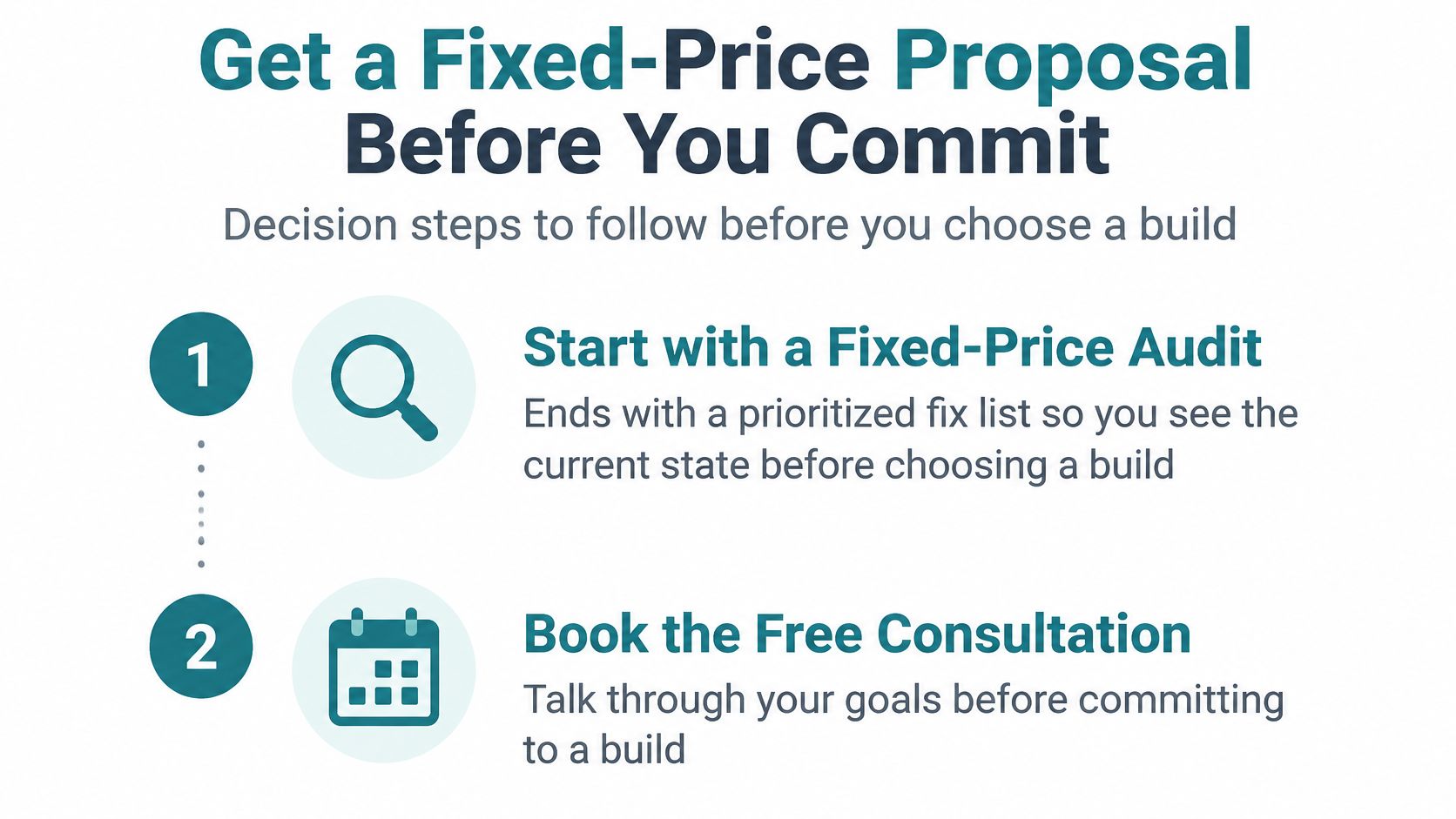
- Start with a fixed-price audit. It ends with a clear, prioritized fix list, and you can request one before choosing a rebuild, integration or app package. The mistake is commissioning a build before anyone has looked at what you already own.
- Book the free strategy call. Goals and budget get discussed before anything is priced. The mistake is arriving with a feature list and no revenue model.
- Request a detailed proposal with clear deliverables, a timeline and one fixed price agreed up front. The mistake is accepting a range with no deliverables attached to it.
- Map every line to the five budget phases. The mistake is a proposal with no testing line and no deployment line, which means both are coming later as extras.
- Separate one-time costs from recurring ones. Hosting, maintenance and third-party tools are annual, not one-off, and a proposal that blurs them understates year two.
- Write the change process into the contract. Name the reserve, the approval path and the person who signs off on scope changes. The mistake is discovering the change-request rate after the change is already built.
- Compare at least two proposals on scope and five-year cost. The mistake is comparing headline prices for two different products that happen to share a name.
If you're scoping an outsourced build, our guide to SaaS development outsourcing covers what to check about ownership, communication and handover before you commit.
The same checklist works with any provider. Fixed-price packages beat hourly billing for most owners because the price is agreed after scope, design complexity, technical requirements and timeline are defined, so the risk of a moving estimate sits with the vendor rather than with you. Helbling Digital Media is a Cincinnati-based agency, and a conversation with us is one way to run this checklist against a real proposal.
If you're planning a SaaS platform, Helbling Digital Media builds SaaS products, client portals, dashboards and integrations with scope and price agreed before the work starts. We begin with a fixed-price audit that ends in a prioritized fix list, or a paid discovery phase that's credited toward your build, so you can see the five-year picture before committing to anything. Visit Helbling Digital Media to book a free strategy call and talk through what your product should cost to build and to own.