
A Cincinnati business owner usually doesn't start by asking, "Should we outsource SaaS development?" The question sounds more like this: "We need a customer portal, subscription billing, reporting, and a mobile-friendly experience. Our internal team can't build it, and the agency we hired says the first release is almost ready. Why can't anyone explain what we own?"
Short answer: Outsourcing SaaS development means hiring an outside team to design, build and maintain your software product. Before you sign, make sure the contract spells out who owns the code, hosting and data, and how releases will be tested and handed over.
That uncertainty gets expensive fast. SaaS is not a one-time website project. It's a living product with customer data, recurring releases, integrations, security obligations, and operating costs that continue after launch. The right outsourcing partner can give you capabilities you don't have internally. The wrong arrangement can leave you paying for rework, managing avoidable risk, and trying to recover your product from a vendor who controls too much of the system.
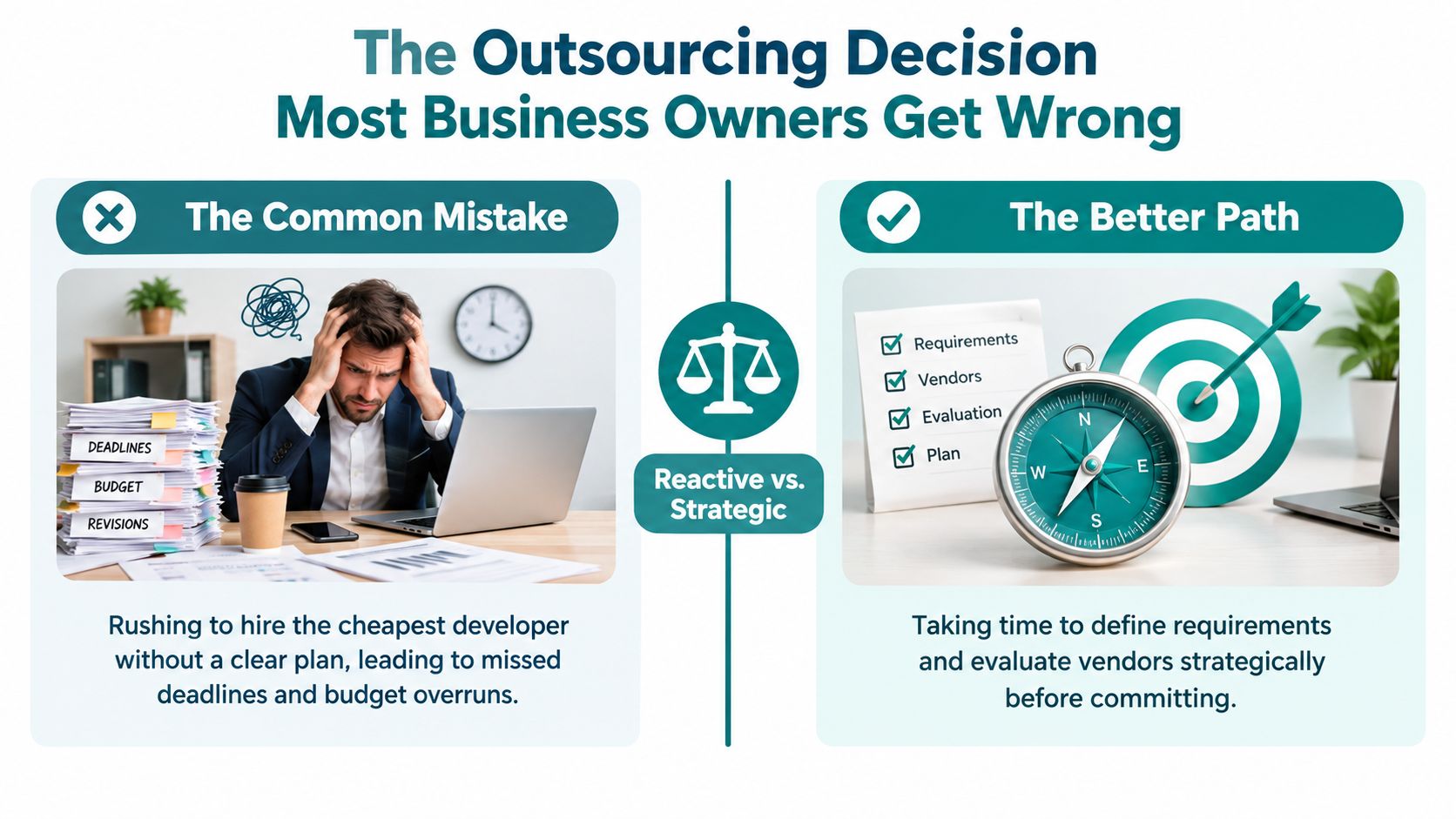
The Outsourcing Decision Most Business Owners Get Wrong
A Cincinnati-area owner recently signs a six-figure contract for a SaaS platform. The proposal promises a modern interface, automated workflows, analytics, and a launch date. A few weeks later, the owner realizes nobody clearly defined who owns the cloud account, who approves scope changes, how billing failures should work, or what happens when the vendor's team changes.
That's not a technology problem. It's a buying problem.
SaaS development outsourcing should buy capability, not just cheaper labor. You may need product planning, interface design, cloud infrastructure, integrations, quality assurance, security knowledge, or ongoing maintenance. Before contacting a vendor, answer three questions:
- What work is outside your company's strengths? Keep product ownership, customer insight, business rules, and final release approval close to the business. Outsource specialized execution when you can define the expected result.
- What measurable outcome defines success? “Build the platform” is not an outcome. A better definition includes a usable MVP, documented workflows, tested integrations, and acceptance criteria for each release.
- How much risk can you absorb? A regulated healthcare portal demands tighter controls than an internal scheduling tool. The contract, access model, and vendor review should reflect that difference.
The commercial market is large, but don't confuse market size with a guarantee of success. The broader application outsourcing market was estimated at USD 131.22 billion in 2025 and is projected to reach USD 215.46 billion by 2031, with an 8.62% CAGR from 2026 through 2031, according to Mordor Intelligence's application outsourcing market analysis. That figure includes application services beyond SaaS development, but it shows why you'll encounter many vendors with very different capabilities.
A strategic decision usually looks like this:
| Work Category | Typical Risk If Outsourced | Recommendation |
|---|---|---|
| Product vision and customer priorities | The roadmap follows vendor convenience instead of business value | Keep internal |
| Interface design and user research | Generic workflows frustrate customers | Share ownership, with internal approval |
| Core engineering and integrations | Poor technical decisions create rework | Outsource with clear technical oversight |
| Security, access, and data governance | Unmanaged exposure becomes your liability | Keep accountability internal |
| Testing, maintenance, and deployment support | Defects reach customers or releases stall | Outsource with measurable service levels |
If you're still defining what custom functionality your business needs, review what custom application development involves before asking vendors for estimates. For specialized healthcare products, a resource such as Ekipa AI healthtech engineering can also help you understand the type of domain expertise a serious provider should bring.
The first test is simple: can you explain the product, the owner of each decision, the first release, and the vendor's responsibilities on one page? If not, you're not ready to sign. You're ready for discovery.
Choosing the Right Outsourcing Model for Your SaaS
The wrong model creates friction before the first feature ships. Staff augmentation adds people. A dedicated team adds continuity. An end-to-end agency adds accountability. Those are different purchases, and business owners often choose based on price instead of operational fit.
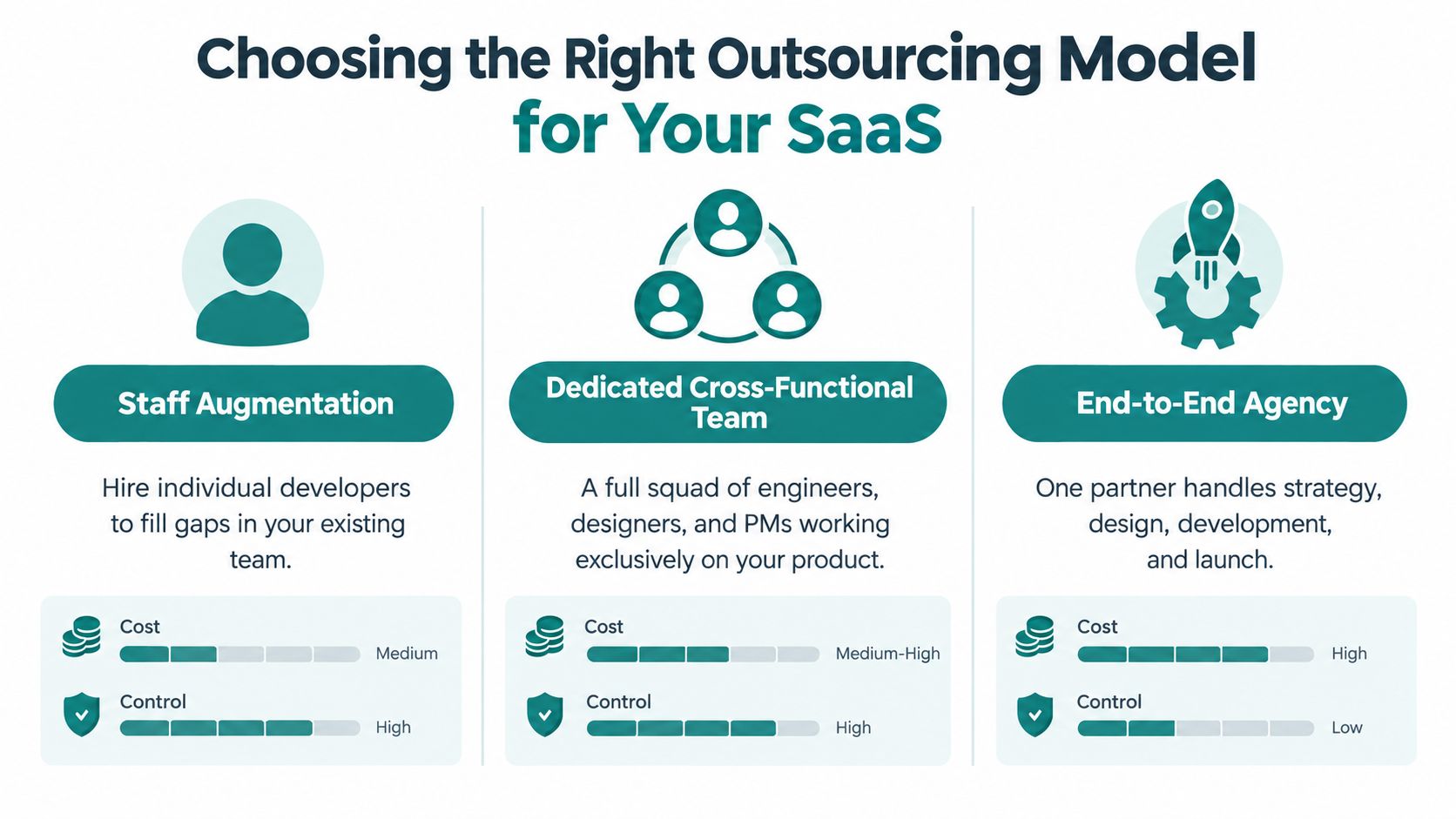
Staff augmentation works when you already have a capable product and engineering leader who can assign work, review pull requests, resolve priorities, and own delivery. It backfires when you have no internal technical team. In that situation, you're not adding capacity. You're hiring individual contributors and expecting them to invent the product plan, architecture, and delivery process for you.
A dedicated cross-functional team is usually the strongest fit for a small or mid-sized company building one or more SaaS products. The team can include engineering, design, quality assurance, and project management, while your business retains product ownership. You get continuity without building every technical role internally.
An end-to-end agency engagement makes sense when you want one partner to manage discovery, design, development, launch, and maintenance. It offers a simpler chain of accountability, but you still need an internal decision-maker. No agency can replace the owner who understands customers, pricing, operational constraints, and commercial priorities.
| Model | Who Owns the Outcome | Best For |
|---|---|---|
| Staff augmentation | Your internal product and engineering leadership | Companies with an established technical team |
| Dedicated cross-functional team | Shared ownership, with a named client product owner | Ongoing SaaS development and multiple releases |
| End-to-end agency | The agency manages delivery, while you retain business ownership | Owners seeking one accountable partner from discovery through support |
A Deloitte survey reported that roughly 60% of companies outsource at least some software development, with motivations including meeting customer demand more efficiently at 35%, optimizing spending at 34%, improving quality at 33%, and accessing specialized talent at 32%, as summarized by Deloitte software development outsourcing statistics. Those motivations point to a better question than “How do we lower the rate?” Ask, “Which capability do we need to add?”
Practical rule: If nobody on your side can make daily product decisions, don't buy staff augmentation.
A hybrid model often works well in Cincinnati. Keep product strategy, customer interviews, pricing, analytics, and final release approval internal. Let an outside team handle design execution, full-stack development, testing, cloud work, and maintenance. For more ideas on structuring the work around delivery speed, review these faster product shipping strategies. The key is naming one internal product owner and giving that person authority to make decisions.
What to Look For in a SaaS Development Vendor
A polished portfolio isn't enough. You need evidence that the vendor can operate a live product after the launch presentation is over.

Start with technical fit
Ask for examples of multi-tenant systems, recurring billing, role-based access, third-party integrations, automated testing, and production monitoring. You don't need to understand every framework. You do need to know whether the vendor has solved problems similar to yours.
Ask directly:
- What happens when one customer has a custom workflow?
- How do you prevent one tenant from seeing another tenant's data?
- How are failed subscription payments handled?
- Who owns the deployment process?
- What does your team monitor after launch?
The answers should be concrete. “We follow best practices” tells you almost nothing. A credible vendor can describe its review process, testing approach, deployment controls, and incident response without hiding behind jargon.
Verify security through evidence
Certifications can help, but they aren't a substitute for operating controls. Ask to see the vendor's secure coding policy, dependency-management process, vulnerability response procedure, access-control policy, and approach to subcontractors.
NIST recommends integrating secure development practices into existing workflows and communicating those requirements to third-party suppliers through explicit software security practices. That aligns with the broader outsourcing research, which identifies vendor reputation, service capability, the client-vendor relationship, and vendor knowledge as important risk factors, while communication problems, cultural barriers, and incompatible requirements repeatedly contribute to failure. The NIST Secure Software Development Framework recommendations provide a useful baseline for your questions.
Test communication before signing
A vendor that takes days to answer during sales will not become more responsive after receiving your deposit. Require a named product owner, written decision records, weekly demonstrations, a shared project tracker, and overlapping working hours for urgent questions.
For a Cincinnati company, local or nearshore collaboration may justify a higher rate if it reduces delays, misunderstandings, and handoff problems. Lower cost only matters if the team can understand requirements and act on them.
Give references specific questions:
- Did the vendor hit agreed milestones?
- Who made product decisions?
- How did the team handle defects?
- Did the final cost match the approved assumptions?
- Would you hire the same team again?
A vague reference is a warning. So is a vendor that won't let you speak with a former client.
The image above shows the individual focus you want from a working team. This video offers another way to think about how product teams communicate and execute:
<iframe width="100%" style="aspect-ratio: 16 / 9;" src="https://www.youtube.com/embed/tA88KArbPRU" frameborder="0" allow="autoplay; encrypted-media" allowfullscreen></iframe>Don't select the vendor with the most impressive sales presentation. Select the one that makes ownership, communication, testing, and escalation easy to verify.
Building an RFP That Actually Protects You
A casual email produces casual proposals. A short, structured request for proposal gives every vendor the same starting point and makes hidden assumptions visible before they become change orders.
Your RFP doesn't need to be long. It needs to answer the questions that affect cost, risk, and delivery.
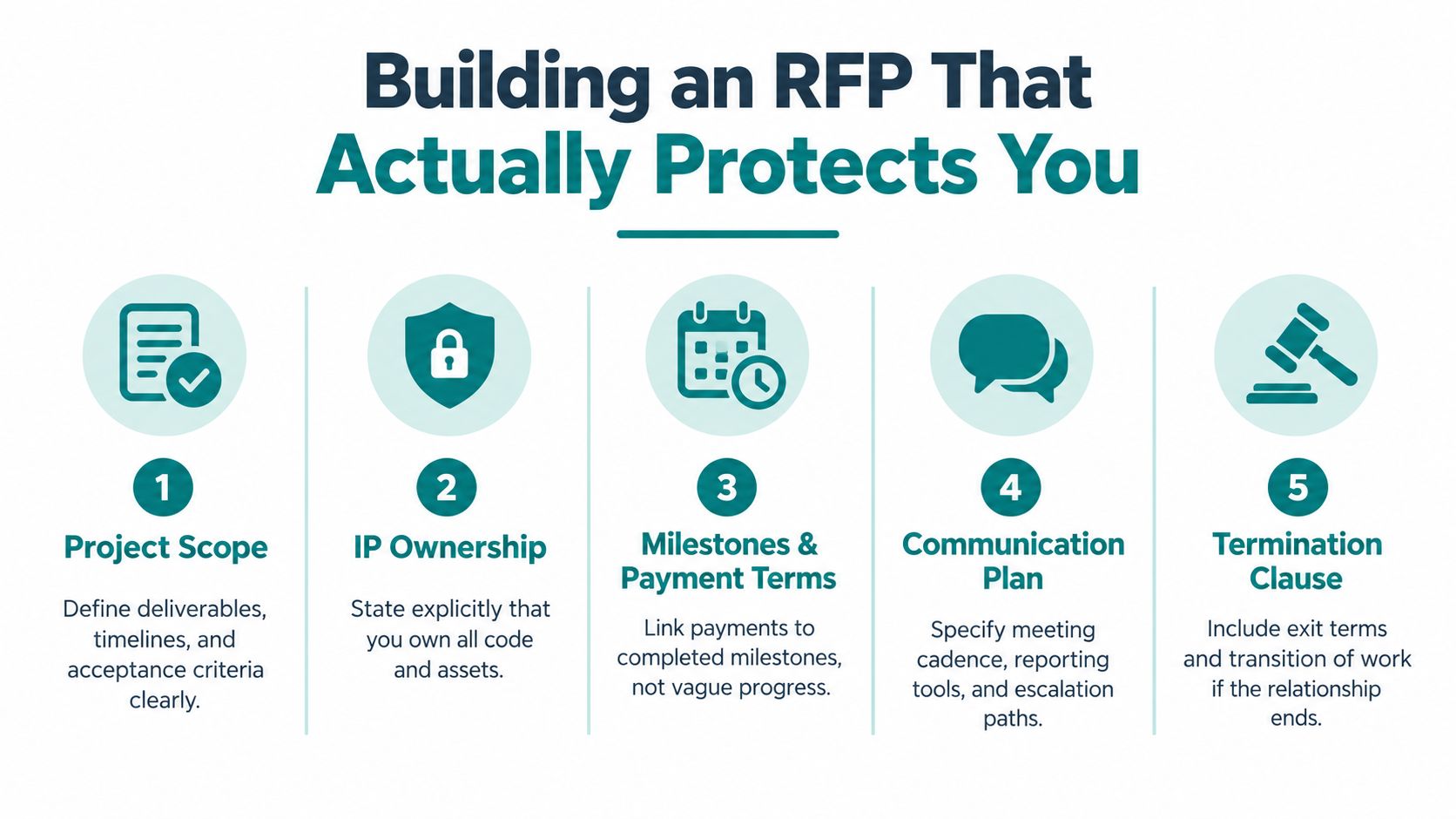
Include these sections
- Business context: Explain who uses the product, what problem it solves, and what the first release must prove.
- Functional scope: List roles, workflows, integrations, reporting needs, billing rules, and administrative requirements.
- Nonfunctional requirements: Describe expectations for speed, uptime, accessibility, security, backups, and auditability.
- Milestones: Separate discovery, architecture, MVP, testing, launch, and post-launch support.
- Acceptance criteria: Define what must be demonstrated before each milestone is approved.
- Ownership: State who owns source code, designs, documentation, repositories, cloud accounts, and data.
- Communication: Specify meeting cadence, reporting tools, working hours, escalation contacts, and decision authority.
- Exit terms: Require repository access, documentation, data portability, transition assistance, and deletion or return of confidential data.
A strong RFP also asks vendors to identify assumptions and exclusions. If an integration depends on an undocumented third-party API, the proposal should say so. If content, data cleanup, or compliance review isn't included, show it plainly.
Use a paid discovery phase when the requirements are complex. Free discovery encourages vendors to guess, and the lowest guess often wins. A paid phase can produce a prioritized backlog, technical direction, wireframes, risk register, milestone plan, and a more defensible delivery estimate.
For a broader framework on evaluating providers, this practical guide for CTOs is useful even if you aren't a CTO. The principles apply to any owner responsible for protecting budget and business continuity.
Score proposals across several categories instead of sorting by price:
| Evaluation Area | What to Check |
|---|---|
| Product understanding | Did the vendor identify the real business problem? |
| Delivery plan | Are milestones demonstrable and sequenced logically? |
| Technical approach | Does the architecture address tenancy, integrations, billing, and maintenance? |
| Security | Are controls, evidence, and responsibilities explicit? |
| Communication | Is there one owner and a practical meeting rhythm? |
| Commercial terms | Are assumptions, exclusions, rates, and change controls clear? |
The proposal that costs the least on paper can still be the most expensive if it leaves major work undefined. Require comparable scopes and acceptance criteria before comparing totals.
Security, Compliance, and IP You Cannot Hand Off
Outsourcing changes who performs the work. It does not transfer accountability for security, compliance, customer data, or intellectual property.
That distinction matters most for healthcare, legal, financial, and professional-services companies. If a vendor mishandles production credentials or exposes customer information, your customers won't care that the mistake happened outside your payroll. They'll hold your business responsible.
A 2025 third-party-risk benchmark reported that 70% of organizations experienced a security breach over the prior three years, up from 55%, and 77% of those breaches originated with a vendor or other third party, according to Chambers' technology outsourcing risk guidance. Treat your vendor as part of your software supply chain, not as temporary extra help.
Put control in the contract and the accounts
Before coding starts, confirm that your company controls:
- Source-code repositories and branch permissions
- Cloud accounts and billing ownership
- Production credentials and secrets
- Backups, logs, monitoring, and deployment records
- Customer data and export capability
- Software dependencies and build artifacts
Require least-privilege access, protected branches, peer review, automated dependency and secret scanning, vulnerability reporting, and a software bill of materials. The vendor should provide immutable build provenance where practical and document how it handles subcontractors.
For a healthcare-adjacent product, require a clear responsibility analysis and appropriate business-associate documentation when protected health information is involved. Define encryption expectations, audit-log retention, backup and recovery objectives, incident notification, and access review. A healthcare website or portal also needs an operating process, not just a statement that the project is “HIPAA compliant.”
Your agreement should cover IP assignment, confidentiality, security evidence, audit rights, insurance, liability allocation, breach obligations, data deletion or return, and transition support. Make sure your company owns custom code and design assets after payment. Don't accept a vendor-managed repository as the only copy of your product.
A practical cybersecurity best practices guide can help non-technical owners organize these controls before a vendor receives access.
The cheapest quote becomes expensive when it creates unmanaged identities, hidden subcontractors, weak integrations, or a painful exit.
That's the contrarian point many outsourcing guides miss. Security is not a procurement checkbox. It's a recurring operating cost, and the buyer remains accountable for deciding how much exposure the business can accept.
Pricing SaaS Outsourcing on Risk-Adjusted Total Cost
Hourly rate is easy to compare and often the least useful number in the proposal. The true cost includes discovery, project management, rework, security remediation, knowledge transfer, cloud setup, documentation, support, and the eventual cost of changing providers.
Published pricing compilations report average outsourced developer rates of approximately $25 to $75 per hour in Eastern Europe and Latin America, compared with roughly $100 to $200 per hour in the United States and Western Europe, as reported by software development outsourcing rate benchmarks. Those ranges can help you understand the market, but they don't tell you what your finished product will cost.
A lower hourly rate can lose its advantage when requirements are unclear, the team has limited working-hour overlap, senior engineers are unavailable, or the vendor bills separately for project management and testing. A higher local or nearshore rate may be cheaper overall if it reduces rework and keeps decisions moving.
Compare identical cost categories
Ask every vendor to separate:
- Discovery and product definition
- User experience and interface design
- Architecture and engineering
- Quality assurance and automated testing
- Security and compliance work
- Cloud infrastructure and deployment
- Project management and reporting
- Documentation and training
- Post-launch maintenance
- Transition and handoff
Then review assumptions line by line. Who supplies content? Who configures third-party accounts? Are data migrations included? What happens when an API changes? What is the change-order rate? Does unused time carry forward?
A Cincinnati owner comparing proposals should use the same scope, acceptance criteria, team composition, and support expectations for every bidder. Don't compare a full-service proposal against a development-only quote.
Calculate the cost of failure
Put a practical value on delay, customer complaints, missed sales opportunities, security fixes, and management time. You don't need a perfect financial model. You need to stop pretending that the invoice is the whole cost.
The strongest proposal may cost more per hour but require less oversight and deliver more usable work. Evaluate cost per accepted milestone, not cost per developer hour. Keep product ownership, architecture approval, data governance, and release approval close to your company. Delegate work that is specialized, testable, and reversible.
Onboarding, Delivery, and Long-Term Maintenance Without Surprises
The first two weeks establish whether the engagement will be controlled or chaotic. Give the team access to the right repositories, staging environments, design files, analytics, project documentation, cloud accounts, and communication channels. Keep production access restricted until the vendor proves it can follow your process.
Write down:
- Who owns product decisions
- Who approves technical changes
- Where requirements and decisions live
- How defects are reported and prioritized
- When demos happen
- How urgent incidents are escalated
- What evidence is required before release
Use short iterations and demonstrable increments. The Standish CHAOS 2020 dataset classified only 31% of software projects as successful, while it reported roughly 90% success for small projects versus less than 10% for large projects, according to the CHAOS report data summary. The practical lesson is straightforward: reduce the size of each decision, show working progress, and stop a weak direction before it becomes a large investment.
Acceptance tests should cover tenant isolation, role-based permissions, subscription-state changes, idempotent billing webhooks, database migration rollback, observability, and load behavior at an agreed concurrency level. Track lead time, escaped defects, deployment frequency, uptime, cloud cost per tenant, and activation or retention signals.
Use a change-control process that records the requested change, business reason, estimate, schedule impact, and approval. Silent scope expansion is how an apparently reasonable project becomes unprofitable for both sides.
Give maintenance a measurable shape
Your contract should define what happens after launch. This sample table gives you a starting point, but adapt the targets to your product and customer commitments.
| Metric | Target | Measurement Window |
|---|---|---|
| Production uptime | Agreed service objective | Monthly |
| Critical incident response | Named response period | Per incident |
| High-severity defect remediation | Agreed remediation period | Per defect |
| Security vulnerability review | Scheduled review and escalation process | Ongoing |
| Backup verification | Documented restore test | Agreed recurring interval |
| Release communication | Written change summary | Every production release |
| Support escalation | Named owner and escalation path | During support hours |
You'll find useful operational guidance in DevOps best practices, especially around repeatable deployment, monitoring, and recovery.
Plan the exit before you need it. Keep repositories and cloud accounts under your control, require current documentation and runbooks, preserve data portability, and include transition assistance in the agreement. Source-code escrow or direct repository access can prevent a vendor dispute from becoming a business interruption.
Before signing, confirm that you have a named product owner, a staged roadmap, written acceptance criteria, security obligations, IP ownership, comparable pricing assumptions, reporting cadence, service levels, and an exit plan. If any of those are missing, the contract isn't finished.
Frequently asked questions
- Who should own the code when I outsource SaaS development?
- Your business should, and the contract should say so in writing, including repositories, hosting accounts and data.
- What should I ask an outsourced development team?
- How they test releases, document the code, handle security and hand over access if the relationship ends.
- Can I start with a smaller first release?
- Yes. A focused first version lets you test the product with real users before investing in more features.
HDM helps Cincinnati-area businesses plan and build custom web applications, SaaS platforms, portals, dashboards, integrations, and ongoing digital growth programs with development, SEO, analytics, and maintenance in one engagement. If you're weighing SaaS development outsourcing, visit HDM to discuss your product requirements, delivery risks, and the right level of technical support.