If you run an MSP in Cincinnati, you've probably felt the same pattern more than once. Referrals come in waves, one networking push produces a few conversations, then the pipeline goes quiet again. Meanwhile, your team still needs steady recurring revenue, not random bursts of interest.
That's where seo for msps stops being a marketing side project and starts acting like part of your sales system. The job isn't to get traffic for the sake of traffic. The job is to get found by the business owner, office manager, or operations lead who is already looking for managed IT help, cybersecurity support, compliance guidance, or a better IT partner.
A lot of MSPs get pulled into the wrong metrics early. They chase broad keywords, publish generic blog posts, and celebrate ranking reports that don't turn into meetings. That's not a visibility problem alone. It's a strategy problem.
The Cincinnati MSPs that usually win online do a few things well. They build a fast site, create pages around high-intent services, show up locally where buyers search, and track results all the way to qualified leads and recurring revenue. That's the difference between "doing SEO" and building a search channel that supports growth.
Why SEO Is Your Most Valuable Salesperson
An MSP owner can only attend so many lunches, send so many follow-up emails, and ask for so many referrals in a quarter. At some point, growth depends on whether buyers can find you when they're ready to make a change.
That's why I like to frame SEO as a salesperson that never clocks out. Your website can answer questions, pre-qualify prospects, explain your offer, and generate inbound leads while your team is handling tickets or onboarding a client. If it's built correctly, it keeps working when you're not.
The business case is strong. SEO for MSPs delivers long-term ROI of 50-150% in year one and 300-500% in year two and beyond, compared with Google Ads at 100-200%, LinkedIn Ads at 80-150%, and cold outreach at 50-100%, according to the Technology Marketing Toolkit MSP SEO guide. That doesn't mean ads or outreach are useless. It means SEO compounds, while most outbound channels reset the moment you stop paying or pushing.
What SEO does better than referral-only growth
Referrals are valuable, but they're hard to forecast. SEO is different because it captures demand that already exists.
- It reaches buyers with intent: Someone searching for managed IT services in your market is much closer to a sales conversation than someone who casually sees an ad in a feed.
- It keeps your brand visible: Prospects often compare multiple providers before reaching out. If your site and local presence are weak, you don't make the shortlist.
- It improves lead quality: The right pages attract businesses looking for ongoing support, not one-off break-fix help.
Practical rule: If your website doesn't clearly explain who you serve, what problems you solve, and how to contact you, SEO won't rescue it. It will only send more people into a weak sales experience.
A lot of business owners hear "SEO" and think blog posts, meta tags, and technical jargon. Those things matter, but only if they support revenue. The useful way to think about SEO is simpler. It helps your MSP show up at the exact moment a buyer is comparing options.
That's also why good SEO works well alongside the rest of your marketing. It gives your referral sources something credible to send people to. It supports paid campaigns. It strengthens your sales conversations because prospects arrive more educated. If you want a broader look at how that fits into an MSP growth plan, HDM has a practical piece on digital marketing for MSPs.
What doesn't work
Some approaches fail over and over.
- Broad, vague targeting: Ranking for a term that doesn't reflect your actual service model won't help much.
- Traffic-first content: If the page attracts readers who will never buy managed services, the traffic is mostly noise.
- Treating SEO like a one-time project: Search visibility improves through consistency, not a single website refresh.
If your pipeline depends too heavily on chance, SEO gives you a way to build predictability into lead generation. That's why it matters.
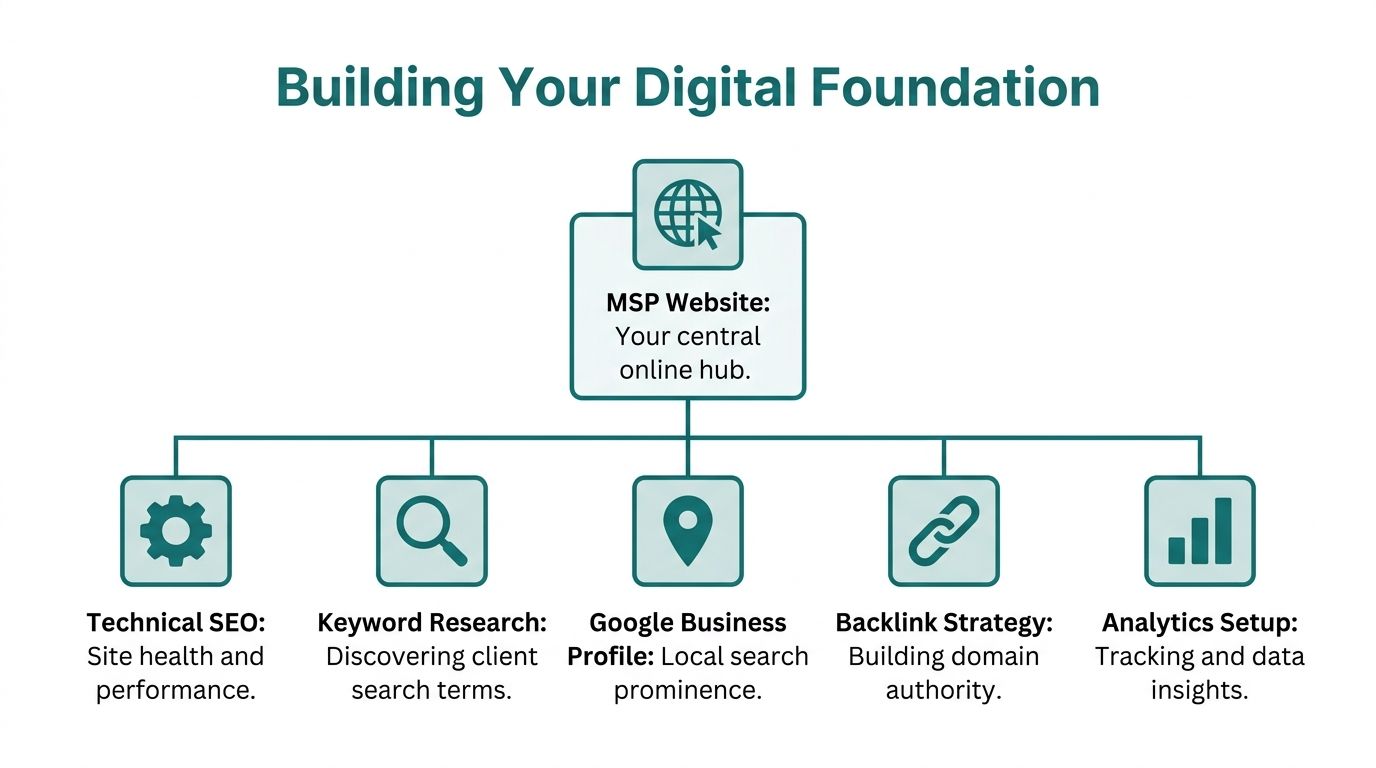
Building Your Digital Foundation
Most MSP SEO problems start before content and backlinks. They start with a weak foundation. The site either targets the wrong searches, or it creates friction once someone lands on it.
That foundation has two parts. First, you need the right keyword strategy. Second, your site has to be technically sound enough to support conversions.
Start with buying intent, not curiosity
A common mistake in seo for msps is targeting whatever looks popular in a keyword tool. That usually leads to educational topics with weak commercial value. Traffic goes up, but sales don't.
What you want instead is a page structure built around services people hire an MSP for on an ongoing basis. Think in tiers.
| Level | Focus | Example Action |
|---|---|---|
| Foundation | Core service intent | Build a page for managed IT services in Cincinnati |
| Support | Industry relevance | Add a page for healthcare IT support or legal IT support |
| Expansion | Problem-based education | Publish content that answers buyer concerns about security, compliance, or cost predictability |
Call this The MSP SEO Growth Pyramid. The base is always your money pages. If those aren't clear, the rest of the content stack won't carry much weight.
The right keyword questions to ask
Before you approve any page, ask:
- Would a decision-maker search this before hiring an MSP?
- Does this term suggest recurring service demand, not a one-time issue?
- Can this page lead naturally to a consultation or assessment?
A useful split looks like this:
- Service pages: Managed IT services, cybersecurity services, co-managed IT, cloud support
- Industry pages: IT support for healthcare practices, law firms, manufacturers, professional services
- Buyer education: Questions around compliance, budgeting, response times, vendor transitions, and risk
That structure keeps your site aligned with how businesses buy. It also reduces the common mismatch where blog content gets attention but service pages stay invisible.
If a page can't plausibly lead to a qualified sales conversation, it probably shouldn't be a priority.
Technical health matters because buyers are impatient
Now the less glamorous part. A slow, clunky website damages SEO and conversions at the same time.
Owners sometimes tune out because terms like Core Web Vitals, schema, and crawlability sound like developer language. In plain English, Google wants pages that load fast, work well on phones, and make content easy to understand. Buyers want the same thing.
If your site is slow, difficult to use, or confusing on mobile, a prospect won't wait around to decode it. They'll leave and keep searching.
What technical SEO should do for an MSP site
Your site should make these basics easy:
- Fast page loads: Service pages need to open quickly, especially on mobile.
- Clean structure: Navigation should separate services, industries, locations, and resources in a way that makes sense.
- Clear page signals: Every important page should have a distinct title, heading structure, and topic focus.
- Mobile usability: Buttons, forms, and calls to action must work cleanly on smaller screens.
- Schema markup: This helps search engines interpret your business, services, and local relevance more accurately.
You don't need to manage these details personally, but you do need to know whether your team or agency is addressing them.
A foundation checklist worth using
Here's the practical version I'd use for a Cincinnati MSP reviewing its site:
- Homepage message: Does it say who you serve, where you serve, and what kind of IT relationship you provide?
- Primary service pages: Does each core service have its own page, or is everything crammed into one generic services page?
- Industry positioning: Do your best-fit verticals have dedicated pages with language those buyers understand?
- Location relevance: Are key markets represented with useful local pages, not thin copy?
- Tracking setup: Can you tell which pages generate calls, forms, or meetings?
This is also where agencies and internal teams often diverge. Some shops focus heavily on rankings and content volume. Others address site performance, analytics, conversion flow, and technical architecture as part of the same growth system. For businesses that need both development and marketing support under one roof, HDM is one Cincinnati-area option because it combines web development, analytics, conversion work, and SEO in the same engagement.
A strong foundation won't make you dominate overnight. It does something more important. It gives every future SEO effort a chance to produce qualified leads instead of wasted motion.
Dominating the Cincinnati Market with Local SEO
If your MSP serves businesses in Cincinnati and the surrounding suburbs, local SEO is where the quickest practical wins usually happen. This is not about trying to look like a national brand. It's about becoming the obvious nearby option when someone searches for support.
Nearly 72% of service-related searches start on Google, and over 80% of users click on local results, according to the local MSP SEO analysis from MSP SEO Agency. For an MSP, that matters because local searches often signal high intent. The person searching isn't browsing industry commentary. They're looking for help.

Your Google Business Profile does more work than most MSPs realize
For local visibility, your Google Business Profile is often the first real impression a prospect gets. Before they even visit your site, they may scan your reviews, service categories, photos, hours, and business description.
A weak profile makes a strong company look small or inactive.
Here's what to tighten first:
- Business details: Make sure your name, address, phone, service areas, and website are accurate and consistent.
- Service listings: Add your core services clearly, rather than relying on a vague business description.
- Photos: Use real team, office, and brand imagery. Stock photos don't build much trust.
- Review process: Ask satisfied clients for detailed reviews that mention the type of work you performed.
- Posts and updates: Keep the profile active with short updates, offers, or educational notes.
This sounds basic because it is. But it's also where a lot of local SEO traction starts.
Think suburb by suburb, not only city-wide
Cincinnati buyers don't always search the same way. Some search for "managed IT services Cincinnati." Others search by suburb or business corridor. If you work in places like Mason, West Chester, Blue Ash, or Northern Kentucky, your website should reflect that service footprint.
The wrong way is to spin up a pile of near-duplicate location pages with only the city name swapped out. Google sees through that, and users do too.
The better way is to create useful local pages that mention:
- The service offered in that area
- The business types you commonly support there
- Relevant local context
- A clear next step for a consultation
For example, a page about managed IT services in Blue Ash should feel like it belongs to businesses operating there. It should speak to the needs of office-based companies, healthcare providers, legal practices, manufacturers, or logistics firms that operate in that market.
Local SEO works best when the page proves you understand the area, not when it just repeats the zip code.
What Google tends to reward locally
Local search visibility usually comes down to three signals people can understand without getting too technical:
| Local signal | What it means in practice | What to do |
|---|---|---|
| Relevance | Does your business match the search? | Build pages that clearly match services and industries |
| Proximity | Are you realistically close to the searcher? | Define service areas and support nearby market pages |
| Prominence | Does your business look established and trusted? | Earn reviews, local mentions, and citations |
That's why local SEO isn't just "set up a listing and wait." It's a combination of profile quality, website relevance, and local trust signals.
If you want a broader look at how local search connects with newer search behaviors, HDM has a useful SEO, AEO, and GEO ranking guide for 2026.
A practical local checklist for Cincinnati MSPs
This is the checklist I'd use if I were auditing a local MSP presence:
- Claim and fully complete the Google Business Profile
- Choose your core local service terms and match them to real pages
- Create one strong city page and a few strong suburb pages, not dozens of thin ones
- Collect detailed client reviews on an ongoing basis
- Keep your contact information consistent across the web
- Use local proof on-page, such as service area references, testimonials, and industry examples
Later in the process, this short explainer is worth a watch if you want a visual overview of how local optimization works in practice.
<iframe width="100%" style="aspect-ratio: 16 / 9;" src="https://www.youtube.com/embed/J9CdiLdTY30" frameborder="0" allow="autoplay; encrypted-media" allowfullscreen></iframe>Local SEO is one of the few parts of seo for msps where disciplined basics often beat flashy tactics. If your profile is complete, your service pages are locally relevant, and your reviews are real and specific, you can become much harder to ignore in your market.
Creating Content That Closes Deals
A lot of MSP content gets read and forgotten. It may even rank. But it doesn't move someone toward a sales call.
That usually happens for one reason. The content wasn't built around the buyer's decision process. It was built around keywords in a spreadsheet.
Many MSP blogs target high-volume keywords with little relevance to actual buyer questions, while service pages lack clarity for business decision-makers. The better approach is to build topic clusters around real buyer needs like compliance, cost predictability, and IT security, as explained in Dakota Ridge Marketing's conversion-focused MSP SEO article.

The pages that bring traffic are not always the pages that bring revenue
Many MSPs often err in this area. A blog post can attract attention from a broad audience. A service page or industry page is more likely to attract a buyer.
You need both, but they should do different jobs.
Top-of-funnel content
This helps a prospect understand a problem.
Examples include:
- Cybersecurity education: topics around phishing risk, backup planning, or security policies
- Compliance guidance: content for healthcare, legal, or regulated businesses trying to reduce risk
- Cost and planning content: articles that help owners understand what outsourced IT support should cover
These pages build trust. They also give your sales team content to send during follow-up.
Bottom-of-funnel content
Here, decisions happen.
Examples include:
- Managed IT services for Cincinnati businesses
- Co-managed IT for internal IT teams
- HIPAA-compliant IT support for healthcare practices
- IT support for law firms or professional services companies
A service page should not read like a technical brochure. It should answer the business buyer's real questions quickly.
What a strong MSP service page needs
When I review MSP websites, weak service pages usually fail in the same places. They lead with generic promises, bury the value proposition, and never explain who the service is for.
A stronger page usually includes:
- A clear headline: Say what the service is and who it helps.
- Pain-point language: Address downtime, security risk, compliance pressure, or internal IT overload.
- Scope of service: Explain what's included in practical terms.
- Industry relevance: Mention sectors you serve well and why.
- Trust elements: Reviews, certifications, case summaries, and FAQs help lower hesitation.
- A direct call to action: Make the next step obvious.
A buyer doesn't need more adjectives. They need to know whether you understand their risk, their environment, and their timeline.
Build content around real sales conversations
The best content ideas rarely come from a tool alone. They usually come from what prospects ask in calls, what stalls deals, and what creates hesitation during evaluations.
Here's a useful way to think about content mapping:
| Buyer stage | What they're thinking | Best content type |
|---|---|---|
| Awareness | We may have an IT problem | Educational blog post or guide |
| Consideration | We need to compare options | Industry page, comparison page, FAQ |
| Decision | We need the right provider | Service page, proof page, consultation CTA |
In this context, topic clusters become valuable. If one vertical matters to your MSP, create a cluster around it. For healthcare, that could include a core industry page, supporting compliance articles, security-focused posts, and FAQs about onboarding or support expectations.
If you serve professional firms, this style of vertical positioning has a lot in common with what works in SEO for professional services firms.
What content usually misses
A few things consistently underperform:
- Vendor-driven blog filler: Content copied or lightly rewritten from vendor material won't build much authority.
- Technical writing without business framing: A business owner cares about risk, cost, continuity, and accountability.
- No conversion path: If every page ends with vague language instead of a clear action, good content still leaks leads.
Good MSP content should sound like a smart advisor talking to a business owner, not like a product catalog talking to an engineer. If your content answers buyer concerns in the order they arise, it won't just attract traffic. It will help close deals.
Building Trust and Authority Across the Web
Most MSP owners hear "link building" and picture a sketchy SEO tactic from a decade ago. That's the wrong mental model.
For a local B2B company, authority usually grows from the same things that build trust offline. Relationships. Visibility. Reputation. Being involved in the business community. Getting mentioned by credible organizations that people already know.
The best links usually come from real-world activity
If your strategy is to buy random placements or chase irrelevant directory listings, you might get a few backlinks on paper. You probably won't build much authority that helps rankings or trust.
The stronger play is to earn mentions from sources that make sense for your market and your audience.
A Cincinnati MSP can build authority through:
- Chamber and association memberships: Local chambers, business groups, and industry associations often provide profile pages and event visibility.
- Local business media: Coverage in regional business publications or community outlets can support both trust and search visibility.
- Partner collaborations: Co-hosting a webinar with an accounting firm, compliance consultant, or legal partner creates content and referral opportunities.
- Vendor relationships: If your team works extensively in Microsoft 365, cybersecurity tooling, backup, or compliance platforms, case stories and partner listings can help.
- Community involvement: Sponsorships and educational events can lead to relevant mentions when handled thoughtfully.
Google tends to trust businesses that other trusted organizations already recognize.
Authority has to make sense topically
Not every mention carries the same value. If your MSP wants to rank for cybersecurity services, managed IT, co-managed IT, or vertical-specific support, it helps when the linking site is relevant to business technology, your market, or your target industry.
That's why digital PR works better than random outreach. You're not just trying to increase a number. You're trying to build a pattern of credible references around your business.
Here's a practical way to judge a link opportunity:
| Opportunity type | Why it helps | Why it may not |
|---|---|---|
| Cincinnati business organization | Relevant local credibility | Limited if the profile is incomplete or inactive |
| Industry association | Strong topical trust | Weak if your positioning doesn't match the audience |
| Vendor or partner page | Supports expertise signals | Less useful if the listing is generic |
| Low-quality directory | Easy to get | Often adds little value and clutters your profile |
Reviews are authority too
Many MSPs separate reviews from authority building. They shouldn't. Reviews shape both local trust and buyer confidence.
A short review that says "great company" is nice. A detailed review that mentions response time, project delivery, compliance support, or strategic guidance is much more useful. It helps prospects understand what working with you is like.
That's why review requests should be part of account management, not an afterthought. Ask after a successful onboarding, project completion, security improvement, or major support milestone. The best time is when the client can speak specifically about the result.
What to avoid when building authority
A few shortcuts usually backfire or waste time:
- Generic directory blasts: These can create noise without real trust.
- Irrelevant guest posts: If the audience has no connection to your services or location, the value is limited.
- Thin local sponsorship pages: If the mention is buried on a page no one visits, don't expect much.
- One-and-done outreach: Authority grows from repeated, credible signals over time.
A good off-site strategy for seo for msps looks a lot like disciplined business development. Show up in the places your buyers and partners already pay attention to. Publish something useful with other trusted organizations. Be visible where local businesses look for credible providers.
That kind of authority helps rankings, but primarily, it helps buyers feel comfortable reaching out.
From Clicks to Contracts Measuring SEO Success
The easiest way to waste money on SEO is to measure the wrong things. A ranking report can look great while sales stay flat. Traffic can rise while lead quality drops. That's why MSPs need reporting tied to pipeline, not vanity.
The numbers that matter most are the ones closest to revenue. According to Dyad Marketing's MSP SEO guidance, the key KPIs to track are keyword rankings with top-10 growth of +15% month over month, organic traffic to high-intent pages, session-to-lead conversion rates of 2-5%, and organic-sourced MRR of 20-30%.

Vanity metrics versus business metrics
Some metrics are still useful, but only as supporting indicators.
Here's the distinction that matters:
- Vanity metrics: raw traffic, impressions, total keyword count, rankings for low-value terms
- Business metrics: qualified form fills, booked calls, sales opportunities, close rates from organic leads, and recurring revenue tied back to organic search
If an agency tells you you're ranking for more terms, your next question should be simple. Are those rankings producing conversations with the types of businesses you want?
What to ask for in an SEO report
A practical MSP SEO report should show:
| Metric | Why it matters | Better question to ask |
|---|---|---|
| Rankings | Indicates visibility progress | Which service and location terms improved? |
| Organic traffic | Shows whether demand is reaching the site | Which high-intent pages gained traffic? |
| Conversion rate | Tells you if pages are persuading visitors | Which pages turn sessions into leads? |
| Organic-sourced MRR | Connects SEO to revenue | How much recurring revenue came from organic leads? |
Tools also matter. GA4, Google Search Console, Ahrefs, and SEMrush can help you understand visibility and on-site behavior. Your CRM should then connect those inquiries to opportunities and revenue. Without that handoff, SEO stays disconnected from the sales pipeline.
Rankings are an input. Revenue is the outcome.
The questions that expose weak reporting fast
If you're evaluating an SEO partner or reviewing your own internal efforts, ask these:
- How many qualified leads came from organic search last month?
- Which service pages generated those leads?
- What percentage of new recurring revenue is tied to organic?
- Are we attracting the industries and company sizes we want?
- Where does the conversion path break down?
Those questions move the conversation out of generic marketing language and into business performance.
A better way to judge progress
Good SEO progress for an MSP often looks like this:
- Service pages attract more of the right visitors.
- Local visibility improves for your target market.
- More inquiries come from companies that fit your service model.
- Sales conversations start with better-informed prospects.
- Organic search contributes meaningfully to recurring revenue.
That's a much better signal than "we published more blogs this month."
For a Cincinnati MSP owner, this is the standard worth holding. If your SEO isn't improving qualified lead flow and helping you understand where recurring revenue comes from, it needs to be reworked.
If your MSP wants a clearer path from search visibility to qualified leads, HDM helps Cincinnati-area businesses connect SEO, website performance, and analytics to real growth goals. The useful starting point is usually simple: identify the pages that should drive pipeline, fix the friction that's blocking conversions, and measure results in terms a business owner cares about.