You're probably in the same spot a lot of Cincinnati business owners hit sooner or later. Sales are decent, referrals help, your website exists, maybe you've tried Google Ads or boosted a few social posts, and now every marketing firm in town is promising "growth." One says branding. Another says SEO. Another says paid media. A fourth says you need an agency of record.
That's where the confusion starts.
When business owners ask what does an advertising agency do, they're usually not asking for a textbook definition. They want to know one practical thing. Will this team help me get more qualified customers, or am I about to pay for nice-looking campaigns that don't move revenue?
A real agency should help you connect your offer to the right audience, build the message, place it where people will see it, and track whether it worked. That's a serious business. The U.S. advertising agency industry is projected to reach $88.7 billion in 2026 according to IBISWorld's advertising agency industry outlook. There's a reason the category is that large. Good agencies do work that most companies can't or shouldn't try to piece together alone.
But the old picture of an agency is incomplete. Today, growth doesn't come from ads alone. It comes from the full system behind them. If you're comparing firms right now, it helps to look at resources that show how agencies are evolving, including SourceLoop's agency solutions for workflow and delivery support.
If your focus is revenue, not just visibility, you also need to think beyond ad placement and into the full growth stack, including SEO, paid media, analytics, and conversion work. That's the difference between buying activity and building a system. For a practical view of that broader model, look at growth marketing services.
The Growth Partner Your Business Is Missing
A lot of owners still think an advertising agency is just the team that makes commercials, designs flyers, or runs Facebook ads.
That's outdated.
A modern agency should act like an extension of your team. They should learn how your business makes money, who your best customers are, what slows down sales, and where your marketing leaks are. Then they should build and manage the pieces that help fix it.
What an advertising agency really does
At its simplest, an advertising agency helps a business plan, create, place, and measure promotional campaigns. That includes research, messaging, creative, media buying, and performance tracking.
In plain English, they answer questions like:
- Who are we trying to reach? Your best-fit customer, not everybody with a phone.
- What should we say? The message that gets attention and earns a response.
- Where should we say it? Search, social, video, email, radio, display, print, or a mix.
- Did it work? Leads, calls, form fills, purchases, booked appointments.
That's the baseline.
Why business owners get frustrated
The problem isn't that agencies do nothing. The problem is that many stop too early. They'll launch campaigns, send a monthly report, and call it strategy. Meanwhile your website loads slowly, the landing page is confusing, your forms break on mobile, and sales staff are chasing weak leads.
Practical rule: If the agency can't explain how clicks turn into closed business, they're only handling part of the job.
For a Cincinnati-area business, that gap gets expensive fast. You don't need more jargon. You need someone who can look at your marketing the same way you look at operations. What's working, what's wasting money, and what needs to be fixed first.
The standard you should expect
A good partner should do three things well:
- Clarify the strategy
- Execute the campaign
- Tighten the path to revenue
That third one is where many firms fall short. It's also where integrated digital partners stand apart. If you're trying to grow online, you're not hiring a vendor to "run some ads." You're choosing who gets to influence demand, customer acquisition, and your digital sales process.
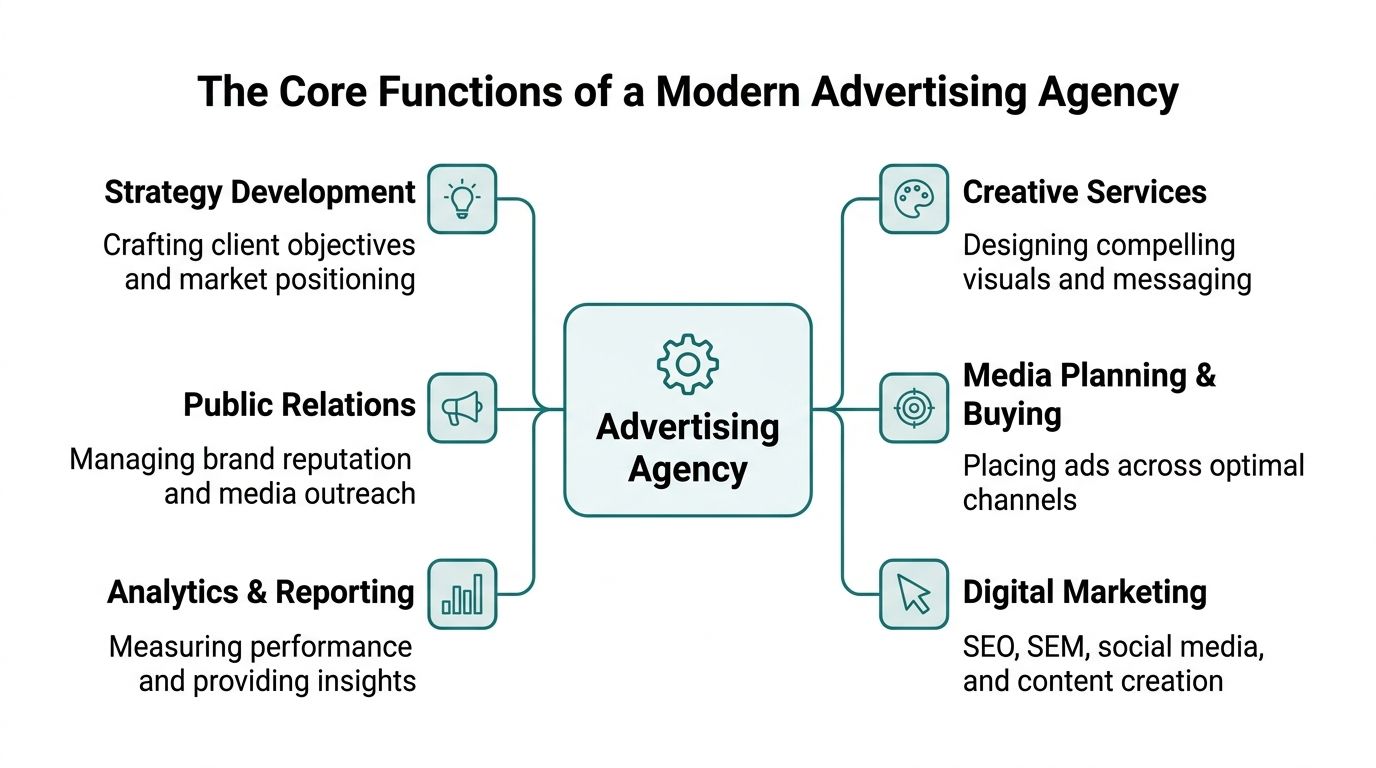
The Core Functions of a Modern Agency
Think of a good agency like a general contractor for growth. You have the business goal. More leads, better customers, stronger visibility, higher revenue. The agency coordinates the specialists needed to get there.
One useful summary is that agencies typically deliver five distinct service categories: market research, planning and budgeting, selecting media, coordinating multichannel campaigns, and integrating marketing efforts across departments, as outlined in Upwork's advertising agency basics guide.
Strategy and research
The serious work begins. Before anyone designs an ad, a competent agency should figure out who you're targeting, what problem you solve, how buyers compare you to alternatives, and which channels fit your budget and sales cycle.
For a local service business, that might mean understanding whether people search by problem, by brand, or by urgency. For an e-commerce company, it might mean mapping product categories to audience intent and seasonality.
Deliverables here often include:
- Audience definition with real customer segments
- Offer positioning so the message is clear
- Channel recommendations based on buying behavior
- Budget planning that matches business priorities
If an agency skips this and jumps straight to creative, you're paying for decoration before direction.
Creative services
Creative is the part most owners picture first. Ad copy. Graphics. Video. Landing page messaging. Brand visuals.
Good creative does not mean "looks expensive." It means the ad makes the right person stop, understand the offer, and take the next step.
A strong agency creative team usually handles:
| Function | What it produces |
|---|---|
| Copywriting | Headlines, ad text, calls to action |
| Design | Display ads, social graphics, layouts |
| Video and motion | Short-form ads, explainers, campaign assets |
| Landing page messaging | Clear pages that match the ad promise |
Good creative earns attention. Better creative matches the sales intent behind the click.
Media planning and buying
Agencies are responsible for deciding where the campaign should run and how money gets allocated. That can include search ads, display, social, video, streaming, radio, print, billboards, or direct marketing.
The point isn't to be everywhere. The point is to put budget where buyers are most likely to respond.
Some agencies are especially strong here. They know how to structure campaigns, manage placements, negotiate media, and shift spend when one channel outperforms another. That matters because wasted media dollars disappear fast.
Analytics and reporting
A modern agency should be obsessive about what happens after launch. Reporting isn't a PDF full of vanity charts. It should show what was spent, what happened, what changed, and what decision comes next.
Look for reporting that answers:
- What did we launch?
- Which messages and channels produced qualified action?
- Where did users drop off?
- What gets changed this month based on performance?
Digital execution beyond the ad
Many business owners often need to broaden their perspective. Today's agency world also includes SEO, content, landing pages, user experience, and conversion tracking. If the ad is the invitation, the website is the actual sales environment.
That's why digital execution can't sit in a separate silo anymore.
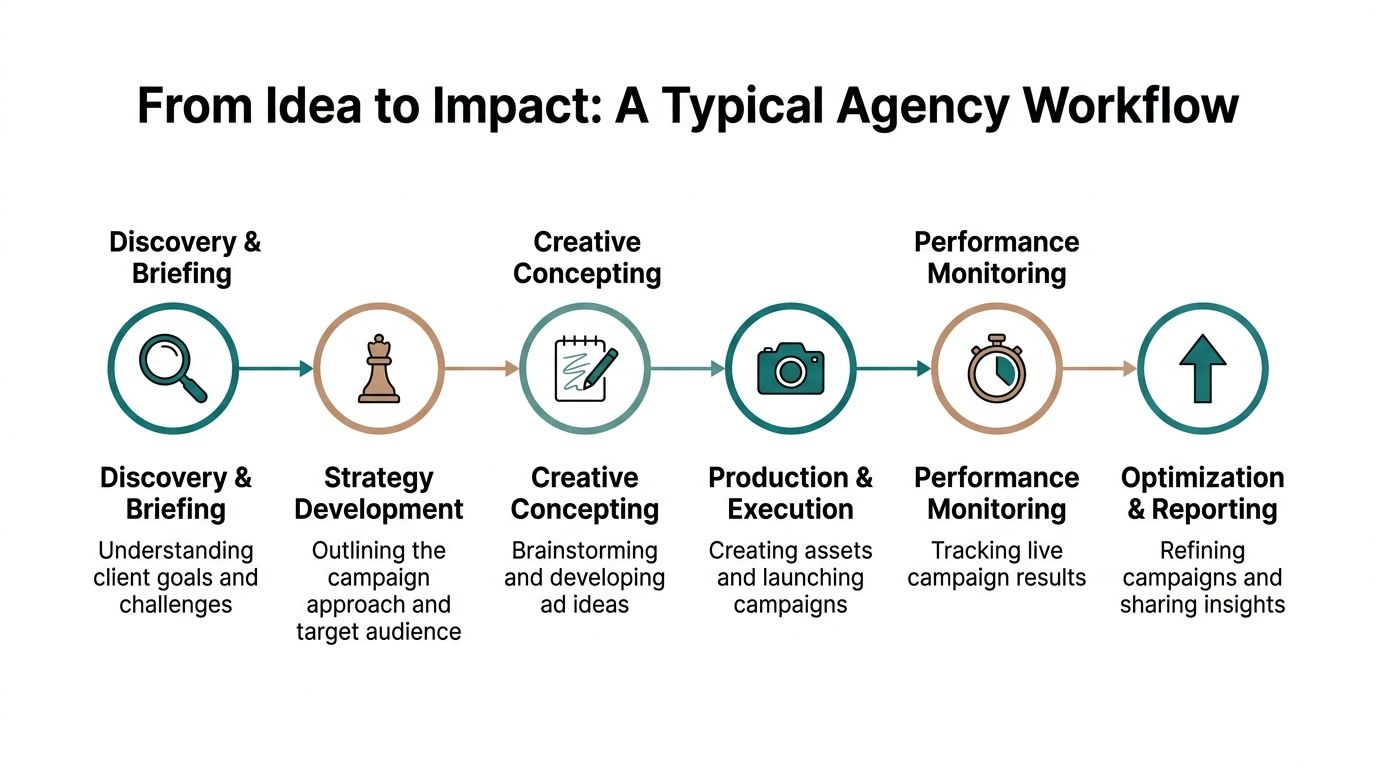
From Idea to Impact A Typical Agency Workflow
Most business owners don't need a theory lesson. They need to know what working with an agency feels like.
A typical engagement starts with a conversation that sounds simple on the surface. You say you need more leads, better website traffic, or stronger online visibility. The agency asks about your market, margins, sales cycle, past campaigns, and what counts as a win.
The day-to-day mechanics are pretty standard. Agencies create plans, map execution, communicate for approvals, perform quality assurance, and monitor campaign results while reporting back to the client, as described in ReportGarden's breakdown of agency duties.
Discovery and briefing
Let's say you run a Cincinnati-area law firm, medical practice, manufacturer, or home services business. In the first phase, the agency should dig into things that matter.
Not just "Who's your target audience?" That question is too vague on its own.
They should ask:
- Where do your best leads come from now?
- Which services have the best margins?
- What happens after someone fills out a form or calls?
- Do you need leads, sales, booked consults, store purchases, or brand lift?
That first phase should produce a brief. Not a fluffy document. A working plan the team can build from.
Strategy and concepting
Once the inputs are clear, the agency turns business goals into campaign logic, sorting out targeting, offers, budget splits, landing page direction, and tracking plans.
If the agency is organized, you'll see a process. If they're sloppy, you'll get a stream of random ideas and no clear priorities.
For owners who want a clearer picture of how mature teams handle process, streamlining marketing agency workflows is a useful reference.
The smoothest agency relationships happen when both sides know who approves what, by when, and against which business goal.
Production and launch
Strategy turns into assets. Ads get written. Graphics get built. Landing pages get designed or updated. Tracking gets installed. Audiences and placements are configured.
Then the campaign goes live.
This part tends to look exciting from the outside, but it's mostly operational discipline. Strong teams catch broken links, mobile layout issues, missing tracking events, approval bottlenecks, and budget errors before they hit your market.
Monitoring and optimization
The first launch is never the final answer. It's the first clean test.
That's why good agencies keep adjusting after launch. They watch which headlines pull, which keywords convert, where bounce happens, and whether your lead quality matches what sales needs.
A healthy workflow usually looks like this:
- Launch carefully with clear tracking in place
- Review early data without overreacting
- Refine creative and targeting based on actual behavior
- Report clearly so the client knows what changed and why
Your role as the client
You're not supposed to run the campaign. But you do need to stay involved where your insight matters.
Your best contribution is usually:
- Fast approvals so momentum doesn't die
- Honest sales feedback on lead quality
- Operational clarity about capacity and priorities
- Business context the agency can't guess on its own
When both sides do their job, marketing stops feeling random and starts acting like a managed growth function.
Understanding Agency Pricing and Measuring ROI
Every owner asks the same question first. What's this going to cost me?
Fair question. But it's not the best first filter. The better question is whether the agency's pricing model matches the kind of work you need.

Modern agencies are also shifting how they judge success. Operational KPIs are increasingly focused on conversions rather than impressions, according to Resource Guru's look at agency operations. That's a good thing. Impressions don't pay payroll. Conversions can.
The three pricing models you'll see most
Here's the short version.
| Pricing model | Best fit | Watch out for |
|---|---|---|
| Monthly retainer | Ongoing campaigns, SEO, paid media, reporting | Vague scopes and bloated meetings |
| Project fee | Website builds, brand work, landing page packages | Scope creep and unclear handoff |
| Performance-based arrangement | Lead generation or tightly tracked acquisition work | Misaligned incentives if quality controls are weak |
A retainer works when you need ongoing strategy and execution. That's common for SEO, paid media, content, analytics, and conversion work.
A project fee makes sense when there's a defined deliverable, like a website redesign, a landing page build, or a campaign launch package.
A performance-based structure sounds attractive, but owners should be careful. If the agreement only rewards volume, not lead quality or sales fit, you can end up buying bad leads faster.
What ROI should actually mean
A lot of reports still bury owners in activity metrics. Clicks. Reach. Views. Likes. Those aren't useless, but they're not the scoreboard.
The useful questions are more direct:
- How much did it cost to generate a qualified lead?
- How many leads turned into customers?
- What channels produced revenue, not just traffic?
- What part of the funnel needs work next?
If the agency can't connect campaign spend to pipeline quality, booked business, or sales outcomes, you don't have ROI. You have motion.
For owners comparing firms, this breakdown of digital marketing agency cost considerations is a practical way to think through scope and pricing.
What to ask before you sign
Don't just ask for a proposal. Ask for operating clarity.
- What is included each month? You want deliverables, not broad promises.
- Who does the work? Senior strategist, account manager, freelancers, or a mix.
- How is success measured? If they can't answer clearly, walk away.
- What happens if performance stalls? You need a response plan, not excuses.
Here's a helpful plain-language overview that many owners find easier to digest before meetings with agencies.
My recommendation
For most small and mid-sized businesses, start with a scoped engagement tied to business outcomes. Keep the reporting simple. Demand clean attribution where possible. And judge the partner by how clearly they connect spend to revenue behavior.
The Critical Gap Most Ad Agencies Wont Mention
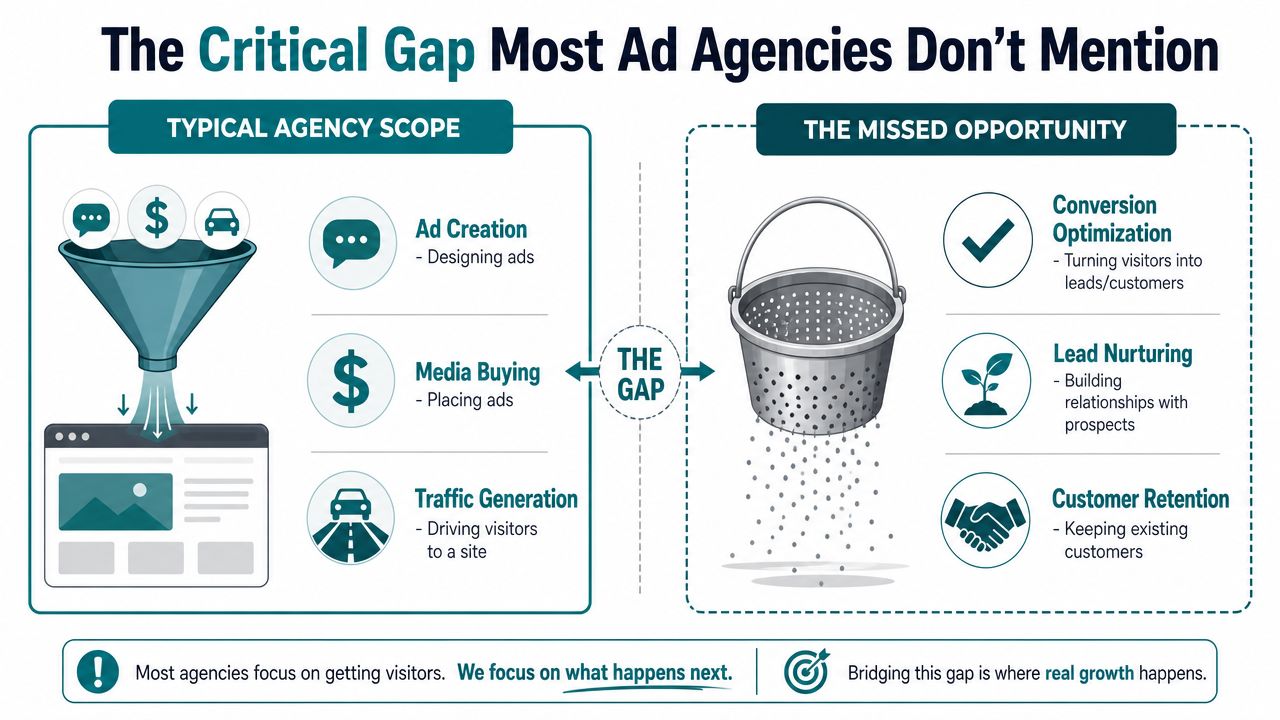
Here's the blunt truth. Most ad agencies are good at getting attention. Far fewer are good at handling what happens after the click.
That gap is bigger than most owners realize. Data cited by Perion shows 78% of agency leaders name media complexity and technical integration as top client pain points, while 65% of public agency service descriptions still omit development capabilities entirely in Perion's ad agency glossary.
That should tell you something.
Traffic is not revenue
An ad can drive a visitor to your site. That does not mean the campaign worked.
If the page is slow, the form is clunky, the mobile experience is weak, or the offer is buried, the click dies there. You paid for interest and built no path for action.
This is the last-mile problem. Traditional agencies often own the front half.
- They create the ad
- They buy the media
- They drive traffic
But the business still needs the second half.
- A landing page that converts
- A website architecture that supports SEO
- A checkout or lead flow that doesn't frustrate people
- Tracking that shows what happened after the visit
- A CRM or follow-up sequence that helps sales close
Without that, you're buying visitors for a broken experience.
If your website can't convert the traffic, your ad budget is subsidizing your weaknesses.
Why this hits some industries harder
If you run a healthcare practice, law firm, or e-commerce business, this issue gets even sharper.
Healthcare sites may need compliant forms, structured patient journeys, and careful handling of private information. Law firms need intake flows that are simple, fast, and credible. E-commerce brands need product pages, carts, checkout logic, and post-purchase flows that don't leak sales.
An agency that only knows media buying won't solve those problems.
What an integrated partner looks like
My strong opinion is this: If you need serious online growth, don't hire separate vendors who barely talk to each other. Don't let one firm run ads, another patch the website, and a third try to make sense of reporting after the fact.
Use an integrated partner when the business depends on digital acquisition.
That means one team, or one tightly aligned setup, can handle:
| Need | Why it matters |
|---|---|
| Web design and development | The site has to support action, not just look nice |
| SEO structure | Organic visibility depends on technical and content decisions |
| Paid media landing pages | Ad traffic needs a focused destination |
| Analytics and tracking | You need clean feedback, not guesses |
| Conversion optimization | Small user-experience fixes often improve business results |
| App or portal development | Some businesses need custom functionality, not templates |
One practical example in this category is HDM, a Cincinnati-area digital agency that handles strategy, development, SEO, paid media, analytics, and custom web work in one operating model. That matters when your business needs both customer acquisition and the technical infrastructure behind it.
The trade-off owners should understand
A specialist media shop may outperform on pure campaign execution in some cases. That's real. But if they stop at traffic and hand off everything else, you need the internal team or second partner to close the loop.
For many SMBs, that setup creates delays, finger-pointing, and lost opportunities.
The fix is simple. Ask every agency one direct question.
After you drive traffic, who owns the website, landing page performance, tracking, and conversion path?
If the answer is fuzzy, the risk is yours.
How to Choose the Right Agency for Your Business
By now, the better question isn't just what does an advertising agency do. It's which one can help your business grow without wasting six months.
Most firms sound competent on a sales call. The right questions expose the difference between a vendor and a real partner.
Ask these questions in every agency meeting
Use this checklist and listen carefully to how they answer.
- How do you define success for a business like mine? If they jump straight to traffic, push deeper.
- What do you need from us in the first 30 days? Strong teams have a process.
- Who handles strategy, and who handles execution? You want to know whether senior people stay involved.
- Can you improve the website or landing pages if conversion is weak? This question reveals the gap fast.
- How do you use AI in your work? Not for buzzwords. For better decisions, workflow efficiency, and stronger customer experience.
- What happens if lead quality drops? Good partners adjust targeting, messaging, and post-click experience.
- How do you report results in plain English? If they hide behind dashboards, that's a warning.
A lot of agency content still hasn't caught up to the AI shift. According to Backtracks on the changing value of advertising agencies, only 12% of agency-focused content discusses how AI changes the value proposition from task execution to strategic AI consulting. That matters because owners don't need another shop that just produces deliverables faster. They need a partner that knows where automation helps and where judgment still matters.
Look for a thinking partner, not a task list
You want a team that can challenge your assumptions, not just take orders.
If you say you need more leads, they should ask whether you need better conversion, better follow-up, stronger positioning, or a different audience mix. If you say you need video, they should explain where video fits in the funnel. If video is part of your plan, these expert video agency recommendations can help you compare options more intelligently.
My advice for Cincinnati-area owners
Pick the agency that understands your business model, speaks plainly, and can connect marketing to the rest of your digital operation. That includes the site, the funnel, the tracking, and the sales handoff.
If you want a structured way to evaluate options, this guide on how to choose a digital marketing agency is worth reviewing before you start signing proposals.
The best agency relationship should feel like adding operating capacity, not adding noise.
If you want a partner that can handle strategy, paid media, SEO, web development, and the technical work that turns traffic into leads or sales, take a look at HDM. They work with businesses across the Greater Cincinnati area and help connect marketing execution to the website and systems behind it, which is usually where growth either compounds or stalls.