

A digital marketing firm is an external growth team that plans, executes, and measures online marketing across SEO, paid media, content, websites, and analytics. In 2026, digital advertising represents roughly 73% of global media spend, with estimates placing the market at about $740 billion. Digital Applied's 2026 industry summary puts that scale in perspective.
You may be sitting in your Cincinnati office looking at a website that hasn't changed in years, a phone that rings less often, and an advertising invoice that doesn't clearly connect to new business. Your marketing may be active, but activity isn't the same as growth.
The right firm gives you more than ads, blog posts, or a redesigned homepage. It connects your business goals, customer experience, marketing channels, tracking, and sales process so you can make better decisions about where money and attention should go.
What a Digital Marketing Firm Actually Does
A digital marketing firm is an outside team responsible for helping a business attract, convert, and retain customers online. That work can include search engine optimization, paid search, social media, content, email, website development, conversion improvement, and measurement.
The important word is responsible. A vendor may deliver a landing page or launch a campaign. A growth partner asks whether the page generated qualified inquiries, whether the campaign reached profitable customers, and whether the sales team could follow up effectively.
The Cincinnati business problem
A typical owner doesn't need more disconnected tactics. You need answers to practical questions:
- Where are qualified prospects coming from?
- Why do visitors leave without contacting you?
- Which marketing investment creates profitable customers?
- What should be fixed before spending more?
A freelancer can be excellent at one discipline. An in-house marketer can understand your company well. A firm earns its place when it combines strategic direction with specialists who can execute across connected parts of the customer journey.
That means the SEO specialist understands the landing page. The paid media manager sees the conversion data. The developer can fix the form or tracking issue blocking performance. The account lead can explain the effect on your pipeline in plain English.
From task provider to operating partner
Digital marketing firms grew alongside search engines, social platforms, and mobile browsing. The market's expansion reflects a broader change in how people discover and evaluate businesses. NewMedia's digital marketing statistics overview describes mobile advertising as a projected $495 billion market in 2026 and worldwide search advertising as forecast to exceed $250 billion that year.
That environment makes isolated execution less useful. A firm that only buys clicks may send traffic to a weak website. A firm that only builds websites may leave the new site invisible. A firm that only publishes content may never connect that content to leads or sales.
A proper engagement connects three layers:
- Positioning, what you sell and why a prospect should care.
- Demand generation, how people find and evaluate you.
- Conversion and retention, what turns interest into revenue and repeat business.
Practical rule: If the firm can't explain how its work affects your sales process or profit model, it's selling deliverables instead of growth.
For a plain-language explanation of the broader agency role, see what an advertising agency does. The distinction matters because your firm should operate close enough to your P&L to challenge weak assumptions, not ship monthly tasks.
Core Services and Deliverables
A capable digital marketing firm usually organizes its work into three connected phases: strategy, build, and growth. This structure helps a business owner see why a campaign may need foundational work before it can produce reliable results.
Strategy
Strategy determines where the firm should focus. It may include customer and competitor research, market positioning, customer journey mapping, offer development, channel selection, and a measurement plan.
The output should be usable, not decorative. You should understand which audiences matter, what message the company will lead with, which pages or offers support that message, and how the firm will judge progress.
Build
Build work creates the assets and infrastructure that marketing depends on. That can include:
- Website design and development, including mobile-friendly page layouts and clear conversion paths.
- Landing pages, built for specific services, locations, audiences, or campaigns.
- Technical SEO, such as crawlability, page structure, internal linking, and search-friendly content organization.
- CRM and marketing technology, so leads don't disappear between a form submission and a sales conversation.
- Tracking infrastructure, including analytics events, conversion definitions, and reliable reporting.
- Creative production, such as photography direction, graphics, video, ad concepts, and brand assets.
For agencies comparing platforms for CRM, reporting, and SEO workflows, this guide to CRM and SEO tools for agencies offers useful context. Tools matter, but the operating process around them matters more.
Growth
Growth is the ongoing work that brings qualified people to the assets and improves what happens after they arrive. It may include paid search, paid social, organic SEO, content marketing, email campaigns, automation, social management, and conversion rate optimization.
Google explains that title links can be generated from several signals, including the page's prominent visual title, while snippets primarily come from page content. Google's guidance on title links and its guidance on snippets make the practical point clear: page copy, headings, titles, and summaries need to agree.
| Phase | Services | Typical Deliverables |
|---|---|---|
| Strategy | Research, positioning, journey mapping, channel planning | Strategy brief, audience profiles, channel plan |
| Build | Website, landing pages, SEO fixes, CRM, tracking, creative | Sitemap, page designs, tracking plan, campaign assets |
| Growth | SEO, paid media, content, email, automation, optimization | Editorial calendar, campaigns, monthly reports, tests |
Before signing, ask what "done" looks like. A serious firm should define the strategic deliverables, production schedule, monthly performance report, decision rights, and quarterly business review. If the proposal lists only activities, you'll have trouble judging whether the engagement is working.
How Firms Price and Structure Engagements
Pricing should match the kind of problem you're hiring a firm to solve. A website rebuild, a continuing SEO program, and an audit require different commitments, so comparing them under one generic "marketing fee" is a mistake.
Four common models
A monthly retainer works best when the firm is managing ongoing SEO, paid media, content, analytics, or website operations. You pay a recurring fee for an agreed scope, capacity, and reporting rhythm.
A project fee suits a defined engagement such as a website rebuild, brand sprint, analytics implementation, or campaign launch. It gives you a clearer endpoint, but the scope must be detailed enough to prevent constant change orders.
Performance or revenue-share pricing ties part of the firm's compensation to measurable outcomes. This can fit lead generation or e-commerce when the business has dependable tracking and a clear definition of a qualified result. Be careful. If the firm can't control sales follow-up, pricing, inventory, or close rates, a pure performance model can create conflict.
Hourly consulting is practical for audits, strategic guidance, training, or short technical assignments. It's less suitable when you need a team executing work every month.
| Engagement Model | Typical Price Range | Best Fit For |
|---|---|---|
| Monthly retainer | Often starts around $2,500 to $5,000 for local SMB work, then scales with scope and media complexity | Ongoing SEO, paid media, content, analytics |
| Project-based fee | Varies by defined scope | Website rebuilds, landing-page systems, brand work |
| Performance pricing | Defined by the agreed outcome or revenue arrangement | Trackable lead generation and e-commerce |
| Hourly consulting | Billed for time used | Audits, advisory work, training, technical reviews |
The retainer range above is a practical market expectation, not a universal quote. The guide to digital marketing agency cost from HDM can help frame the questions you should ask about scope and fees.
Compare proposals line by line
Check whether the fee includes ad spend, photography, video, copywriting, design revisions, software, hosting, development, reporting, and account management. Also check ownership. Your business should retain access to its website, analytics property, advertising accounts, CRM data, and creative files.
Ask about the contract term, notice period, onboarding fee, approval process, and what happens when priorities change. A low monthly fee can become expensive if every useful item sits outside the scope.
How Firms Measure ROI and Report Results
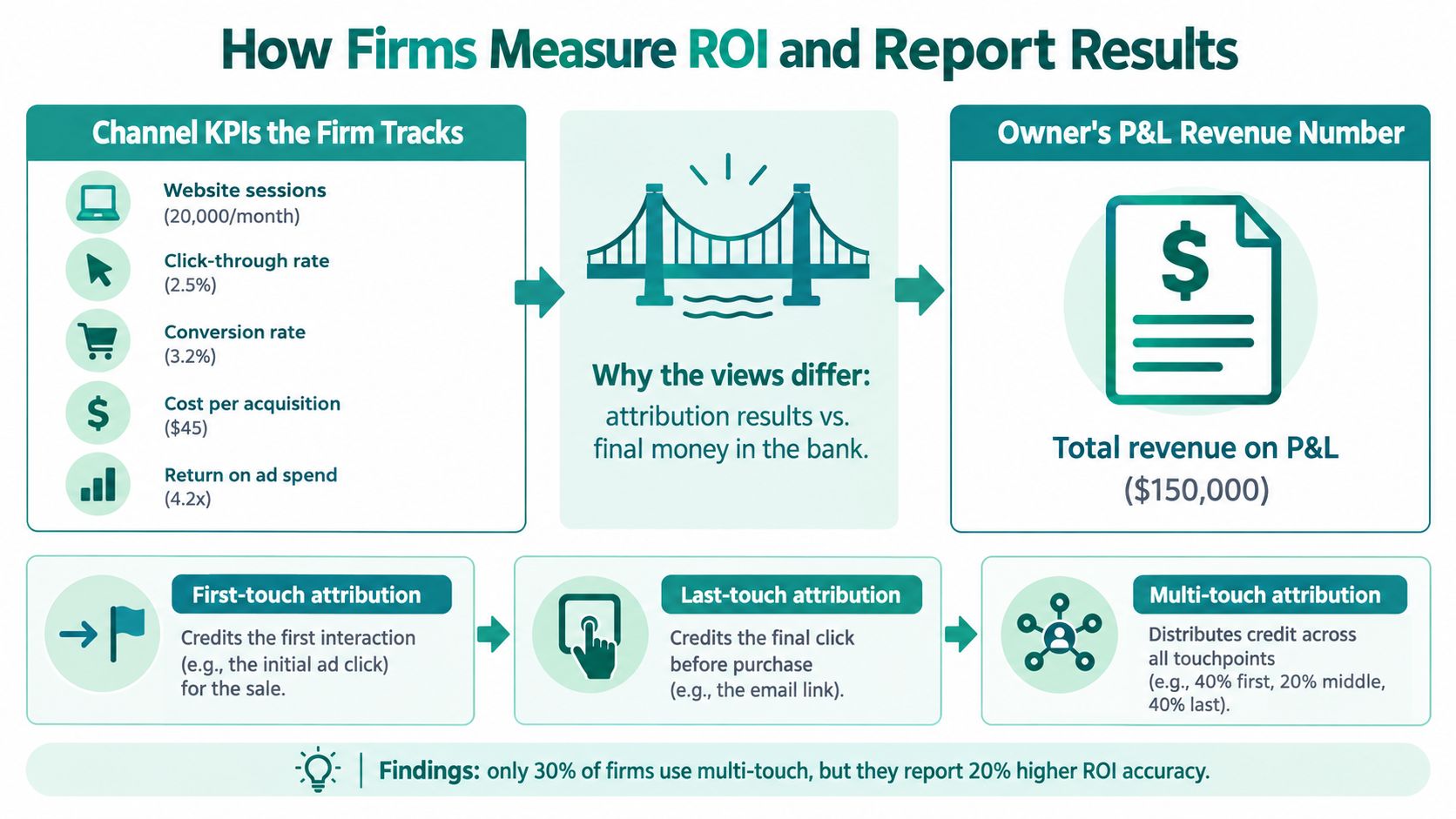
A firm can report strong click-through rates and still fail to produce profitable business. That's why measurement has to connect channel performance to qualified leads, closed revenue, and margin, not stop at traffic.
At the channel level, a firm may watch CTR, CPC, conversion rate, landing-page conversion rate, engagement, cost per acquisition, and return on ad spend. One digital marketing agency benchmark reports Google Ads CTR at 3.84%, CPC at $11.84, ad conversion rate at 4.4%, and landing-page conversion rate at 4.0%. The benchmark source shows why message alignment matters. A higher click cost demands stronger conversion efficiency.
Attribution explains the gap
Your analytics platform records interactions. Your accounting system records money. Those systems answer different questions.
- First-touch attribution credits the first meaningful interaction.
- Last-touch attribution credits the final interaction before conversion.
- Multi-touch attribution distributes credit across several interactions.
- Incrementality testing asks whether the marketing activity caused additional demand beyond what would have happened anyway.
A Cincinnati B2B firm may see a prospect download a guide, attend a webinar, speak with sales, and sign a contract much later. A local service company may receive a call after several searches and a retargeting visit. The reporting model should show the path without pretending any one click created the entire result.
For a deeper look at how to connect multiple interactions to revenue, review multi-touch attribution.
What a useful report contains
In the first month, the firm should establish tracking, clean up definitions, and identify obvious conversion problems. By the second month, it should show early channel patterns and explain what it's changing. By the third month, it should give you a stronger basis for continuing, reallocating, or stopping work.
A useful dashboard includes:
- Cost per acquisition, separated by meaningful lead or customer type.
- Pipeline value, tied to lead quality and sales stages.
- Blended ROAS or MER, where appropriate for the business model.
- Offline conversions, such as booked appointments, signed matters, or closed projects.
- Forecasts and decisions, not just historical charts.
GA4-style engaged sessions, enhanced conversions, and server-side tracking parity are increasingly important in privacy-constrained measurement. A current KPI framework considers an enhanced-conversions match rate above 60% healthy and server-side parity between 95% and 105% of client-side tracking healthy. Swydo's digital marketing metrics framework provides those reference points.
Be wary of reports dominated by impressions, follower growth, or sessions without conversion context. Require a written forecast, measurement plan, and quarterly review with clear go or no-go decisions.
Industry-Specific Considerations
Industry experience isn't a logo wall. It's evidence that the firm understands the risks, approval processes, customer behavior, and reporting requirements inside your business.
Healthcare and HIPAA-covered practices
Healthcare marketing requires more than adding a privacy notice to a website. A qualified firm should understand business associate obligations, PHI-safe tracking, intake routing that avoids exposing sensitive information, and ad copy that doesn't imply knowledge of a person's condition.
Review workflows need care, too. A firm should design review requests that invite feedback without soliciting protected health information. Ask how forms, call tracking, analytics scripts, appointment tools, and remarketing are handled before you approve a campaign.
Law firms and professional services
Law firms need disciplined content review. The firm should understand Ohio advertising rules, avoid unsupported case-type claims, separate educational content from guarantees, and maintain clear approval steps before publication.
Attorney review isn't an inconvenience. It's part of the engagement. Ask who writes the copy, who checks claims, how disclaimers are managed, and whether the firm has experience working within ethical walls around sensitive matters.
E-commerce and direct-to-consumer brands
E-commerce reporting needs to move beyond traffic and advertising clicks. The firm should understand average order value, lifetime value, contribution margin, merchandising performance, inventory constraints, buy-box share where relevant, and the difference between revenue and profitable revenue.
Technical execution also matters. Shopify, WooCommerce, Klaviyo, product feeds, catalog structure, analytics, and conversion testing must work together. A firm that only adjusts ad targeting may miss a product-feed error, weak product detail page, or retention problem.
| Vertical | Compliance/Rule | Tracking Difference | Reporting Priority | Hiring Filter for Firm |
|---|---|---|---|---|
| Healthcare | HIPAA-aware handling and careful claims | PHI-safe forms, calls, and analytics | Qualified inquiries and booked care | Ask for healthcare workflow examples |
| Law and professional services | Ohio advertising rules and attorney review | Matter source and qualified consultation tracking | Consultations, matters, and revenue | Require a documented approval process |
| E-commerce and DTC | Product, privacy, and platform requirements | Store, feed, email, and purchase data | Margin, repeat value, and profitable sales | Test Shopify, Klaviyo, and feed knowledge |
Ask a prospective firm to describe a problem it encountered in your industry, what it changed, and what it learned. Generic answers usually mean generic delivery.
Choosing the Right Firm Checklist
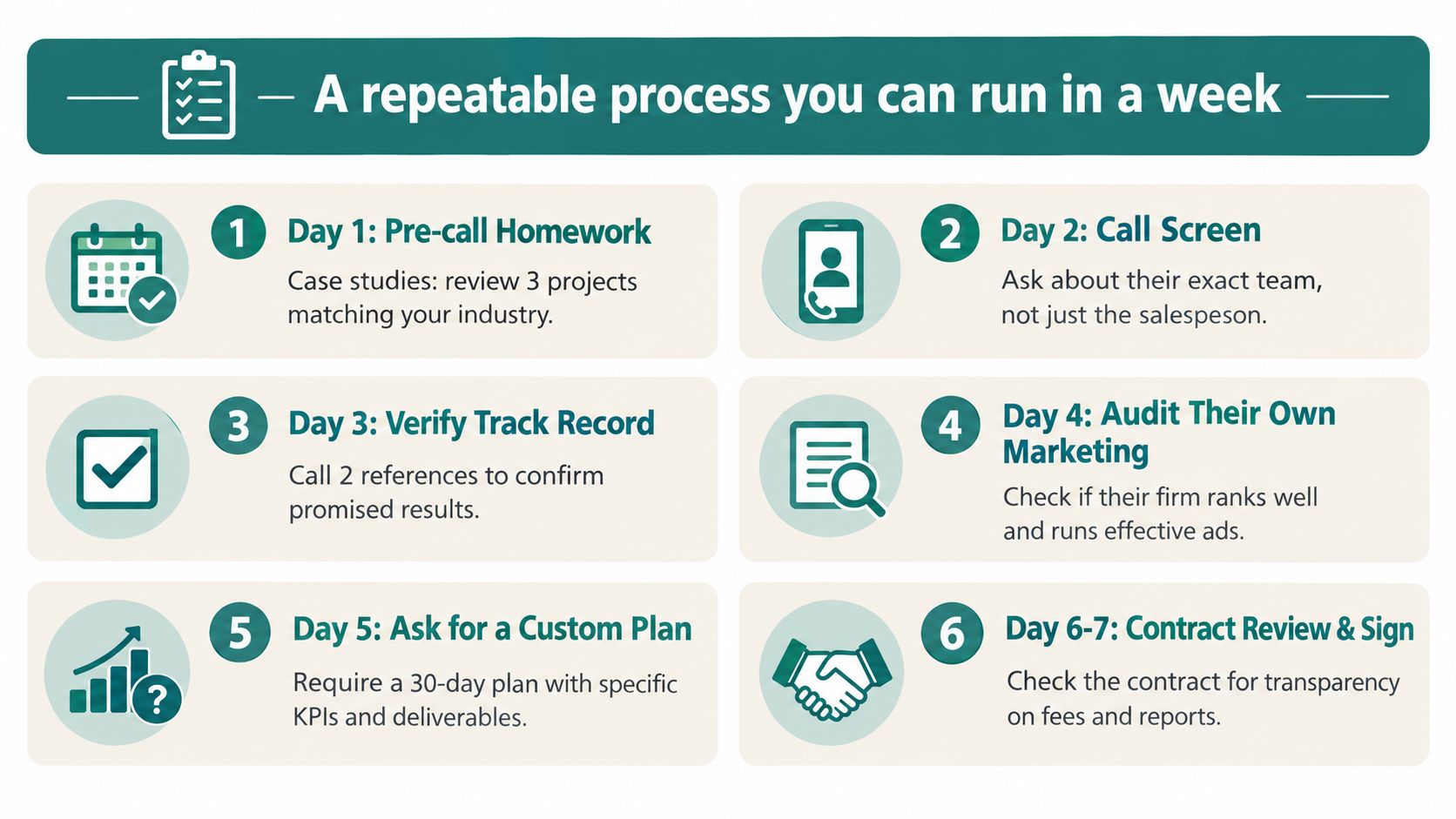
Don't choose a firm from a polished sales call. Run a short verification process before you discuss a long-term contract.
Start by reviewing relevant case studies, checking references, and confirming who will work on the account. Make sure your company will own or retain access to paid media accounts, analytics properties, website files, CRM data, and reporting history.
Questions that reveal the operating model
Use these questions during discovery:
- How would you position our business? Look for customer and market reasoning, not a list of channels.
- What would you fix first? A partner prioritizes; a vendor promises everything.
- Who writes our copy? You should know the writer, reviewer, and approval path.
- Who handles technical work? Confirm whether development is internal, subcontracted, or excluded.
- How will you define a qualified lead? The answer should reflect your sales process.
- What happens if a channel underperforms? Expect a testing and reallocation plan.
- How often will we review results? Reporting should have a predictable rhythm.
- What does creative production include? Clarify concepts, revisions, photography, video, and usage rights.
- Which tools require separate payment? Software and data costs should be visible.
- Who owns the accounts and data? The answer should be your business.
- What do you need from our team? A realistic partner identifies approvals and sales follow-up.
- What would make you recommend stopping? Honest firms can name a no-go decision.
For readers comparing firms that emphasize measurable outcomes, this performance marketing agencies guide provides another useful framework for evaluating outcome-focused services.
Red flags worth taking seriously
Walk away from ranking guarantees, opaque media buying, vague reporting, long lockups with no review point, and advertising accounts owned entirely by the agency. Also be cautious when the salesperson presents a large team but can't identify the people who'll perform the work.
A serious firm can provide relevant case studies with names, references you can call, sample reports, and a diagnostic engagement. A 30-day diagnostic is often more informative than signing a 12-month agreement based on promises.
Next Steps and Common Questions
Shortlist two or three firms that understand your market and business model. Ask each for an audit or diagnostic, then book a paid strategy session before signing an ongoing contract.
The right firm will ask about revenue goals, sales capacity, margins, customer value, and the timeline for decisions. It should propose a clear working horizon, often 90 to 180 days, and give your team shared access to analytics and core accounts.
Common questions
How long does it take to see results?
Paid campaigns can produce early signals, while SEO, content, and website improvements usually need more time. Ask for milestones rather than a guaranteed date.
When is a firm the wrong fit?
It's the wrong fit when you don't have a clear offer, can't support lead follow-up, or expect marketing to solve an operational problem it doesn't control.
What should the first 90 days include?
Expect access and tracking checks, a baseline audit, prioritized fixes, initial campaigns or content, reporting definitions, and a review of what deserves more investment.
How should I evaluate a proposal?
Compare goals, deliverables, ownership, assumptions, fees, media spend, reporting, contract terms, and the people assigned to the work.
Can a firm work with an in-house marketer?
Yes. The best arrangement gives the internal person strategic support, specialist execution, clear responsibilities, and shared visibility instead of creating competition.
For Cincinnati owners, the decision is simple: hire a firm that can explain the business outcome behind each marketing activity, show how it will measure progress, and tell you what it won't do.
HDM offers digital strategy, web design and development, SEO, paid media, analytics, conversion optimization, AI consulting, and ongoing website support for businesses across Greater Cincinnati and beyond. Visit HDM to discuss a practical growth plan built around your website, marketing channels, and revenue goals.