
Is Your Sales Team Working Harder, Not Smarter? As a business owner in the Cincinnati area, you've probably seen this happen. A rep needs the latest pitch deck, pricing sheet, or case study, but it lives in someone's inbox, an old shared drive, or a Dropbox folder no one trusts. By the time they find it, the buyer has moved on or the conversation has lost momentum.
That's where sales enablement tools earn their keep. They help your team find the right content, learn the right message, and use it at the right moment. For SMBs, that matters because wasted sales time usually shows up somewhere else in the business. Slower follow-up, inconsistent proposals, poor handoff from marketing, and lower close rates all hit growth.
This isn't just enterprise noise. The market itself shows how central these platforms have become. Fortune Business Insights projects the global sales enablement platform market will grow from $7.20 billion in 2026 to $25.65 billion by 2034, with North America holding a 37.00% share in 2025, according to its sales enablement platform market forecast. If you're investing in better websites, stronger SEO, and campaigns aimed at boosting B2B revenue, your sales process needs the same attention.
For Cincinnati companies, the question usually isn't "Do we need better sales infrastructure?" It's "Which tool fits the way we sell?" Some platforms are full enterprise suites. Others are better for onboarding, content search, field teams, or buyer-facing deal rooms.
The list below gets to the point. These are the sales enablement tools worth looking at in 2026, with clear trade-offs so you can choose based on your team size, industry, and implementation reality.
1. Seismic

Seismic is the tool I'd put on the shortlist when content control is your biggest issue. If your team sells across multiple products, multiple reps, or regulated workflows, Seismic gives you one governed system for content, coaching, personalization, and analytics instead of a pile of disconnected tools.
That matters for healthcare groups, legal-adjacent service firms, and larger Cincinnati B2B companies where "close enough" messaging can create compliance risk. Seismic is built for teams that need approved versions, controlled distribution, and a cleaner way to connect sales assets to pipeline activity.
Where Seismic fits best
Its strength is breadth. You get centralized content management, learning, certifications, coaching, and AI-supported recommendations in one platform. That broad footprint can reduce tool sprawl, especially if your team has outgrown ad hoc systems and needs something more disciplined than cloud folders and tribal knowledge.
It's also one of the better fits when sales content has to match a real content strategy. If your website, email nurture, and sales materials are telling different stories, the software won't fix that by itself, but a more structured system makes it easier to align everything. That's the same reason teams investing in stronger digital content often revisit their broader e-commerce content strategy at the same time.
Practical rule: Don't buy Seismic just because it's powerful. Buy it if you'll actually use governance, coaching, and analytics together.
The trade-offs
Seismic is rarely the lightest or cheapest option. Pricing is quote-based, implementation takes work, and your team needs someone to own rollout, permissions, cleanup, and adoption. For a smaller business with a handful of reps, that can be more platform than you need.
There's also roadmap uncertainty to weigh. The company announced a definitive merger with Highspot in February 2026, so buyers should ask direct questions about licensing, migration paths, and product direction before signing anything.
Best for: Complex organizations, compliance-heavy sales environments, and content governance Watch for: Larger implementation effort and higher likely total cost Start here: Seismic
2. Highspot
Highspot tends to win teams over faster than heavier platforms because reps like using it. That sounds simple, but adoption is where a lot of sales enablement projects fall apart. A tool can have every feature in the world and still fail if reps avoid it.
For Cincinnati SMBs and mid-market firms, Highspot often sits in a useful middle ground. It offers content management, training, guidance, and analytics, but the experience feels more approachable than some enterprise suites. If your team is willing to embrace a new system only if it's intuitive, Highspot deserves a serious look.
Why sellers usually take to it
The strongest part of Highspot is usability paired with structure. Reps can find governed content, follow in-workflow guidance, and use learning modules without feeling like they've entered a corporate training portal. That matters when your sales process depends on quick responses and consistent follow-up.
It also aligns well with a common U.S. stack pattern. Many companies separate core systems into CRM, sales enablement, and revenue intelligence rather than forcing one tool to do everything, as described in this overview of commercial excellence tools in the U.S.. If you already run Salesforce or HubSpot and want a dedicated enablement layer, Highspot fits that model cleanly.
The trade-offs
Highspot still comes with enterprise-style buying friction. Pricing is quote-only, the sales process can be lengthy, and successful rollout usually needs cleanup of your content library first. If your files are scattered, outdated, or duplicative, Highspot will expose that problem fast.
The other issue is timing. Like Seismic, Highspot is operating under the announced merger news from February 2026. Existing customers continue to be supported, but new buyers should press for specifics.
If your team won't tolerate a clunky system, usability isn't a nice-to-have. It's the deciding factor.
Best for: Mid-market teams that want strong adoption and guided selling Watch for: Quote-only pricing and near-term roadmap questions Start here: Highspot
3. Showpad
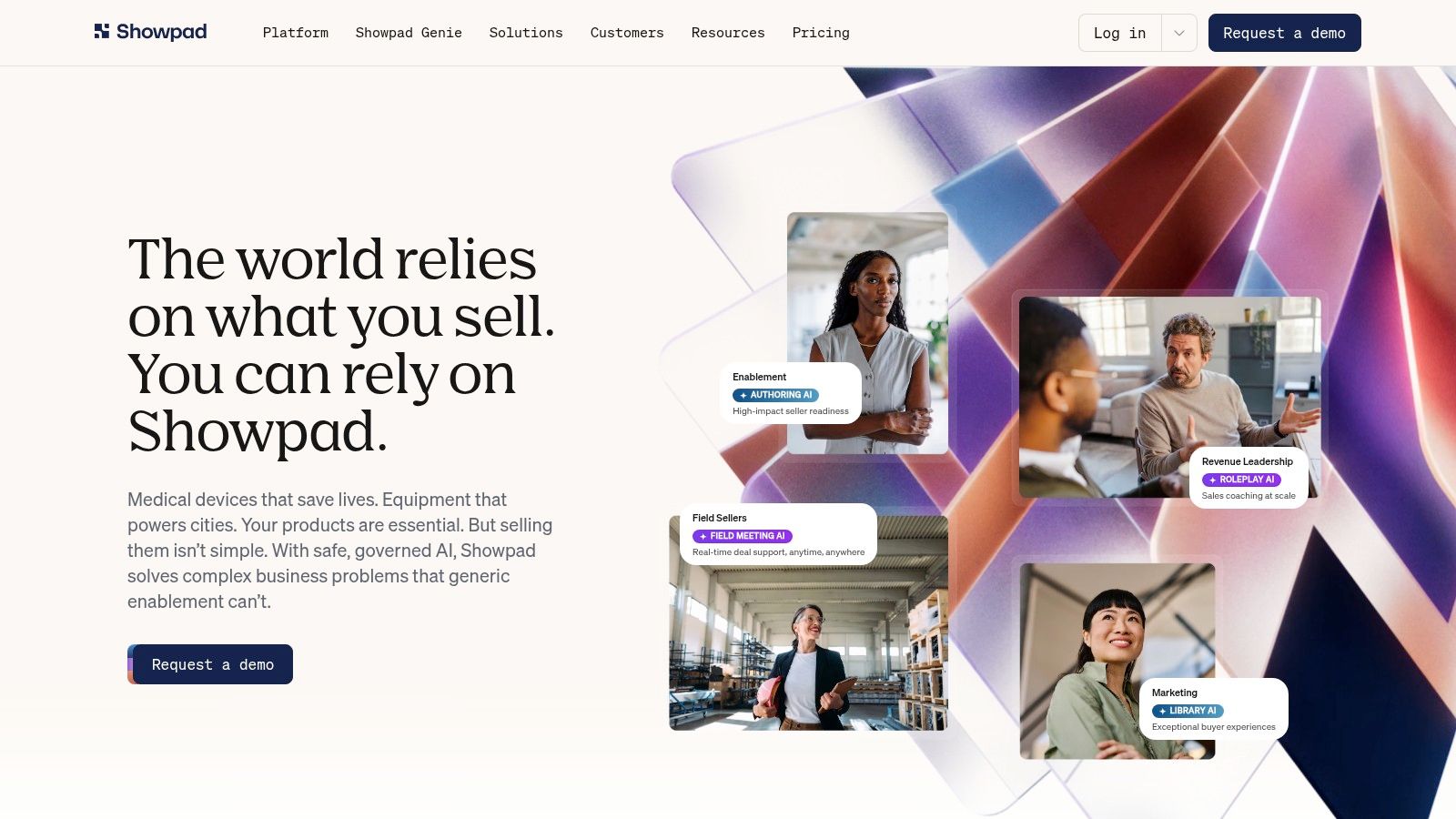
Showpad is a strong option when you want one vendor to handle content, readiness, coaching, and buyer engagement in the same ecosystem. That makes it appealing for growing companies that don't want to stitch together separate tools for training, content management, and digital sales rooms.
It's especially relevant if your team does a mix of inside sales and field selling. Showpad has long been good at governed content delivery, and its broader platform now reaches further into coaching and readiness as well.
Why it stands out
A lot of SMB owners start looking for sales enablement tools because content is messy. Then they realize the bigger problem is consistency. One rep tells the story one way, another rep presents a different offer, and no one can see what influences buyer movement. Showpad gets attention because it brings content and readiness together instead of treating them as separate projects.
That's useful in industries where reps need both control and flexibility. Healthcare-related businesses, medtech-adjacent suppliers, and regulated service firms often need approved messaging plus strong field execution. Showpad's combined platform is built for that kind of environment.
The trade-offs
The biggest caution is complexity during consolidation. If you're pulling assets from shared drives, old LMS platforms, and legacy sales folders, migration can become a significant project. Packaging is also evolving, so buyers should get very clear on what's included and what future changes could affect administration.
There's another practical issue many buyers miss. A lot of organizations still struggle to prove how enablement affects revenue. Allego cites an Econsultancy finding that 68% of sales leaders can't quantify how enablement tools influence deal closure rates or shorten sales cycles, even though 74% of organizations invest in them, in this discussion of sales enablement solution use cases. That's not a Showpad-only problem, but it is a buying problem. Ask how the platform connects usage, coaching, and content to actual deal progression.
Best for: Teams that want one platform for content, training, and buyer engagement Watch for: Migration work and changing packaging Start here: Showpad
4. Mindtickle
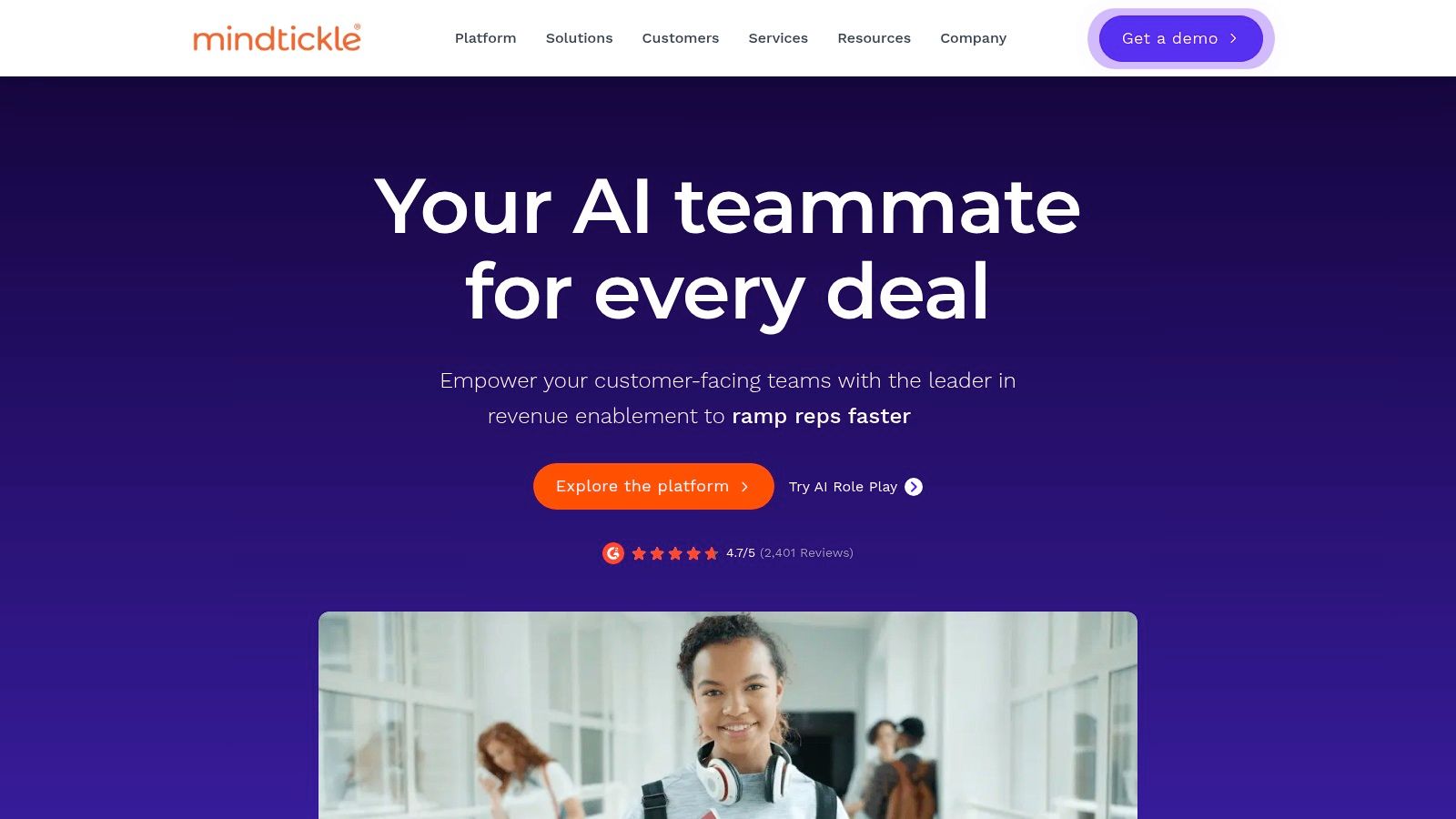
Mindtickle is the one to look at if your main problem isn't content storage. It's rep readiness. Some companies don't need a massive content suite as much as they need better onboarding, measurable coaching, role-play, and a more repeatable way to get reps productive.
That distinction matters. If your Cincinnati team keeps missing the same objections, delivers uneven demos, or takes too long to ramp new hires, training discipline will produce more value than a prettier content library.
Where Mindtickle makes sense
Mindtickle focuses on sales readiness. It offers AI role-play, coaching workflows, competency mapping, and readiness analytics. In practical terms, that means managers can do more than say "watch this training." They can measure whether reps can apply what they learned.
For companies investing in process improvement and automation across the business, this can fit into a broader operational upgrade. Teams that are already using AI in other parts of the business often see enablement as the next natural step, especially when paired with smarter AI workflow automation behind the scenes.
The trade-offs
Mindtickle isn't usually the best pick if your first need is exhaustive content governance. Seismic and Showpad go deeper there. Mindtickle can support content experiences and digital sales room functions, but its real value is structured training and readiness.
It's also a quote-only platform, and cost can climb when you add modules. That's manageable if onboarding and coaching are mission-critical. It's harder to justify if you only need a searchable file hub.
What to test in the demo: Ask to see exactly how a new rep is onboarded, certified, coached, and re-tested after a product change. That reveals whether the platform matches your process or just markets to it.
Best for: Organizations that want measurable onboarding and coaching Watch for: Less depth in content governance and potential module complexity Start here: Mindtickle
5. Allego
Allego appeals to companies that want consolidation without jumping straight into the heaviest enterprise stack. It combines learning, coaching, content management, conversation intelligence, video selling, and digital sales rooms in one platform. For many mid-market teams, that's a practical middle path.
This matters if you're trying to reduce software sprawl. A lot of SMBs have one tool for onboarding, another for content, another for call review, and a fourth for buyer follow-up. That stack gets expensive and harder to manage as you grow.
Why Allego gets attention from leaner teams
Its positioning is straightforward. It aims to replace several point tools and make the economics easier to understand, even though you still need a quote. The platform also includes AI features as part of its broader offering, which can simplify buying discussions for teams that don't want surprise add-ons after implementation.
For owners who care about budget discipline, that matters. So does practicality. If your reps spend their day moving between training, content, and customer conversations, one environment is easier to adopt than four.
The trade-offs
Breadth can also be the drawback. Very small teams may find Allego does more than they need. If your sales operation is still simple, you might pay for capabilities that sit idle.
There's a bigger strategic question too. AI coaching sounds great in demos, but workflow fragmentation still kills adoption. ZoomInfo cites a 2026 Gartner study showing 59% of reps abandon AI coaching features because of workflow fragmentation, while only 22% of enablement tool reviews detail real integration depth with Salesforce, Gmail, or Gong in this look at AI sales enablement tools. When you evaluate Allego or any AI-forward platform, ask where coaching appears and whether reps have to leave their normal workflow to use it.
Best for: Mid-market teams looking to consolidate learning, coaching, and content Watch for: More functionality than very small teams need Start here: Allego
6. SalesHood
SalesHood feels more opinionated than many platforms. That's a good thing if your team needs structure fast. It was built with sellers in mind, and you can feel that in the way it handles onboarding, guided learning, certifications, peer video practice, and buyer-facing content pages.
For SMBs, this often translates into a simpler rollout. You don't need a huge operations team to start building repeatable sales habits. If your sales leader wants something practical rather than sprawling, SalesHood is worth a look.
Why it works for growing teams
SalesHood is strong when your challenge is standardization. Reps need to learn the same process, practice the same talk tracks, and use approved content without a massive enterprise deployment. It's lighter than the broadest suites but more structured than DIY document storage and ad hoc coaching.
That makes it useful for owners trying to connect sales performance back to marketing investment. If you're spending on campaigns, content, and web improvements, you also need clearer visibility into what influenced a deal. That's one reason many firms revisit multi-touch attribution while refining their enablement process.
The trade-offs
SalesHood doesn't go as deep on enterprise governance as Seismic or Showpad. If your business has heavy compliance requirements, strict version control, or a giant cross-department content footprint, you may outgrow it.
Its analytics and integrations are also narrower than some of the larger platforms. That doesn't make it weak. It just means you should match it to your actual maturity level, not the one you hope to have three years from now.
Best for: SMB and mid-market sales teams that need faster onboarding and simpler structure Watch for: Lighter governance and narrower analytics breadth Start here: SalesHood
7. Mediafly
A Cincinnati owner sits through a pipeline review and hears the same problem again. Reps are sending decks, proposals, and case studies, but buyers still do not clearly see the financial case for changing vendors. Mediafly is built for that gap.
It fits companies that sell through complexity. Manufacturers, healthcare service providers, B2B firms with long buying committees, and consultative teams that need to justify cost, risk, and expected return tend to get the most from it. For local SMBs trying to bring enterprise-style sales discipline into a manageable process, Mediafly is one of the clearer options because it centers the conversation on value, not just content distribution.
Where Mediafly is strongest
Mediafly combines content control with guided selling, digital sales rooms, learning tools, and value-selling features such as ROI and TCO calculators. The practical benefit is straightforward. Reps can walk a prospect through the business case with approved materials, instead of piecing together spreadsheets and slides on their own.
That matters in regulated and credibility-sensitive industries. A healthcare company in Cincinnati may need approved messaging that avoids casual claims and supports HIPAA-aware sales conversations. A law firm or legal services provider may need tighter control over what gets shared, who shared it, and whether the material reflects current positioning. Mediafly is better suited to those environments than lighter content libraries because it connects governance with buyer-facing execution.
Analysts at Gartner note in their overview of sales enablement technology that these platforms increasingly bring together content, guidance, training, and buyer engagement in a single operating layer for sales teams. Mediafly matches that model well, especially for companies that win by proving financial impact during the deal.
In complex deals, the rep who clarifies the buying case usually has the advantage.
The trade-offs
Mediafly takes planning. Content cleanup, calculator design, permissions, and CRM alignment all need real work before the platform starts paying off. If your sales process is still mostly owner-led, short-cycle, or loosely documented, that effort can outweigh the benefit.
Price is another factor. Mediafly is usually a better fit for firms that already know they need structured value selling and have enough deal size to justify the cost.
For Cincinnati SMBs, that is often where a local implementation partner helps. An agency like HDM can translate enterprise terminology into a practical rollout plan, decide what content belongs in the system, and keep the first phase focused so the tool improves sales execution instead of becoming another half-used platform.
Best for: Complex B2B teams that need value-selling tools and stronger buyer-facing structure Watch for: Higher implementation effort, higher cost, and a setup process that rewards mature sales operations Start here: Mediafly
8. Paperflite

Paperflite is one of the easier recommendations for lean teams that mostly need content control, search, sharing, and buyer engagement tracking. If your current setup is "everything in Google Drive and nobody knows what's current," Paperflite solves a very real problem without dragging you into a massive rollout.
That narrower focus is a strength. Not every company needs a training ecosystem, AI coach, and full readiness program on day one.
Why SMBs like it
Paperflite is content-first. It helps organize material, improve discovery, create branded buyer experiences, and track engagement tied to accounts and opportunities. That's often enough for a growing team that wants cleaner execution without buying an entire enablement suite.
This matches a useful distinction in the market. Spekit describes two critical mechanical splits in U.S. enablement: just-in-time enablement for delivering guidance where reps work, and sales CMS for managing, sharing, and tracking content, in its overview of free sales enablement tools. Paperflite sits much closer to the sales CMS side of that split, which is exactly what many SMBs need first.
The trade-offs
Paperflite is not a full LMS or coaching platform. If your real issue is poor onboarding or inconsistent sales skills, a content-first platform alone won't solve it. It also offers lighter governance than the largest enterprise tools.
Still, for teams replacing ad hoc folders with a governed, searchable library, that's often the right first move. Start with the bottleneck that hurts buyers and reps the most.
Best for: Lean teams that need a better content hub and buyer-facing sharing Watch for: Limited training and coaching depth Start here: Paperflite
9. Pitcher

Pitcher is more specialized than most tools on this list, and that's exactly why the right buyer should pay attention. It's built for field reps, especially in life sciences, medtech, and other regulated environments where mobile access, compliant content, and offline reliability matter.
If your team spends time in clinics, on-site visits, or field meetings, the usual desktop-first enablement approach can break down fast. Pitcher addresses that operational reality better than horizontal platforms built mainly for inside sales.
Why regulated field teams consider it
Pitcher focuses on mobile-first detailing, sample management, compliant content delivery, Salesforce and SharePoint integrations, and support for offline use. That makes it well suited to organizations that need field execution, not just a polished content portal.
For healthcare-related businesses around Cincinnati, the compliance angle matters. If patient privacy, auditability, or industry-specific controls shape your sales process, generic content tools can create risk because they weren't designed around those constraints.
The trade-offs
The downside is obvious. Pitcher is narrower in horizontal use cases. If your team sells standard B2B services from a desk, much of what makes Pitcher valuable won't matter. Pricing is quote-only, and implementation tends to be more programmatic than plug-and-play.
This is one of those tools where fit matters more than feature count. The right team may love it. The wrong team will overbuy.
Best for: Life sciences, medtech, and regulated field sales teams Watch for: Narrower use cases outside field-heavy, compliance-focused sales Start here: Pitcher
10. Bloomfire
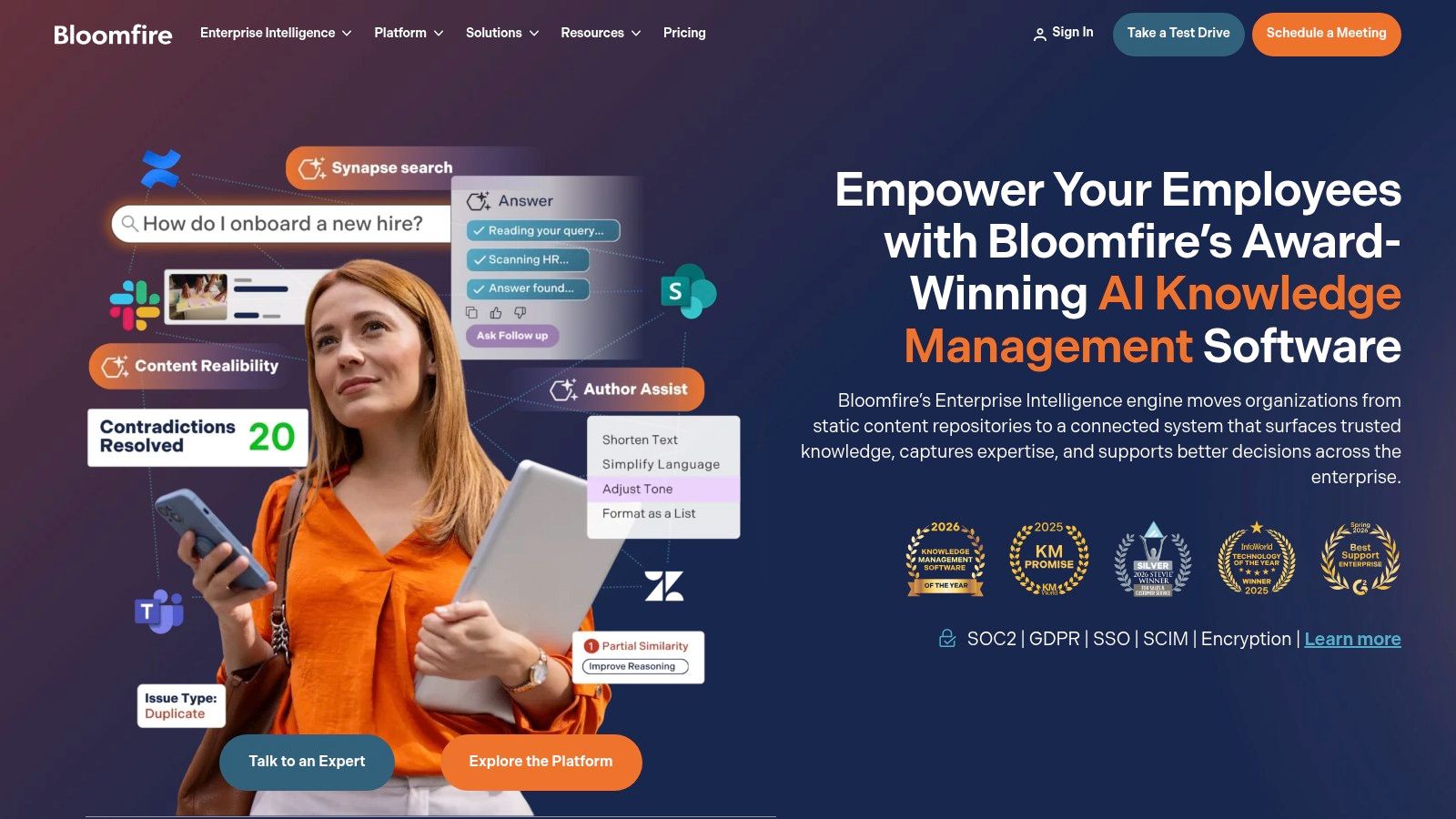
Bloomfire is the right conversation when the problem is simple and painful. Your team can't find answers fast enough. Product details, battlecards, process docs, competitive notes, and FAQs exist, but they're buried across systems and people.
In that situation, a full enablement suite may not be your best first investment. A knowledge platform that gives reps reliable answers quickly can create more immediate value.
Where Bloomfire shines
Bloomfire is built around searchable knowledge, Q&A workflows, governance, content contribution, and analytics that help identify knowledge gaps. That makes it useful not only for sales, but also for marketing and customer support. If multiple teams need the same source of truth, Bloomfire becomes easier to justify.
Many organizations are formalizing enablement but still need a practical first step. Cirrus Insight notes that the global sales enablement platform market was valued at $5.23 billion in 2024 and is projected to reach $12.87 billion by 2032, and that structured enablement with charter, headcount, integrated technology, and measured coaching captures advantages in win rate, quota attainment, and ramp time, according to its review of sales enablement statistics. Bloomfire can support that structure by fixing the knowledge layer first.
The trade-offs
Bloomfire is not a full learning system or conversation intelligence platform. It won't replace a dedicated onboarding tool if your main issue is coaching and certifications. It's also quote-only and tends to skew toward teams that can support a broader knowledge program.
A searchable answer base won't fix a broken sales process. It will fix the daily friction that makes a decent process hard to follow.
Best for: Teams that need faster, more accurate answers across sales, marketing, and support Watch for: Not a complete replacement for LMS or coaching platforms Start here: Bloomfire
Top 10 Sales Enablement Tools Comparison
| Product | Core features | UX & adoption | Value proposition / USP | Best fit & pricing/implementation |
|---|---|---|---|---|
| Seismic | Governed content, personalization, automation, training/coaching, analytics, AI recommendations | Enterprise-grade power; effective but heavier change management | Strong governance and deep analytics for compliance; broad suite reduces tool sprawl | Large enterprises and regulated teams; quote-only pricing, significant implementation; pending merger with Highspot adds near-term uncertainty |
| Highspot | Content library, in-workstream Guidance/playbooks, learning modules, AI recommendations, analytics | Intuitive UI; fast seller uptake and adoption | Seller-first usability with tight Salesforce integrations; strong analytics | Mid-market to enterprise sales teams; quote-only pricing; merger with Seismic may affect roadmap |
| Showpad | Content management, guided seller experiences, training/coaching, Digital Sales Rooms, buyer analytics | Integrated experience; active product releases; migration can be complex | Single vendor for content + readiness + buyer engagement; strengthened life-sciences focus | Field and regulated industries; contact for pricing; packaging changes rolling out |
| Mindtickle | Onboarding, AI role-play, coaching, readiness scoring, conversation intelligence add-ons | Training-centric UX; measurable readiness but needs admin support | Deep training and readiness workflows with clear performance measurement | Teams focused on structured onboarding and certifications; quote-only, multi-module packaging |
| Allego | LMS/LXP, coaching, content mgmt, DSR, conversation intelligence, video selling; AI included | User-friendly consolidation; fast time-to-value | Cost-efficient consolidation of learning, coaching and content; transparent per-user messaging | SMBs and mid-market sellers; per-user model but contact required for quotes; buyout program available |
| SalesHood | Playbooks, guided learning paths, peer video practice, buyer pages, templates, analytics | Opinionated, sales-centric workflows; quick to stand up and adopt | Seller-built, pragmatic alternative that speeds rep ramp and adoption | SMB and mid-market revenue teams needing fast deployment; lighter enterprise governance |
| Mediafly | Governed content, guided selling, value/ROI calculators, learning/readiness, DSR, analytics | Enterprise-oriented UX; powerful for value-selling but requires migration | Differentiates with value-realization tools (ROI/TCO) for complex deals | Enterprises with large libraries and multi-stakeholder deals; quote-only pricing |
| Paperflite | AI-assisted content organization/search, branded buyer pages, engagement analytics, Salesforce integration | Quick deployment and user-friendly; fast time-to-value | Content-first, affordable entry to searchable, trackable libraries | SMBs and scale-ups focused on content discovery; more affordable but not a full LMS |
| Pitcher | Mobile-first detailing, sample management, compliant content, offline support, integrations | Mobile-centric UX for field reps; reliable offline performance | Purpose-built for life sciences/medtech with compliant detailing and field execution | Regulated field teams with complex catalogs; quote-only pricing, programmatic implementation |
| Bloomfire | Federated searchable knowledge base with AI, Q&A workflows, content contribution, usage analytics, SSO/connectors | Fast findability; reduces time-to-answer and improves messaging consistency | Knowledge-management focus for consistent answers across teams | Sales, marketing, support teams needing KM; quote-only pricing; not a full LMS |
Making Your Choice: A Guide for Cincinnati Businesses
A Cincinnati owner signs off on a sales enablement platform, expecting faster follow-up and better close rates. Ninety days later, reps still pull files from shared drives, managers cannot see what content gets used, and marketing is stuck updating two systems instead of one. That outcome is common because tool selection is only part of the decision. The bigger question is which platform fits the way your team sells.
Start with the bottleneck that is costing revenue today. Teams that lose time searching for the latest deck, case study, or pricing sheet usually get more value from content-first or knowledge-first tools such as Paperflite or Bloomfire. Teams with inconsistent onboarding, weak coaching, or uneven messaging usually need Mindtickle or SalesHood before they need a larger content library. Companies with multiple product lines, approval layers, and tighter brand control often fit better with Seismic, Highspot, or Showpad.
Adoption is no longer limited to enterprise sales orgs. Mid-sized companies are using enablement tools because scattered content, slow ramp time, and poor CRM hygiene create the same problems at a smaller scale. As noted earlier, investment in this category has grown quickly. Many organizations now treat sales enablement as an operating function, not a side project owned loosely by sales and marketing.
For Cincinnati healthcare and legal firms, compliance should shape the shortlist early. A polished interface does not solve approval workflows, record handling, or access controls. If your team works with regulated messaging or sensitive client and patient information, review permission settings, audit trails, retention policies, and implementation support before you spend time on feature demos. In HIPAA-sensitive environments, the process around the tool matters as much as the tool itself.
E-commerce brands and lead-driven service businesses usually have a different problem. They need to connect website activity, CRM stages, follow-up content, and reporting well enough to see what influences closed revenue. If sales cannot tell which materials moved a deal forward, the platform becomes another content repository instead of a growth system.
Implementation decides whether the purchase pays off. Content has to be cleaned up. File naming has to be standardized. CRM fields have to map correctly. Managers have to coach to the new workflow, or reps will return to old folders, saved attachments, and one-off workarounds.
That is why many Cincinnati SMBs benefit from a local implementation partner. HDM works with companies already investing in websites, SEO, paid media, CRM improvement, and automation. In that setup, sales enablement supports the full revenue process. Marketing brings in demand, operations keep data clean, and sales gets the right content and workflow at the point of use.
There is also a practical local signal. Cincinnati employers are actively hiring for roles tied to modern enablement stacks, including platforms and prospecting tools that sit close to CRM and content operations. The local market is already treating enablement as part of day-to-day revenue execution.
The right platform improves sales performance when it matches your sales motion, connects cleanly to the rest of your systems, and gets rolled out with real process discipline.
If you're evaluating sales enablement tools alongside a website redesign, CRM cleanup, SEO strategy, or broader growth plan, HDM can help you connect the pieces. HDM works with Cincinnati-area businesses to build the digital infrastructure behind better lead generation, smoother sales handoff, stronger content operations, and measurable online growth, without turning the process into enterprise-level chaos.